How to Choose Soil Scoops for Container Gardening
A soil scoop is useful when a trowel spills potting mix from an open bag or cannot pour neatly into a container. The best format is not simply the biggest: its bowl has to enter the bag, clear the pot rim, hold loose mix inside its sidewalls, and remain controllable when loaded.
As an Amazon Associate, The Good Home Doc may earn from qualifying purchases.
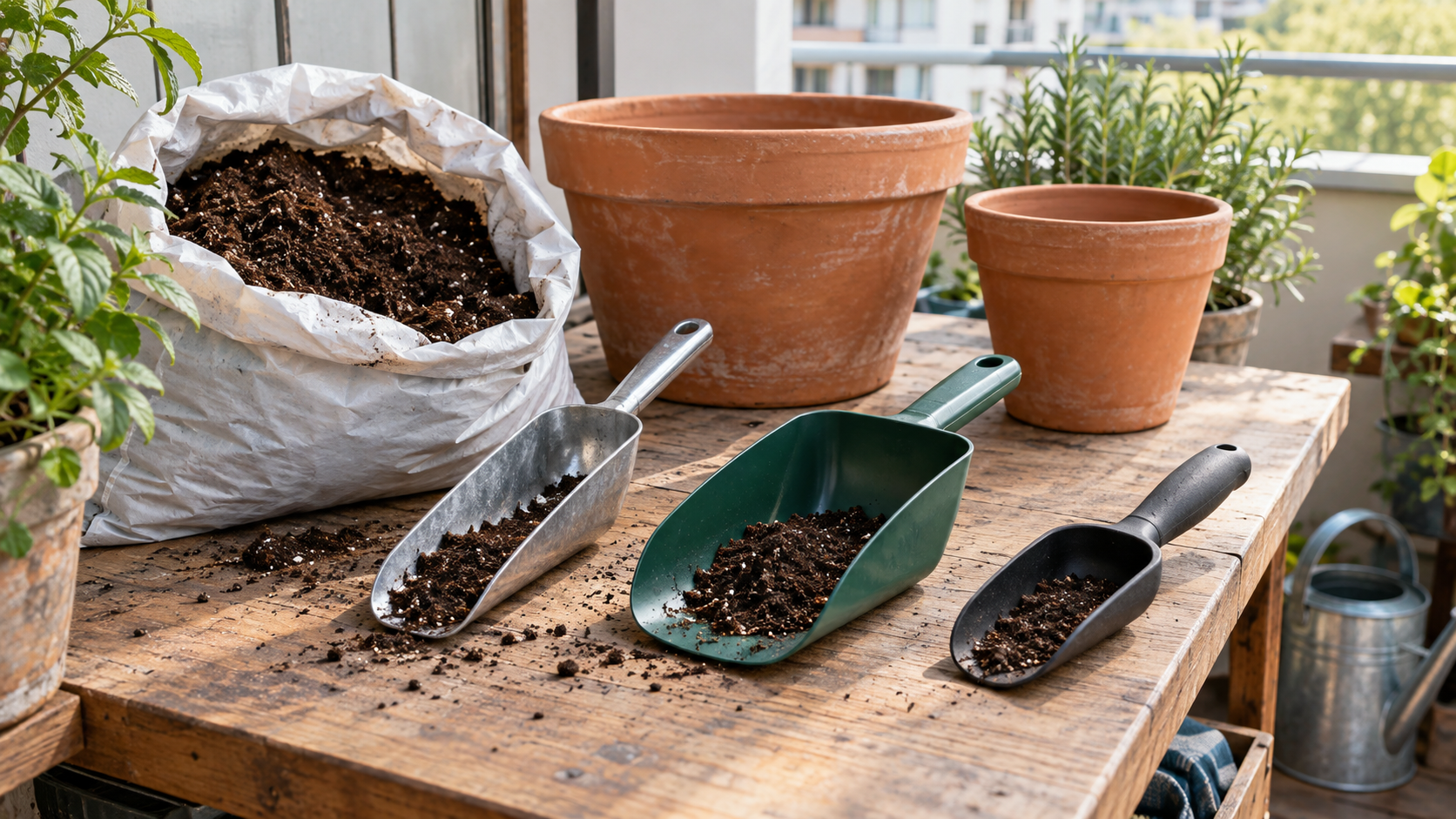
Quick decision before shopping
First measure the available space, identify the setup or surface constraints, and decide who will maintain the item. Skip the category if it blocks access, conflicts with the manufacturer's instructions or lease, or adds more upkeep than the problem justifies.
Choose the opening fit before the material: These affiliate category searches are comparison starting points, not tested rankings.
- Browse category: Compare narrow soil scoopsCheck total width, bowl depth, handle length, edge shape, and whether the scoop can enter both the potting-mix bag and your smallest pot.
- Browse category: Compare wide, high-sided soil scoopsLook for useful sidewalls and a controllable grip when moving larger batches into wide planters or a mixing tub.
- Browse category: Compare compact potting scoopsPrioritize access and a precise pour for houseplant pots; expect more trips when filling a large container.
Confirm current dimensions, material, included quantity, intended use, cleaning and storage directions, warnings, warranty, and return terms for the exact scoop. Seller photos are not a substitute for measurements.
Quick comparison
| Format | Best fit | Main tradeoff | Skip when |
|---|---|---|---|
| Narrow, deep scoop | Small pot openings and reaching into partly used bags | Moves less mix per trip | The deep bowl catches on a shallow bag or is awkward to empty |
| Wide, high-sided scoop | Wide planters, mixing tubs, and larger transfers | Needs more bag and pot clearance | The scoop cannot enter the smallest opening without tipping |
| Compact hand scoop | Houseplants, top-ups, and precise placement around roots | More repeated trips for a large pot | You routinely fill large containers from a full bag |
Measure the route the scoop must travel
Measure the usable opening of the potting-mix bag or storage bin, the inside opening of the smallest pot, and the clearance around any plant already in the container. Compare those measurements with the scoop's widest bowl dimension—not just the handle or narrow front edge.
A large scoop can be efficient in an open mixing tub and frustrating inside a flexible bag. A narrow scoop can reach the bottom of a bag but require many trips for a large planter. If you repot both tabletop plants and patio containers, one medium scoop may be a workable compromise; two formats only make sense when both have a regular job and a storage place.
What matters most
Bowl width, depth, and sidewalls
Raised sidewalls help keep loose mix in the scoop while it moves, but very deep sides can make a controlled pour harder through a tight pot opening. A broad, flatter shape favors open containers, while a narrower tapered nose offers more placement control.
Handle geometry and loaded control
Check handle length, diameter, texture, and the transition between handle and bowl. A scoop should remain controllable with the amount of mix you intend to carry. Headline volume is not useful if the filled tool twists in the hand or cannot pass through the opening.
Material and edge
Metal scoops can have a thin leading edge and need drying after cleanup according to the maker's directions. Molded plastic can be lighter and may have thicker walls. Neither material guarantees durability. Avoid using a soil scoop to pry roots, break compacted ground, move rocks, or perform work intended for a digging tool.
Must-have features
- Published dimensions: Bowl width and length are needed to judge bag and pot access.
- Useful sidewalls: The scoop should contain a normal transfer without an unstable mound.
- A controllable handle: Grip and balance should suit the intended amount and working position.
- Clear care guidance: Know whether the tool should be hand-washed, dried immediately, or kept out of weather.
- A realistic storage spot: Soil residue should not spill into a drawer or shared shelf.
Nice-to-have features
- Hanging hole: Useful if the complete scoop hangs without blocking a door or walkway.
- High-visibility color: Easier to find among bags, pots, and foliage.
- Measurement marks: Helpful for repeatable transfers only when the task does not require exact formulation.
- Seamless bowl: May simplify cleanup, though corners and handle joints still need attention.
Soil scoop versus hand trowel
A scoop is shaped to carry and pour loose material. A hand trowel is generally shaped for digging and planting. For transferring packaged potting mix into clean containers, higher sidewalls usually make the scoop easier to control. For opening a planting hole, loosening established material, or working in a bed, use a tool intended for that task and follow its instructions.
Do not treat either tool as a lever, hammer, or chemical-measuring device. Follow the potting-mix maker's handling directions, work with ventilation appropriate to the product, and use any protective equipment specified on the package.
Apartment and balcony setup
- Put the bag, pot, and tools on a stable, easy-to-clean surface before opening the mix.
- Use a tray or properly sized potting mat where loose material could enter floor gaps, drains, or a shared area.
- Keep the work back from balcony edges, doors, walkways, children, and pets.
- Do not sweep potting mix or plant debris over a railing or into a drain; follow building and local disposal guidance.
- Clean and dry the scoop as directed before bringing it indoors.
Who should skip each format?
Skip a narrow scoop if most work involves filling large, open containers and repeated trips make the job impractical. Skip a wide scoop if the bag or pot opening is smaller than the complete bowl or you cannot control it when loaded. Skip a compact scoop if it would turn every routine fill into dozens of transfers.
Skip buying a dedicated scoop when a clean container already transfers the material neatly and the potting-mix directions allow that use. Also skip the category if the real task is digging, cutting roots, mixing dense landscape material, or handling a product whose instructions require different equipment.
Buying checklist
- Measure the smallest bag, storage-bin, and pot openings the scoop must enter.
- Decide whether the routine job is a small top-up, houseplant repot, or large-container fill.
- Compare complete bowl width, depth, sidewall height, handle length, and stored size.
- Choose the smallest format that moves a useful amount without forcing the openings.
- Check material, joint construction, intended-use limits, care guidance, and warranty.
- Plan a stable work surface, spill containment, and dry storage spot.
- Skip oversized sets unless every format has a distinct recurring use.
Plan the low-level work area
If container work also involves tending plants beside a raised bed, compare garden kneeling pads by usable size, ground conditions, cleaning, and storage. A pad is a surface accessory, not a substitute for balance or mobility support.
Bottom line
For small pots and bag access, a narrow or compact scoop usually offers the best control. For wide planters and open mixing tubs, a wider high-sided scoop can reduce trips. Measure the complete transfer path, choose a load you can control, and favor clear dimensions and care instructions over vague capacity or durability language.
When the job is opening a planting pocket rather than carrying loose mix, compare hand trowels for container gardening by blade shape, pot access, grip, and care.
Next step: Put this decision in context with the home-product buying framework guide.