Tension-Pole Shower Caddy vs Over-the-Showerhead Caddy for Renters
Choose a tension-pole caddy when you have a suitable corner, two firm contact surfaces, and enough products to justify a larger vertical organizer. Choose an over-the-showerhead caddy when the shower arm and fixture layout permit it and you need compact storage with almost no floor or ceiling contact. Neither is automatically damage-free: the correct choice depends on what supports it.
As an Amazon Associate, The Good Home Doc may earn from qualifying purchases.
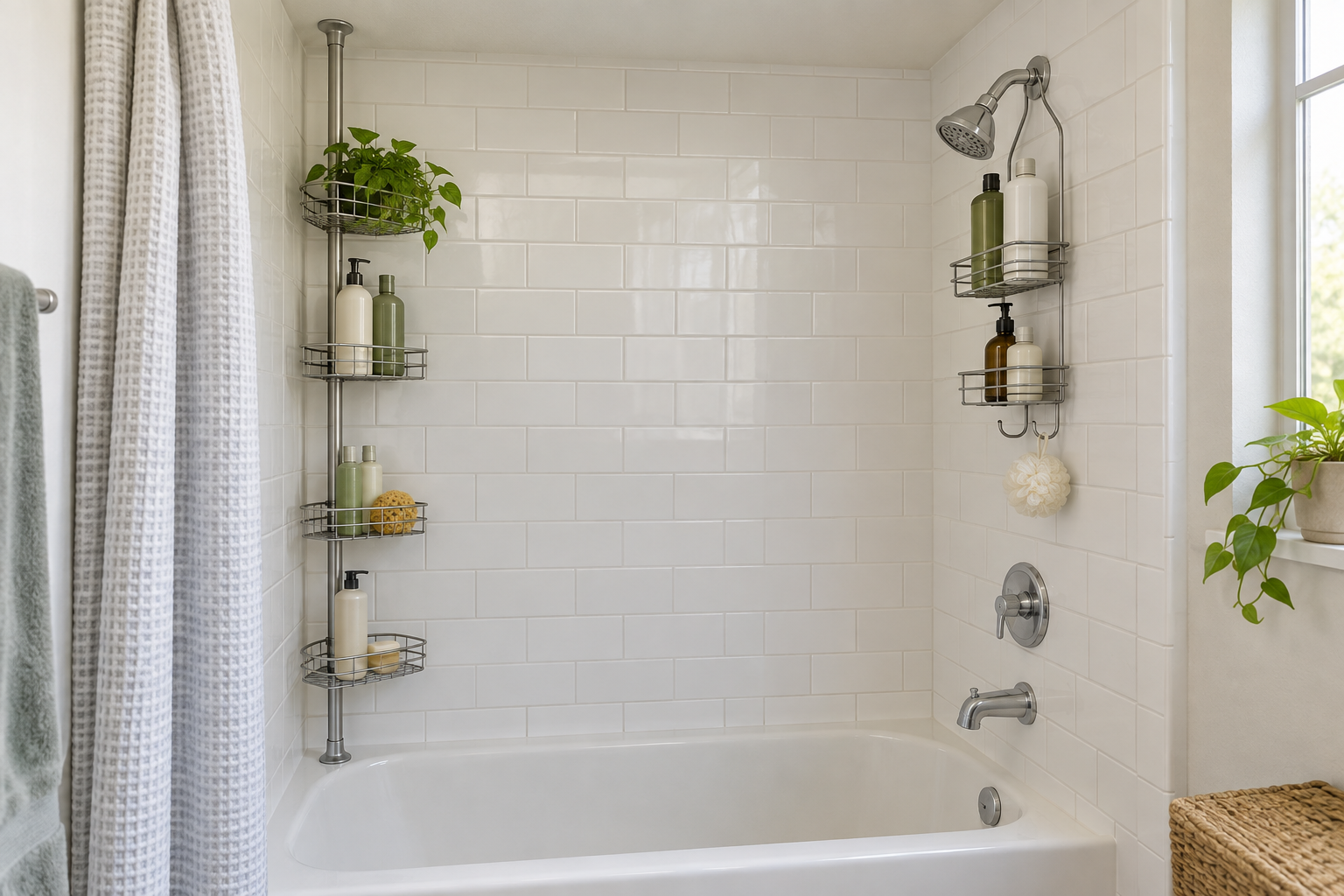
Quick decision before shopping
First measure the available space, identify the setup or surface constraints, and decide who will maintain the item. Skip the category if it blocks access, conflicts with the manufacturer's instructions or lease, or adds more upkeep than the problem justifies.
Confirm the support point before shopping: These affiliate category links are comparison starting points, not tested winners.
- Browse category: Compare tension-pole shower caddiesVerify the complete height range, top and bottom contact requirements, basket dimensions, stated load, drainage, assembly, and care instructions.
- Browse category: Compare over-the-showerhead caddiesCheck hanger opening, shower-arm clearance, anti-slip method, basket depth, fixture access, load, drainage, and cleaning.
This is a product-format comparison, not an installation guarantee. Read the current caddy, shower fixture, tub or shower, ceiling, and lease instructions before use. A shower caddy should not be used as a grab bar, body support, step, or place for breakable containers.
Quick comparison
| Decision | Tension-pole caddy | Over-the-showerhead caddy |
|---|---|---|
| Support point | Compression between two approved, firm surfaces | Hangs from a compatible shower arm or documented fixture location |
| Critical measurement | Exact vertical span plus corner and shelf clearance | Hanger opening, arm length and angle, and clearance around the showerhead |
| Storage pattern | Several baskets spread vertically | Compact baskets concentrated near the fixture |
| Main conflict | Sloped, flexible, textured, or delicate contact surfaces | Fixture controls, hose, spray path, wall clearance, or an unsuitable shower arm |
| Cleaning | More pole, joints, baskets, and a lower contact area | Fewer contact points, but removal may be needed to clean behind it |
Start with what will carry the load
A tension pole uses compression. Its fit depends on the complete measured span falling inside the maker's range and on both ends contacting surfaces the instructions allow. A flat floor-to-ceiling corner may work; a narrow tub rim, sloped ceiling, flexible surround, textured finish, or suspended ceiling may not. More pressure is not a fix for unsuitable geometry and may mark or damage a finish.
An over-the-showerhead caddy concentrates its load near the shower fixture. Confirm exactly where the maker allows the caddy to hang and whether the opening, collar, grip, or suction stabilizers fit the arm and wall. Do not loosen, twist, or use the caddy to reposition plumbing. If the shower arm, flange, head, connection, or wall feels loose or moves, stop and report the problem through the rental's repair process.
Measure the entire wet-area setup
For a tension pole, measure the vertical span at the precise installation point rather than assuming the ceiling height is uniform. Include the lower foot, upper pad, adjustment hardware, basket rotation, shower curtain path, ledges, grab bars, controls, and the tallest bottle. Check whether each basket can be positioned without blocking access or forcing products into the water stream.
For a hanging caddy, record the shower-arm diameter and accessible straight length, the distance from the arm to the wall, and the space above and behind the showerhead. Map any handheld hose, diverter, filter, large rain head, sliding bar, controls, and spray pattern. Confirm that bottles can be removed without bumping the showerhead or putting leverage on the pipe.
Compare useful capacity, not basket count
A four-basket tension pole is not automatically more useful than a two-basket hanging caddy. Measure the actual bottles and tools used in one week. Compare each basket's inside width, depth, rail height, slots, and stated load. Pump bottles need overhead room and a shelf that does not flex excessively; razors and small items need holders designed for their size.
Keep the load modest and distributed as directed. Large refill bottles, glass containers, heavy tools, and loosely balanced items are poor shower storage. If the household needs bulk supplies, keep the working quantity in the shower and store refills in a dry, accessible cabinet.
Stability is a routine, not a one-time check
With a tension system, follow the assembly order and pressure-setting directions. Recheck alignment and contact after initial loading and during cleaning, using the schedule and warning signs in the instructions. A leaning pole, slipping foot, bowing component, cracked pad, corrosion, or basket that rotates unexpectedly is a reason to unload and stop using it.
With a hanging caddy, use only the documented anti-slip and wall-stabilizing parts. Suction cups or wall bumpers may limit movement but do not turn every wall into a structural support. Recheck the hanger after the caddy is removed for cleaning or after a showerhead adjustment. Stop if the fixture connection moves, the hanger deforms, or the caddy interferes with a hose or controls.
Plan for drainage and cleaning
Open wire or perforated baskets help water leave, but joints, coatings, collars, pads, hooks, and bottle bottoms still collect residue. Compare how easily every surface can be reached and what the manufacturer permits for cleaning. Rinse product spills promptly, allow the organizer and containers to dry, and avoid abrasive or chemical cleaners that the finish instructions exclude.
A tension pole creates more vertical surface and a bottom contact area that can hide residue. A showerhead caddy may be quicker to remove, but you need a safe way to unload it and clean behind it without pulling on the fixture. Neither format corrects persistent dampness, damaged sealant, loose tile, staining, or a plumbing leak; report those conditions rather than covering them with storage.
Rental and household constraints
Ask the landlord or property manager when the lease restricts pressure-mounted accessories, contact with painted ceilings or surrounds, or items supported by plumbing fixtures. Photograph and note the condition of approved contact areas before installation. Keep the packaging and removal instructions for move-out.
Place products so falling items are less likely to strike a person or damage the tub. Keep the floor, controls, doorway, curtain, and any required access clear. In homes with children or pets, avoid accessible sharp tools, small detachable parts, chemicals, and cords. Anyone who needs balance or accessibility support should use equipment designed and installed for that purpose; neither caddy is support equipment.
Who should choose each format?
A tension-pole caddy is the stronger candidate when the measured span and both surfaces are explicitly suitable, the corner stays clear of other shower functions, several shelves would reduce clutter, and the renter accepts the extra assembly and cleaning.
An over-the-showerhead caddy is the stronger candidate when the fixture is compatible and sound, the hanger will not crowd the showerhead or hose, only a modest working set of products needs storage, and ceiling or floor contact is undesirable.
Skip both when the only available support is loose, damaged, sloped, flexible, prohibited by the lease, or outside the documented fit range. A freestanding shower-floor organizer, permitted over-door caddy, or storage just outside the wet area may fit better. If plumbing or the surrounding surface moves, leaks, cracks, or shows recurring moisture, report it and use a qualified repair path instead of adding load.
Another removable support-point choice
If the shower has smooth nonporous tile and a separate compatible door, compare a suction-cup basket with an over-the-door caddy. That decision depends on uninterrupted cup contact versus door thickness and movement, not ceiling span or shower-arm fit.
Bottom line
The better renter shower caddy is the one whose support point is genuinely compatible. A tension pole trades a larger vertical footprint and more cleaning for distributed shelf space. An over-the-showerhead model saves floor and ceiling contact but puts compatibility questions close to the plumbing fixture. Measure the full setup, keep loads modest, preserve access, and follow current product and lease instructions.