Tabletop Ironing Board vs Ironing Mat for a Small Apartment
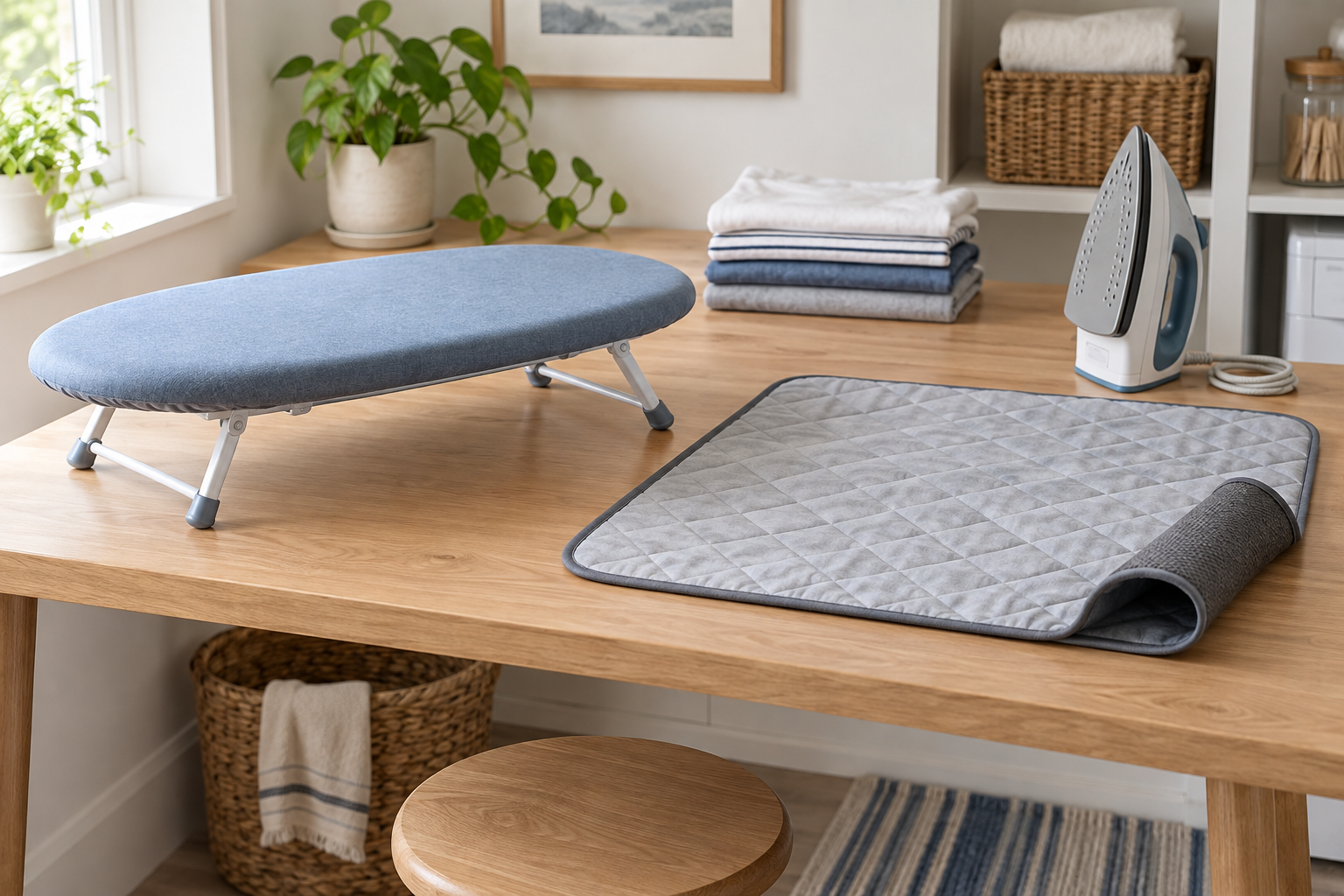
A tabletop ironing board is the stronger fit when you want a raised, defined pressing surface and have a stable table that fits its feet. An ironing mat stores smaller and sets up faster, but it depends completely on a flat support surface that both the mat and furniture makers allow for heat and steam. Neither format makes an unsuitable table safe. If you have not decided whether a rigid compact board earns space at all, start with the tabletop ironing board buy-or-skip guide. If a mat already fits the decision, compare compact ironing mat formats by usable area, backing, surface guidance, care, and storage.
As an Amazon Associate, The Good Home Doc may earn from qualifying purchases.
Quick decision before shopping
First measure the available space, identify the setup or surface constraints, and decide who will maintain the item. Skip the category if it blocks access, conflicts with the manufacturer's instructions or lease, or adds more upkeep than the problem justifies.
Compare only after checking your support surface and storage spot: Browse category: browse compact tabletop ironing boards or Browse category: browse portable ironing mats.
These are category shortcuts, not tested rankings. Verify open and stored dimensions, supported surfaces, cover and padding, heat and steam limits, leg locks and feet, care, cooldown, storage, iron instructions, and every manufacturer warning.
The short answer
- Choose a tabletop board for collars, sleeves, hems, and other work that benefits from a firm raised edge, provided its complete footprint sits securely on a suitable table.
- Choose an ironing mat when smallest stored size matters most and you already own a flat, stable, manufacturer-approved support surface.
- Skip both when the only available base is heat-sensitive, unstable, damp, crowded, or prohibited by either product's instructions.
Side-by-side tradeoffs
| Decision point | Tabletop ironing board | Portable ironing mat |
|---|---|---|
| Working support | Provides its own raised padded deck, but still needs a stable table beneath every foot. | Copies the shape and stability of the surface underneath it. |
| Garment handling | A defined edge can help position sleeves, collars, and small sections. | A broad mat can suit flat touch-ups, but has no raised edge. |
| Stored shape | Shorter than a full board, yet rigid and thicker after the legs fold. | Usually rolls or folds into a smaller space, subject to its storage instructions. |
| Main failure point | Feet, legs, or locks do not fit or sit securely on the chosen table. | Heat, moisture, dye, or pressure affects the furniture below. |
Measure the full setup, not just the product
Measure the usable worktop, then subtract anything that must remain clear: the upright iron, its cord, folded garments, and your hand path. For a tabletop board, compare the distance and shape of every foot with the support table. All feet must sit fully on the top—not on a rounded edge, leaf seam, tray, or overhang—and the working height should not force an awkward reach.
For a mat, measure the actual padded area rather than the overall roll. Its entire working area should lie flat. Do not assume a dining table, counter, floor, bed, washer, dryer, or other appliance is suitable. Check the mat, furniture, appliance, and iron instructions; a cover or mat cannot override a surface prohibition.
Setup and stability
A tabletop board adds legs, hinges, feet, and sometimes a lock. Open it exactly as directed, confirm every support is engaged, and press lightly before bringing over a heated iron. Stop if it rocks, slides, bends, or places the work too close to the table edge. Do not improvise risers or add a towel beneath the feet unless the maker permits it.
A mat removes the leg mechanism, but that does not make the setup automatic. Smooth it flat on a clean, dry, stable surface and keep it away from an edge where it or the cord can be pulled. A magnetic label does not mean every appliance top is approved, level, cool, or safe for the task.
Heat, steam, and the surface underneath
“Heat resistant” is not a universal temperature, duration, steam, or furniture-protection promise. Match the exact mat or board instructions to the iron setting and garment care label. Steam can carry heat and moisture through padding, and repeated work in one spot can affect finishes even when a quick touch-up seems fine.
Use a location with a sound outlet and an ordinary, unobstructed cord route. Do not use damaged electrical equipment or an extension arrangement the iron maker prohibits. Keep the iron upright only where its instructions allow, never leave it unattended, and unplug it after use.
Garment fit and working routine
A tabletop board's narrow end and raised edge usually give more positioning choices for small shaped areas. Its limited length can still be frustrating for trousers, dresses, bedding, or long repeated strokes. Measure the garments you actually press rather than assuming “compact” means sufficient.
A mat works best for occasional flat touch-ups that fit within its approved area. Moving a garment repeatedly can be acceptable for rare use but tedious for a weekly pile. If you need a broad uninterrupted surface, stable iron rest, or long sessions, a properly fitted full-size or over-door board may be the more realistic category.
Maintenance, cooldown, and storage
For either format, follow the cover or mat cleaning label and let every layer dry fully before storage. A tabletop board also needs checks for loose fasteners, bent legs, damaged feet, a cover that has shifted, and a lock that no longer engages. Replace or stop using it according to the maker's guidance rather than repairing load-bearing hardware casually.
Let the iron and pressing surface cool in a protected place before folding, rolling, or putting either into a closet. Storing a mat while warm or damp can transfer heat or moisture to nearby belongings. Do not wrap a cord around a hot iron unless its instructions expressly permit that routine.
Who each option fits
A tabletop board fits when
- You have a strong, flat table with room for every foot and the upright iron.
- You regularly press shaped details and value a firm edge.
- The board's rigid stored dimensions fit a shelf or closet.
- You are comfortable checking the leg and lock before each use.
An ironing mat fits when
- Storage volume is the binding constraint.
- Your approved support surface is flat, stable, clean, and replaceable if the instructions acknowledge residual risk.
- Your work is occasional and mostly flat.
- You can cool and dry the mat completely before storing it.
Who should skip each option
Skip a tabletop board if its feet do not fit fully, the mechanism is difficult to secure, or you need a longer uninterrupted deck. Skip a mat if you cannot verify the supporting surface, need a raised edge, or do not accept the possibility of heat, moisture, texture, or color transfer described by the product guidance.
Skip both if the room lacks a safe cord route, stable work surface, cooling place, or suitable storage. A garment steamer is not an automatic substitute: it has its own textile, water, heat, hanging, electrical, and storage rules.
A practical pre-purchase check
- List the garments and sections you press most often.
- Measure the complete work surface, product footprint, work height, and stored shape.
- Read supported-surface, temperature, steam, care, cooldown, and storage instructions.
- Confirm the iron can stand upright with a clear cord route and no edge conflict.
- For a board, verify the leg and lock routine; for a mat, verify the exact furniture beneath it.
- Choose the simplest format that makes the whole routine workable.
Bottom line
Choose a tabletop ironing board when a raised, stable edge matters and its full support footprint fits your table. Choose an ironing mat when compact storage matters more and an approved base surface is already available. The mat does not supply stability or protect every finish, while the board does not eliminate the need for a suitable table, careful setup, cooldown, and storage.