How to Choose Compact Ironing Mats for Small Apartments
A compact ironing mat makes sense when occasional flat touch-ups matter more than a raised board edge and you can verify a suitable work surface. Choose the mat only after checking its usable padded area, supported surfaces, iron and steam limits, backing, cooldown routine, and stored shape. “Heat resistant” is not a promise that every table, counter, floor, bed, washer, or dryer is suitable.
As an Amazon Associate, The Good Home Doc may earn from qualifying purchases.
Quick decision before shopping
First measure the available space, identify the setup or surface constraints, and decide who will maintain the item. Skip the category if it blocks access, conflicts with the manufacturer's instructions or lease, or adds more upkeep than the problem justifies.
Start with the format your verified surface and storage spot can support: These affiliate category links are shopping starting points, not tested rankings.
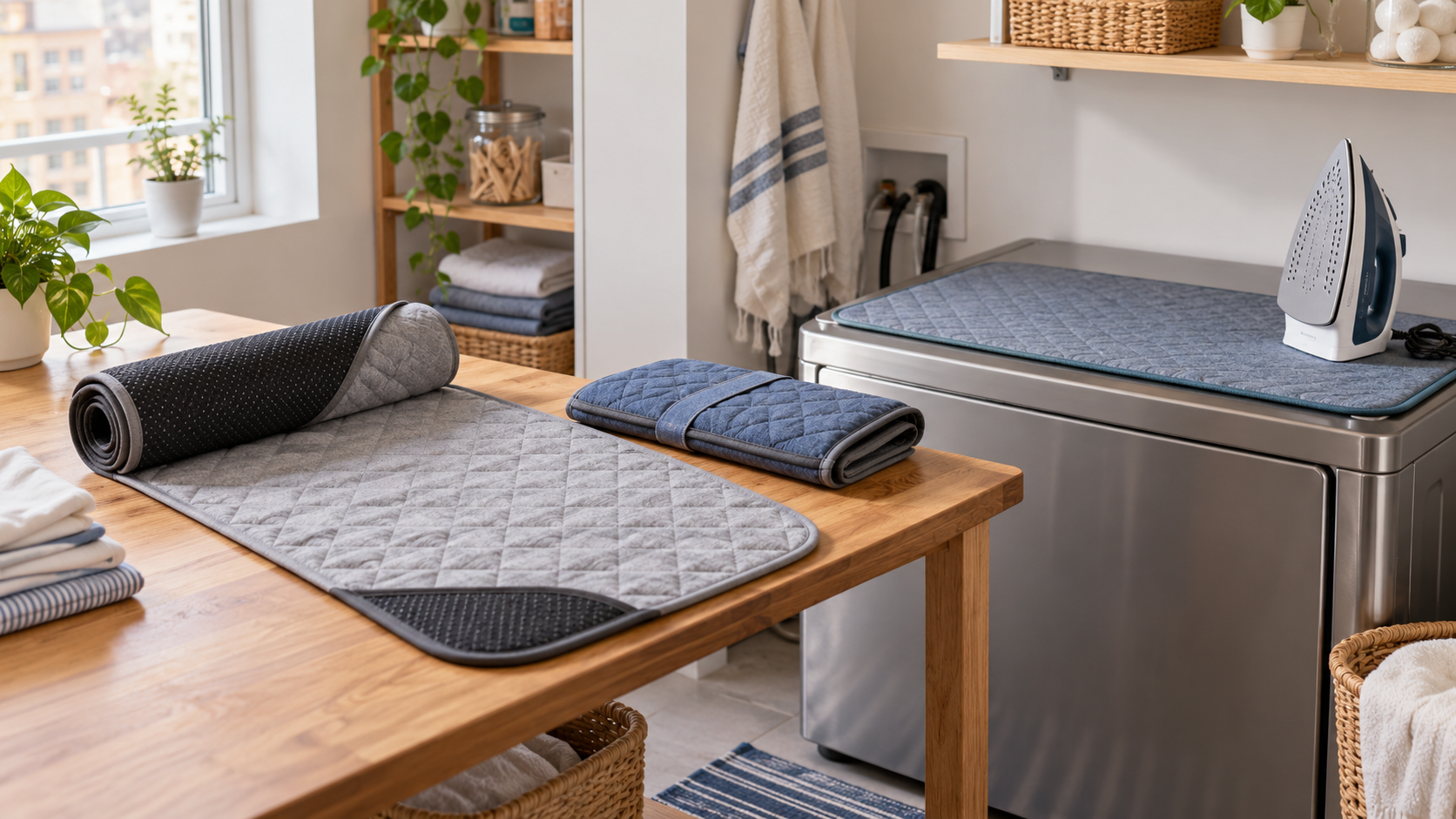
- Browse category: Roll-up portable ironing matsCompare usable area, rolled diameter, ties, layer construction, and the exact approved support surfaces.
- Browse category: Foldable compact ironing matsCompare fold lines, final stored dimensions, padding, care, and whether the mat lies flat after storage.
- Browse category: Magnetic-style appliance-top ironing matsConsider only when both mat and appliance instructions permit the exact cool, clean, level surface.
Before buying, verify current manufacturer instructions for dimensions, layer materials, supported surfaces, backing contact, temperature and steam limits, cleaning, drying, cooldown, storage, and every warning. Confirm the iron and supporting-surface instructions separately.
Quick Picks by Apartment Constraint
- Smallest shelf or drawer space: a roll-up mat whose rolled diameter and fastening method fit the measured storage spot.
- Flatter stacked storage: a foldable mat when its folded footprint fits and the maker allows repeated folding.
- Only an appliance top is available: a magnetic-style mat only after verifying the appliance model, mat guidance, surface temperature, levelness, controls, lids, ventilation, and lease rules.
- Collars, sleeves, shaped seams, or regular ironing: skip a mat and compare a compact board with a firm raised edge.
- No verified heat- and steam-compatible surface: skip the category rather than improvising a base.
Measure the Usable Area and the Whole Work Zone
Product width and length may include binding, tapered corners, hanging loops, or an unpadded edge. Compare the stated usable area with the garments and sections you press. A small mat can handle hems or a shirt front in stages, but repeated repositioning may make trousers, dresses, and linens impractical.
Measure the supporting surface too. The entire mat must lie flat without bridging a seam, control panel, lid edge, rounded corner, or overhang. Leave a separate maker-approved place for the iron to stand upright, plus a clear hand path and cord route. Do not set a hot iron on the mat unless the instructions explicitly designate an iron-rest area.
Compare the Three Main Mat Formats
Roll-Up Mats
Roll-up mats avoid hard fold lines and can fit a narrow shelf or closet. Compare rolled diameter as well as flat size; thick padding and a bulky tie can make the stored roll larger than expected. Check whether rolling direction matters and whether the product must be fully cool and dry before storage.
Best fit: occasional pressing with narrow vertical storage. Skip when: the roll has no secure storage spot or tends to unfurl into other belongings.
Foldable Mats
Foldable mats store as a flatter rectangle, which can work in a drawer, bin, or shelf stack. Seams or fold channels can reduce the uninterrupted work area. Confirm that the folded layers do not trap moisture and that the mat lies flat without curling after storage.
Best fit: a measured drawer or shelf with enough flat footprint. Skip when: fold lines fall under the garment areas you press most or the care directions do not suit your laundry routine.
Magnetic-Style Appliance-Top Mats
A magnetic label describes the backing; it does not certify every washer or dryer as an ironing station. Appliance tops vary by material, shape, finish, temperature, vibration, controls, lids, vents, detergent openings, and maker restrictions. Never use the appliance while ironing on it, and do not cover controls, ventilation, warnings, or access points.
Best fit: only a specific appliance and mat combination that both manufacturers permit while the appliance is off, cool, stable, clean, and dry. Skip when: permission or compatibility is unclear, the top is curved, controls or lids are involved, or the setup affects normal appliance access.
Must-Have Features
- Specific surface guidance: named compatible and incompatible surface types rather than a broad heat-resistant claim.
- Usable-area dimensions: enough uninterrupted padded space for the actual work.
- Documented limits: clear temperature, steam, duration, and iron-placement instructions.
- Stable backing: a maker-described contact layer suited to the verified surface, without promising zero transfer or damage.
- Practical care: cleaning and drying instructions that fit the likely starch, water, fiber, or dye contact.
- A complete storage plan: measured rolled or folded dimensions and a protected place where the cooled mat can stay flat or secured.
Nice-to-Have Features
- A hanging loop when the maker permits hanging and the rental has an approved hook.
- A storage strap attached in a way that stays clear during use.
- Contrasting sides that make the working face easy to identify.
- Replaceable covers or documented replacement parts, when genuinely available.
Heat, Steam, Surface, and Lease Limits
Read the garment care label, iron manual, mat instructions, and support-surface guidance together. Steam carries heat and moisture through layers; repeated pressure in one spot can affect finishes. A towel under the mat is not an automatic solution and may change stability, heat, and moisture behavior.
Renters should ask the landlord or property manager before using an appliance or furnished surface in a way the lease, building rules, or manufacturer instructions do not clearly allow. Do not describe a mat as damage-free. Test patches cannot prove that longer heat or steam exposure will leave a finish unchanged. Stop if the setup shifts, smells unusual, discolors, transfers dye, traps moisture, or changes the supporting surface.
Setup, Maintenance, and Portability
- Choose a clear, stable work location away from water, room traffic, children, pets, and an edge where the cord can be pulled.
- Confirm the support is clean, dry, cool, level, and explicitly compatible.
- Lay the mat completely flat and keep every edge supported.
- Use only the temperature, steam, pressure, and duration permitted by the garment, iron, and mat instructions.
- Keep the iron upright in its approved place, never leave it unattended, and unplug it after use.
- Let the iron and mat cool fully; clean and dry the mat as directed before rolling or folding it.
- Before a move, store the clean mat so the backing cannot mark furniture or collect debris.
Who Should Skip a Compact Ironing Mat
- People who routinely press large garments, bedding, or shaped details that benefit from a raised edge.
- Anyone without a manufacturer-approved support surface and a safe, ordinary cord route.
- Renters relying on furnished furniture or a landlord-owned appliance without clear permission and compatible instructions.
- Households that cannot provide a protected cooling location before the mat returns to storage.
- Anyone expecting the mat to repair a damaged surface, stabilize a wobbly table, or make a prohibited setup safe.
Buying Checklist
- List the garments and exact sections you press most often.
- Measure the required usable area, support surface, upright-iron spot, cord route, and stored space.
- Choose roll-up, foldable, or magnetic-style only after confirming the storage and support constraints.
- Verify supported surfaces, temperature and steam limits, backing, layer materials, care, cooldown, and storage.
- Check the iron, furniture or appliance, lease, and building instructions independently.
- Skip the mat if the full setup depends on an unverified surface, unstable location, or improvised protection.
Bottom Line
The best compact ironing mat for a small apartment is not simply the smallest one. It is a mat whose usable area fits the work, whose current instructions permit the exact supporting surface and ironing routine, and whose cooled, clean stored shape fits a real shelf, drawer, or hook. Choose roll-up for narrow storage, foldable for a flat compartment, or magnetic-style only for a specifically verified appliance setup. Choose a compact board instead when a firm raised edge and more predictable work surface matter.