Reusable Silicone Food Bags vs Rigid Containers for a Small Freezer
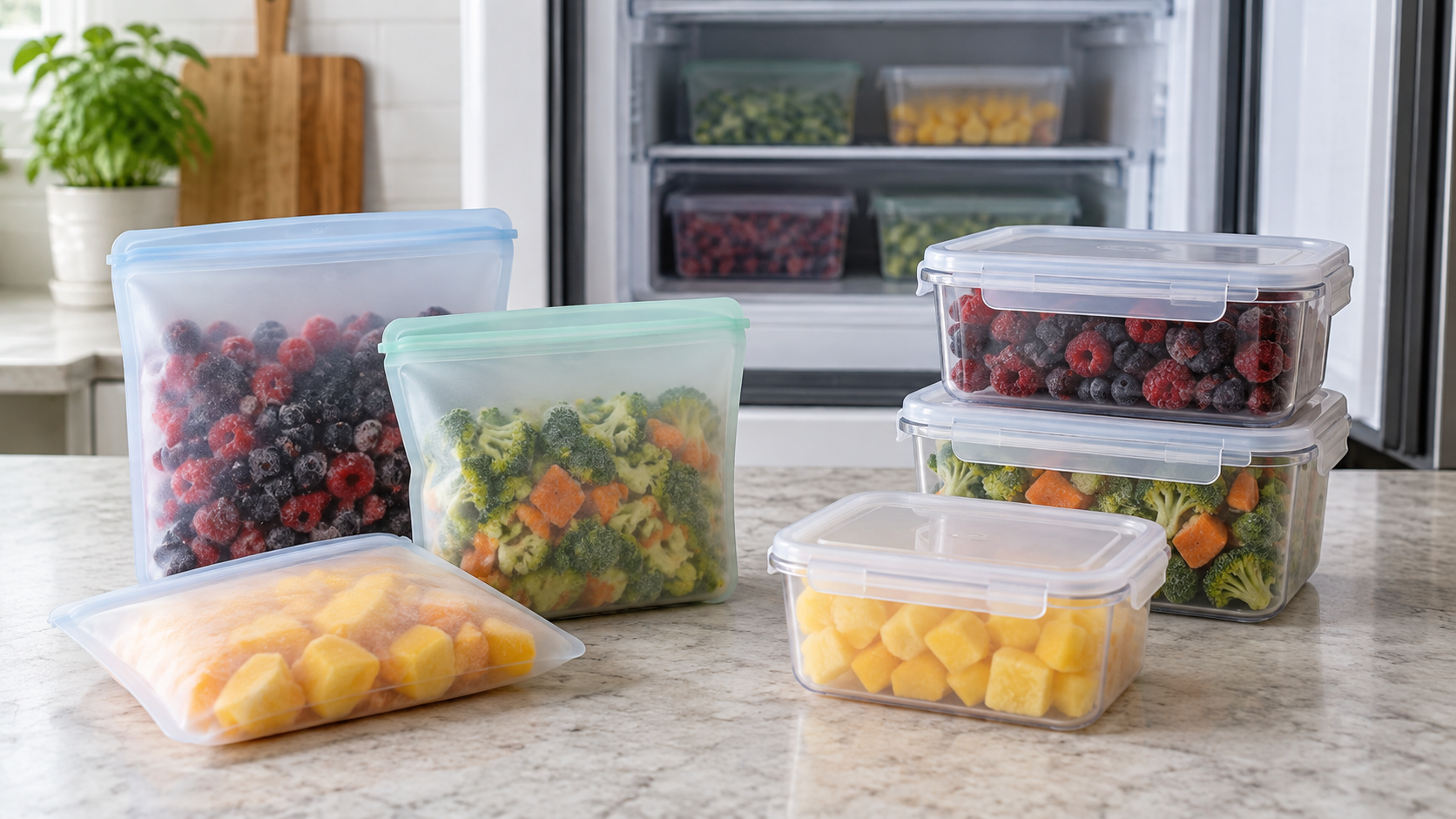
A reusable silicone bag can bend around an awkward gap and store nearly flat when empty. A rigid container protects its contents and builds a more predictable stack. In a small freezer, the better choice depends less on advertised capacity than on the shapes you freeze, how you arrange them, and how much washing and drying effort you will repeat.
As an Amazon Associate, The Good Home Doc may earn from qualifying purchases.
Quick decision before shopping
First measure the available space, identify the setup or surface constraints, and decide who will maintain the item. Skip the category if it blocks access, conflicts with the manufacturer's instructions or lease, or adds more upkeep than the problem justifies.
Compare the format that fits your freezer routine:
- Browse category: Shop reusable silicone freezer bagsStart here when flexible shape and compact empty storage matter most.
- Browse category: Shop rigid freezer food containersStart here when crush protection and stable stacking matter most.
These are category shopping routes, not tested rankings. Confirm the exact product's freezer suitability, permitted foods, fill guidance, closure instructions, temperature limits, and care directions before use.
Quick Decision
Choose reusable silicone bags when the freezer has shallow gaps, you regularly freeze flat portions or loose ingredients, and you have a realistic way to hold bags open for washing and complete drying.
Choose rigid containers when food would be damaged by pressure, you want self-supporting vessels for filling, or same-footprint containers can form a stable stack without wasting shelf height.
Choose a small mixed system when flat ingredients and delicate leftovers share the freezer. Standardize one or two bag sizes and one container footprint so the collection does not become a pile of mismatched closures and lids.
Flexible Bags vs Rigid Containers at a Glance
| Decision point | Silicone bags | Rigid containers |
|---|---|---|
| Freezer geometry | Can freeze flat and fit irregular gaps | Uses a fixed footprint and height |
| Contents | Good for portions that tolerate pressure | Better protection from crushing |
| Filling | May need a stand or careful support | Stays open and upright on its own |
| Empty storage | Usually compact but must remain fully dry | May nest or stack; lids need a home |
| Upkeep | Corners, seals, and interiors can take effort to dry | Lid channels and gaskets can trap residue or water |
These are format tendencies, not permissions. The manufacturer's current instructions decide whether a particular bag, base, lid, gasket, or clip is suitable for freezing, washing, thawing, or reheating.
When Silicone Food Bags Fit Better
Flexible bags earn their space when they can be laid flat in a single layer until the contents firm up, then filed upright or stacked. That routine can turn shallow shelves and narrow side gaps into useful storage. Bags also take less cabinet space between uses if they are completely clean and dry before being closed or nested.
The tradeoff is handling. A soft bag can slump while being filled, and pressure from other items can change the shape of soft or delicate food. Check the maker's fill line and closure method, leave the required expansion room, and do not assume a zip-style top is leakproof. Liquids may need upright containment or a different format.
Silicone bags fit best for: permitted fruit, vegetables, baked goods, and measured portions that can tolerate a flexible package.
Skip silicone bags when: you dislike hand-positioning the interior for washing, lack space to dry them fully open, need strong crush protection, or cannot confirm that the exact bag is intended for the food and freezer routine.
When Rigid Containers Fit Better
A rigid base is easier to fill on the counter and protects food from the weight of the freezer stack. Matching rectangular containers can make shelf planning simple because the occupied footprint does not change. Clear sides can also make the contents visible without opening the lid.
That predictability can waste room when containers are only partly filled or when a tall lid leaves unusable air above a shallow portion. Measure exterior dimensions, including lid clips and rims, rather than buying by volume alone. Check whether the set truly nests when empty and whether stacked lids stay organized.
Rigid containers fit best for: foods that need shape protection, portions that are awkward to fill into a soft bag, and freezers that accept a repeatable rectangular stack.
Skip rigid containers when: the fixed shape leaves dead space, full containers become difficult to lift, the lid system is hard to replace, or empty bases and loose lids would overwhelm the available cabinet.
Measure the Freezer Before Buying
- Map usable zones: Measure shelf width, depth, and vertical clearance after accounting for vents, drawers, rails, and the door's closing path.
- Choose a portion shape: Note whether common portions are best stored flat, upright, or protected in a box. Do not buy a large set before testing that geometry.
- Allow for expansion: Follow the product's fill guidance for foods that expand during freezing. A container filled to its rim is not using space efficiently if it cannot close safely.
- Plan the label surface: Decide how contents and dates will be identified, then confirm the label or marker can be removed as intended without damaging the product.
- Measure the empty system: Include drying stands, nested bases, loose lids, and bag organizers in the storage calculation.
Setup, Freezing, and Thawing
Use only products whose documentation permits the intended freezer use and food type. Let hot food cool according to reliable food-safety guidance before packing it, and use authoritative guidance for storage duration; this format comparison is not a food-preservation timetable. Freeze bags in a position the maker permits, support them until firm if needed, and keep closures away from sharp freezer edges.
Thaw according to the food recipe, food-safety guidance, and the container maker's instructions. “Freezer safe” does not automatically mean a bag or every part of a container may go directly into a microwave, oven, boiling water, or another heating method. Temperature permissions may differ for a base, lid, gasket, and closure.
Cleaning and Maintenance
Inspect seals, corners, rims, clips, and gaskets during every wash. Residue or trapped water is easier to spot before pieces are nested. Hold silicone bags fully open until every interior surface is dry; turn them inside out only if the manufacturer permits it. For rigid sets, remove a gasket only when instructions explain how to remove and reinstall it.
Retire a piece according to its maker's guidance when it is cut, cracked, warped, persistently stained or odorous, or no longer closes as intended. An orphaned lid or closure that cannot form the intended seal is a storage problem, not spare capacity.
Who Should Skip Both
Skip buying another reusable set if the freezer is already full of mismatched serviceable pieces. First inventory what closes correctly, discard food as appropriate under reliable food-safety guidance, and standardize the active sizes. Disposable freezer bags may suit an occasional, low-volume need better than a reusable product that will not be washed and dried consistently; the tradeoff is recurring supply and waste.
If the real problem is a crowded cabinet rather than freezer geometry, start with the food-storage container guide for shallow cabinets. If material, heating, portability, and weekly meal prep are the main questions, use the glass versus plastic comparison instead.
Next step: If flexible storage has already won the format decision, compare reusable freezer bag shapes, closures, and care requirements before choosing a set.
Bottom Line
Silicone bags make the strongest case when flexible shape and flat freezing recover otherwise unusable freezer space. Rigid containers make the strongest case when protection, easy filling, and a stable repeatable stack matter more. Measure the complete system, buy only a few compatible sizes, and verify the exact product's freezer, fill, closure, thawing, and care instructions before relying on it.