How to Choose Reusable Food Storage Bags for Small Freezers
The most useful reusable freezer bag is not necessarily the one with the largest stated capacity. In a small freezer, exterior shape, closure bulk, filling stability, and the space needed to wash and dry the bag can matter more. This guide compares bag formats rather than naming unsupported winners.
As an Amazon Associate, The Good Home Doc may earn from qualifying purchases.
Quick decision before shopping
First measure the available space, identify the setup or surface constraints, and decide who will maintain the item. Skip the category if it blocks access, conflicts with the manufacturer's instructions or lease, or adds more upkeep than the problem justifies.
Compare the format that fits your freezer:
- Browse category: Compare flat reusable freezer bagsA practical starting point for portions that can freeze in a thin, stackable layer.
- Browse category: Compare stand-up reusable freezer bagsWorth considering when easier filling and upright shelf access matter more than minimum thickness.
- Browse category: Compare reusable zip-style freezer bagsUseful when familiar handling and compact empty storage are priorities.
These are category searches, not tested rankings. Confirm the exact bag's food-contact documentation, freezer use, permitted temperatures, fill guidance, closure method, washing instructions, and return terms before buying.
Quick Picks by Freezer Routine
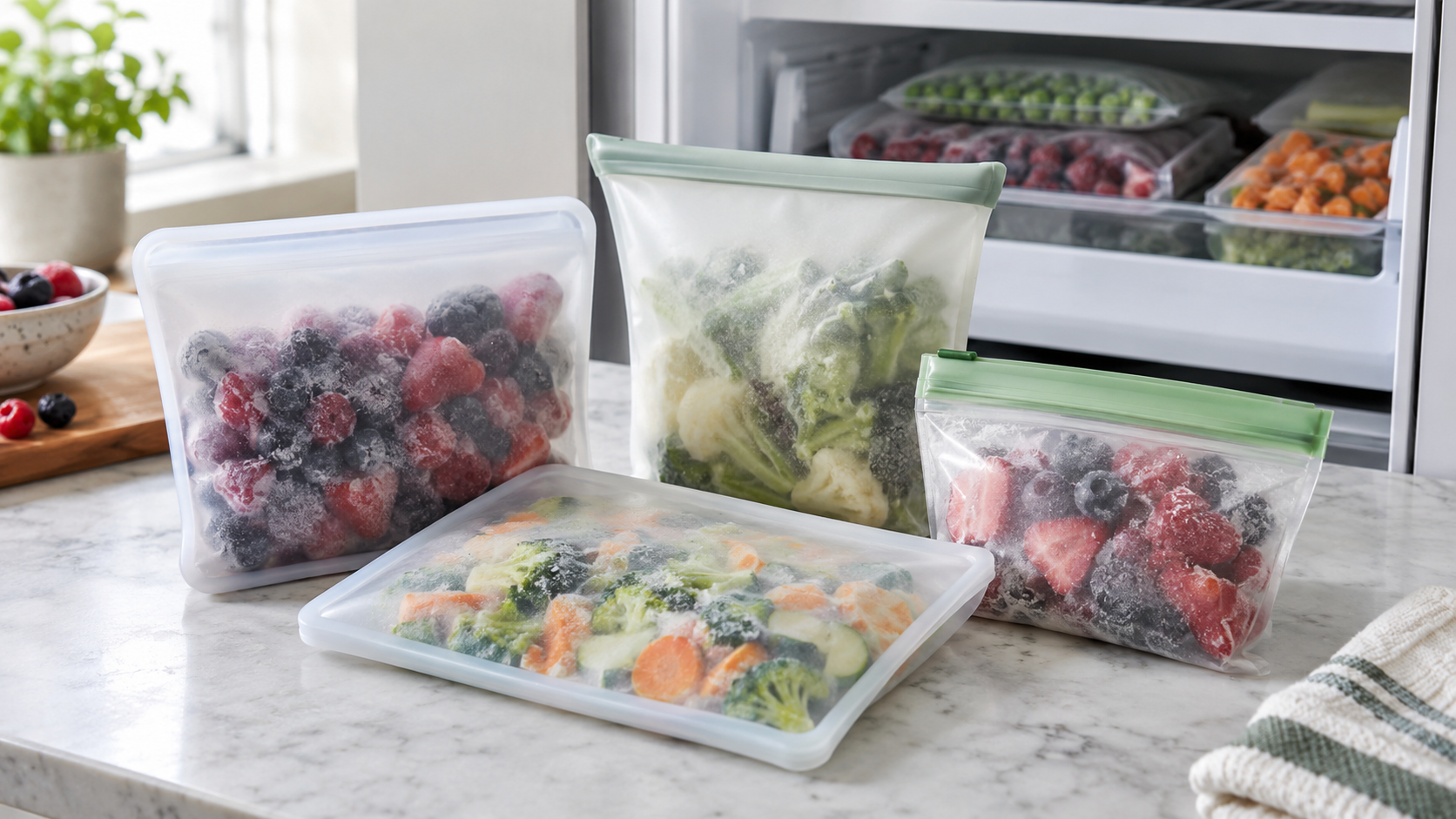
Choose a flat rectangular bag for measured portions that tolerate pressure and can freeze flat before being filed upright or stacked. Check the complete exterior size and closure, not just capacity.
Choose a stand-up bag when filling without a separate holder matters and the freezer has enough vertical clearance. Its gusset can use more shelf depth and may take longer to dry.
Choose a lightweight zip-style bag when empty bags must store compactly and the maker documents the intended freezer use. Flexible sides provide less crush protection and can be awkward to wash fully open.
Reusable Freezer Bag Formats Compared
| Format | Strongest fit | Main tradeoff | Verify before buying |
|---|---|---|---|
| Flat silicone bag | Thin portions and filing frozen packs upright | Heavier material and corners may slow drying | Exterior dimensions, fill line, closure bulk, cleaning method |
| Stand-up silicone bag | Counter filling and upright shelf access | Gusset uses depth and can trap wash water | Open-base footprint, freezer height, permitted foods, drying access |
| Reusable zip-style bag | Compact empty storage and familiar handling | Less structure for filling and contents protection | Freezer documentation, seam care, closure alignment, replacement guidance |
| Slider or removable-bar closure | Users who prefer a guided closure | Extra parts need cleaning and can be misplaced | Complete closed width, part replacement, washing instructions |
Measure the Space and the Portion
Measure the usable width, depth, and height of each freezer zone after accounting for drawer rails, vents, baskets, and the door path. Then measure a typical portion. A bag advertised by volume may become too wide for a drawer when filled, while a thick closure can prevent a seemingly suitable bag from standing upright.
- Pick an orientation: decide whether each portion will freeze flat, stand upright, or lie in a basket.
- Include the closure: record the complete sealed width and height, including sliders, bars, tabs, or rigid rims.
- Allow permitted fill space: follow the maker's fill guidance rather than forcing the stated capacity into a crowded package.
- Plan a freezing surface: a bag intended to freeze flat needs a level temporary spot until the contents become firm.
- Count washing space: include the rack, holder, or counter area needed to keep the interior open until fully dry.
Closure and Filling Criteria
A closure should be easy to align consistently and easy to inspect for trapped food. A thick pinch seal can be simple but may be stiff. A slider can guide the closure but adds a separate part or a bulkier edge. A stand-up base can free both hands during filling, while a flat flexible bag may need a jar, rack, or compatible holder.
Do not treat “zip,” “seal,” or “freezer safe” as a leakproof promise. Follow the exact product instructions, keep closures clean, and use secondary containment when the maker or the food routine calls for it. Avoid filling a soft bag with foods that could puncture it or with hot contents unless the documentation explicitly permits that use and temperature.
Materials, Temperature, and Food Use
Silicone, polyethylene blends, and other reusable materials can have different instructions even when they look similar. Verify food-contact documentation and the manufacturer's current freezer, dishwasher, microwave, thawing, and temperature guidance for the exact product. Freezer permission does not automatically grant microwave, boiling-water, oven, or sous-vide permission.
This guide does not set food-storage times. Label contents and dates, and follow current authoritative food-safety guidance for cooling, freezing, thawing, and discarding food. A reusable bag is a container choice, not a preservation guarantee.
Cleaning, Drying, and Replacement
The best bag for repeated use is one your household can actually clean and dry. Look for an opening wide enough to reach the interior and a shape that remains open on your drying setup. Check whether the maker permits dishwasher use, turning the bag inside out, brushes, or drying racks; improvised handling can stress seams or closures.
Inspect seams, corners, gussets, closures, and surfaces after every wash. Retire a bag according to its maker's guidance if it develops a cut, puncture, split seam, warped closure, persistent residue, or another condition that prevents intended use. A large multipack is poor value if most sizes do not match your portions or drying space.
Who Should Skip Reusable Freezer Bags
- Anyone who needs rigid crush protection for delicate foods.
- Households without a reliable way to clean and completely dry bag interiors.
- People whose current serviceable containers already fit the freezer and portions well.
- Anyone unable to verify the exact product's food-contact and freezer-use instructions.
- Users who regularly lose separate sliders, closure bars, or small parts.
If you are still deciding between flexible and rigid storage, start with the reusable silicone bag versus rigid container comparison. For a wider way to assess product materials, maintenance, measurements, and skip conditions, use the home product category buying framework.
Bottom Line
For a small freezer, choose the bag format that fits a repeatable portion, closes within the measured compartment, and can be washed and dried without becoming a chore. Flat bags favor space-efficient portions, stand-up bags favor easier filling, and zip-style bags favor compact empty storage. Verify the exact product's documentation before relying on any of them.