Rolling Utility Cart vs Freestanding Shelves for a Rental Kitchen
Choose a rolling utility cart when a small group of everyday supplies needs to move between a parking spot and a work zone. Choose freestanding shelves when the same measured patch of floor can support more fixed, visible storage without narrowing the kitchen route. Neither is automatically renter-safe or stable: the exact unit, room, lease, assembly, loading, and restraint instructions decide the fit.
As an Amazon Associate, The Good Home Doc may earn from qualifying purchases.
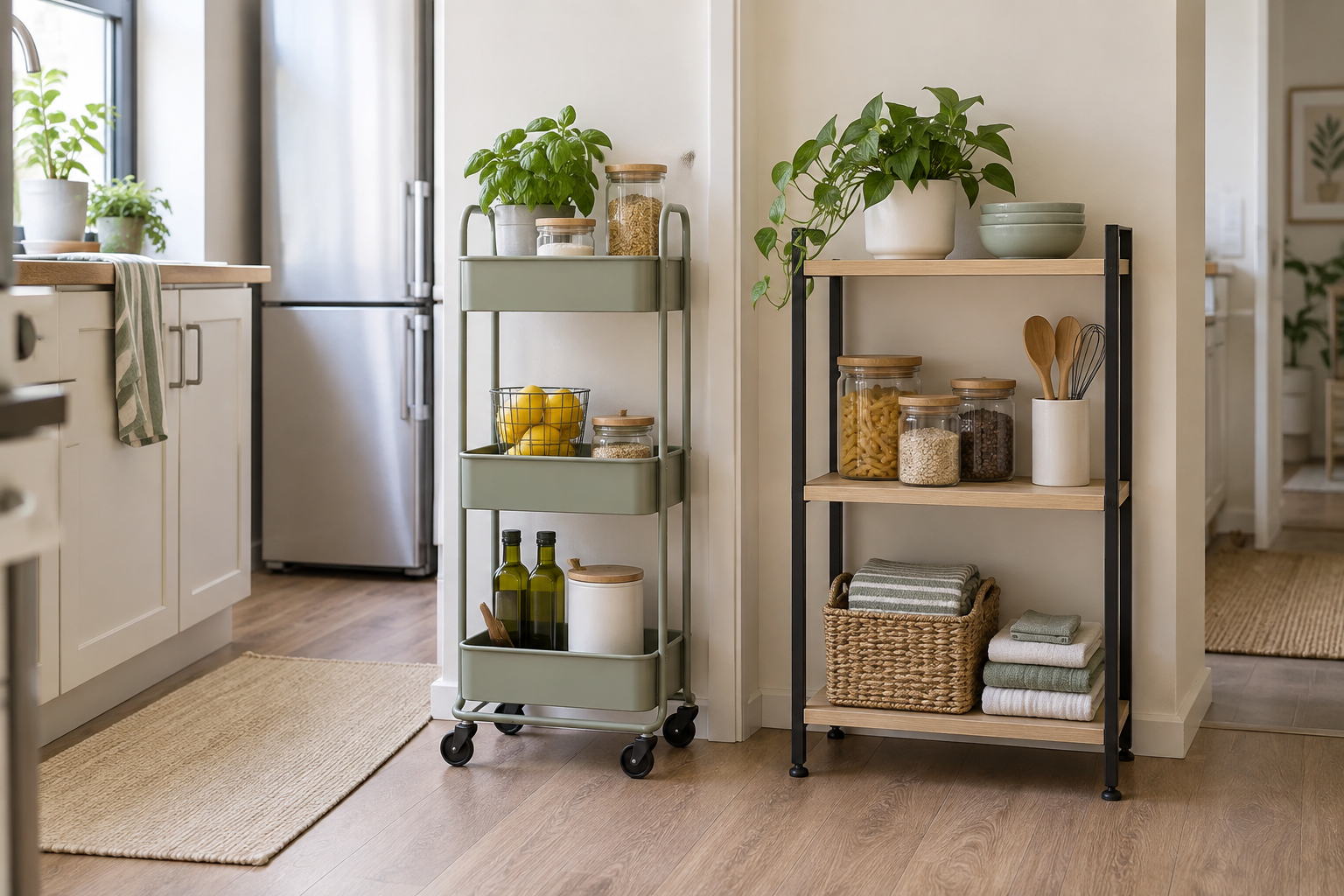
Quick decision before shopping
First measure the available space, identify the setup or surface constraints, and decide who will maintain the item. Skip the category if it blocks access, conflicts with the manufacturer's instructions or lease, or adds more upkeep than the problem justifies.
Compare formats only after measuring: These affiliate category links are starting points, not tested product rankings.
- Browse category: Compare slim rolling utility cartsCheck the widest assembled dimension, shelf clearance, stated loads, caster design, handles, and cleaning instructions.
- Browse category: Compare narrow freestanding kitchen shelvesCheck the full base, height, shelf dimensions, leveling, assembly, stated loads, and any required tip restraint.
This comparison covers product formats rather than named models. Dimensions, materials, hardware, load limits, heat and moisture restrictions, assembly, and restraint requirements vary. Verify the current instructions for the exact unit and ask the landlord before any anchoring or other alteration.
Quick Comparison
| Decision point | Rolling utility cart | Freestanding shelves |
|---|---|---|
| Best fit | A defined group of supplies that benefits from moving | More fixed vertical storage in one permanent location |
| Space to measure | Parking footprint plus its complete rolling and turning route | Full base, height, shelf access, baseboard gap, and nearby door swing |
| Access | Can move toward a work zone, then park away | Items stay visible and reachable in one place |
| Stability check | Casters, locks, floor transitions, frame proportions, and load placement | Level floor, frame proportions, shelf loading, assembly, and restraint instructions |
| Moving day | Often compact, but wheels and bins may need securing | May offer more capacity but can be taller, heavier, or slower to disassemble |
Start With the Storage Job
Name the items before choosing the furniture. A cart makes sense for a contained routine—coffee supplies, lunch-packing items, or produce that the product instructions allow—when those items genuinely need to travel. Shelves make more sense for a broader pantry overflow that stays put and remains easy to see.
If the plan is simply “extra kitchen storage,” pause. Inventory the intended contents, measure the largest container, note what must stay low or out of reach, and assign every item to a shelf. Open storage can become visible overflow quickly, whichever frame supports it.
Measure the Whole Operating Footprint
For a cart, tape its widest assembled footprint at the parking spot, including handles and projecting casters. Then tape or walk the full route it must travel. Test refrigerator, oven, dishwasher, drawer, cabinet, and room-door movement along that route. Include thresholds, grout joints, rugs, and any tight turn.
For shelves, measure the complete base and height—not just shelf width. Account for baseboards, trim, sloped floors, access to outlets or shutoffs, and the space needed to reach the lowest and highest shelf. Keep either format out of required paths and away from heat, moisture, or appliance ventilation where its instructions or the room make placement unsuitable.
Mobility Versus Capacity
A cart gives up some capacity to its frame, wheel hardware, handles, and maneuvering space. That trade can be useful if movement supports the routine. If the cart would never leave its parking spot, wheels may add maintenance and movement without adding real function.
A narrow shelf can use vertical space more efficiently, but height does not guarantee a better fit. Confirm each shelf's usable dimensions and stated load, then follow the maker's loading and tip-restraint instructions. Do not assume “freestanding” means anchoring is optional, and do not improvise an attachment in a rental.
Stability Is Product- and Room-Specific
Keep heavier items low on either format and avoid unstable stacks or overhanging containers. For a cart, check whether the casters suit the actual floor and whether any locks are reachable when parked. Locks can resist rolling; they do not correct a loose frame, uneven floor, top-heavy load, or collision risk.
For shelves, assemble every brace and fastener as directed, check the unit on the real floor, and follow all leveling and restraint guidance. If the required restraint conflicts with the lease, wall construction, or an unknown utility location, choose a different product or ask the landlord or a qualified installer rather than skipping the instruction.
Cleaning and Daily Access
A cart can roll away for floor cleaning, but wheels collect hair and debris and may mark or catch on some floors. Freestanding shelves eliminate caster care, yet the fixed base and wall gap can be awkward to clean. Compare smoothness, seams, removable trays, shelf liners allowed by the maker, and whether spills can be reached promptly.
Both formats leave contents exposed to dust and kitchen residue. Closed containers may simplify upkeep, but confirm they fit without projecting beyond the shelf. Do not place leaking packages, unstable glass, or an appliance on a surface not approved for that use.
Who Should Choose Each Format?
A rolling cart is the better candidate when there is a permanent parking spot, a clear movement route, a modest assigned load, and a repeat reason to bring supplies closer. It also suits renters who expect to move and can transport the cart safely.
Freestanding shelves are the better candidate when storage should stay in one location, vertical capacity matters more than mobility, every shelf remains reachable, and the unit's assembly and restraint requirements work in the rental.
Skip both when either option blocks circulation, appliances, ventilation, utilities, or cleaning; when the floor is unsuitable; when children or pets can climb or pull on the unit; or when landlord and manufacturer requirements cannot both be met. Shelf risers inside existing cabinets, drawer organizers, decluttering, or landlord-approved built-in storage may solve the bottleneck without adding floor furniture.
Bottom Line
Buy the cart for useful movement, not merely because it has wheels. Buy shelves for useful fixed capacity, not merely because they are taller. Tape out both operating footprints, assign the contents, verify the exact product instructions, and choose the format that leaves the rental kitchen easier—not harder—to walk through, use, clean, and eventually move out of.