Is an Electric Spin Scrubber Worth It for Bathroom Cleaning?
An electric spin scrubber can be worth it when broad, intact bathroom surfaces need frequent scrubbing, a controllable powered head suits those surfaces, and you have a practical place to charge, dry, and store the tool. It is less convincing for tight detail work, delicate finishes, damaged grout or caulk, or a routine that a simple hand brush already handles well.
As an Amazon Associate, The Good Home Doc may earn from qualifying purchases.
Quick decision before shopping
First measure the available space, identify the setup or surface constraints, and decide who will maintain the item. Skip the category if it blocks access, conflicts with the manufacturer's instructions or lease, or adds more upkeep than the problem justifies.
Shop only after the surface check: This affiliate category link is a starting point, not a tested product ranking.
- Browse category: Compare electric spin scrubber formatsCheck current approved surfaces, head dimensions, speed controls, handle range, water-resistance limits, charging instructions, replacement brushes, and care directions.
This is a category decision framework, not a product test. Surface approvals, water resistance, speeds, batteries, charging, attachments, warranties, and replacement parts vary by model. The bathroom-surface maker's care guidance and the scrubber manual both matter; a seller listing does not override either one.
Quick Answer
It is probably worth it if the recurring job covers broad compatible tile, a tub, or shower panels; the rotating head stays controllable at the angle you need; and powered rotation would remove a real bottleneck in your routine.
Delay the purchase until you list every surface, measure the tightest corner and storage spot, and confirm where all wet attachments can dry separately from the charger.
Skip it if the main work is grout-detail cleaning, the surfaces prohibit the supplied brush material, the bathroom lacks a dry charging location, or the tool's weight and spinning reaction make precise control difficult.
The Five-Minute Fit Check
- Name the repeat job. Broad wall residue, a tub floor, corners, grout lines, and fixtures need different head shapes and levels of control.
- List every material and finish. Check current care instructions for tile, stone, grout, acrylic, fiberglass, glass, coatings, and metal before choosing a brush.
- Measure access. Record the smallest corner, space behind fixtures, highest comfortable reach, collapsed handle length, and storage footprint.
- Plan charging and drying. The charger needs the dry location and clearances stated by the maker. Wet heads need ventilation before storage.
- Check replacement parts. Confirm the exact attachment system and whether suitable brush heads and the battery or charger can be replaced.
When Powered Rotation Earns Its Storage Space
The best case is repetitive work over a broad compatible surface. Rotation supplies repeated brush movement while the user guides the head, which may make the routine easier to continue than repeated hand strokes. A telescoping handle can also extend reach when it locks securely and remains controllable.
That advantage disappears when the head is too wide for the job, skips across a curved surface, or demands constant correction. Powered rotation does not choose the right pressure, cleaner, dwell time, or brush stiffness. You still have to follow both the surface and cleaning-product instructions.
Control Matters More Than Maximum Speed
Look for an on-off control you can reach without changing grip and, if speeds are offered, documentation explaining them. A faster setting is not automatically better. Start with the least aggressive surface-approved head and setting, test an inconspicuous area, and stop if the finish changes or the tool becomes hard to steer.
A long handle shifts leverage. Compare the complete working weight, locked handle positions, head angle, and whether the scrubber pulls sideways when it meets an edge. A manual brush is often the more precise tool around sealant, hardware, narrow grout lines, and small corners.
Water Resistance Has Limits
Do not translate a water-resistance statement into permission to submerge the tool, rinse the charging connection, or leave the body in pooled water. Read the current manual for the exact model's wet-area limits, cleaning method, charging-port care, and required drying time. Charge only in the location and configuration the manufacturer specifies.
Keep the working area ventilated as product labels direct, avoid splashing outlets or powered fixtures, and never mix cleaning products unless their labels explicitly permit it.
Brush Heads Create an Upkeep Routine
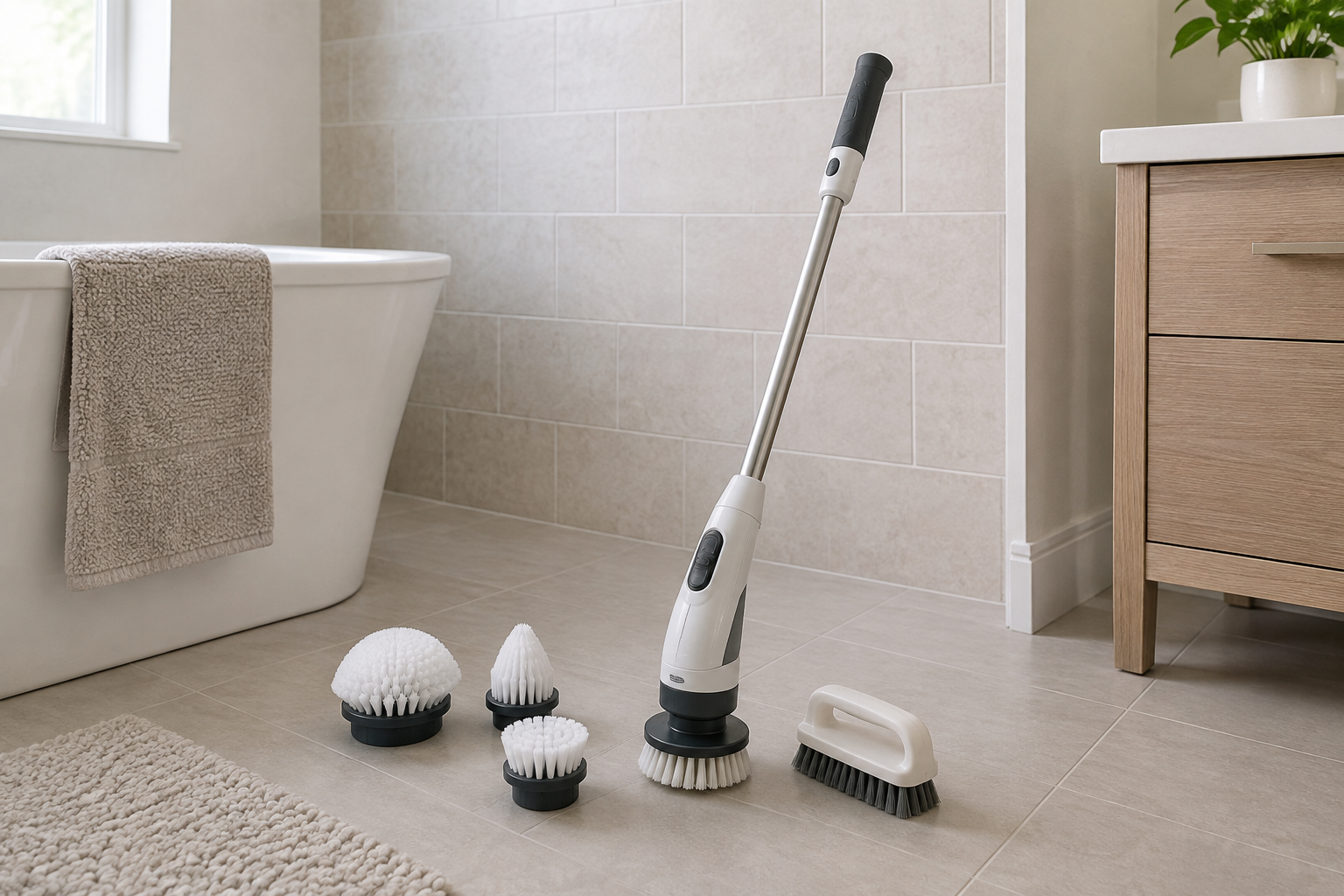
Extra heads help only when their shapes and materials fit actual jobs. A broad flat head may suit open surfaces, a dome can follow some curves, and a smaller brush can reach corners—but names and shapes do not prove surface compatibility. Check the bristle material, head dimensions, attachment lock, and replacement identifier.
After use, follow the maker's instructions for removing trapped debris, rinsing approved parts, and drying them completely. Store clean heads where air can circulate. Replace worn or distorted attachments rather than pressing harder to compensate.
Must-Haves Versus Nice-to-Haves
Must-haves: documented surface compatibility, controllable operation, a secure head connection, a handle that locks at useful lengths, explicit water and charging instructions, washable or replaceable heads, and a realistic drying and storage plan.
Nice-to-haves: a second useful speed, a compact hanging or standing arrangement, clearly labeled job-specific heads, charge-status reporting, and replaceable components. A large attachment bundle is not valuable when most heads duplicate one another or lack clear care guidance.
Who Should Skip an Electric Spin Scrubber?
- Anyone whose bathroom surfaces are delicate, damaged, unknown, or not approved for the supplied brush material.
- Households whose main task needs close visual inspection and precise hand pressure rather than broad repeated passes.
- People who find the complete tool awkward to hold or difficult to control when the head rotates.
- Bathrooms without a dry, manufacturer-approved charging and storage arrangement.
- Anyone unwilling to remove, clean, dry, and eventually replace the brush heads.
- Shoppers expecting rotation to repair failed grout or caulk, diagnose moisture, remove mold safely, or prove that a surface is sanitary.
Know When the Problem Is Not a Scrubbing Problem
Stop treating the issue as routine cleaning when grout is crumbling, caulk is separated, a surface is loose or cracked, water escapes the enclosure, or discoloration and odor keep returning after ordinary care. Renters should report suspected leaks or damage to property management. Persistent moisture, suspected mold, electrical concerns, or repairs involving the building belong with an appropriately qualified professional.
Bottom Line
An electric spin scrubber is worth considering when broad compatible surfaces, frequent scrubbing, controllable reach, and a workable charging-and-drying routine line up. It is not a universal upgrade: a manual long-handle scrubber costs less, stores simply, and often gives better control for occasional or detailed work. Decide from the actual surfaces and recurring bottleneck, then verify the exact model's instructions before buying.
If powered rotation fits, compare corded and cordless electric spin scrubbers by outlet access, cord routing, runtime, charging, and battery upkeep. If manual reach is the better fit, use the long-handle shower scrubber guide to compare head shape, handle lock, surface fit, and drying.
Next step: Put this decision in context with the home-product buying framework guide.