Removable rental-kitchen towel storage
How to Choose Over-the-Cabinet Towel Bars for Rental Kitchens
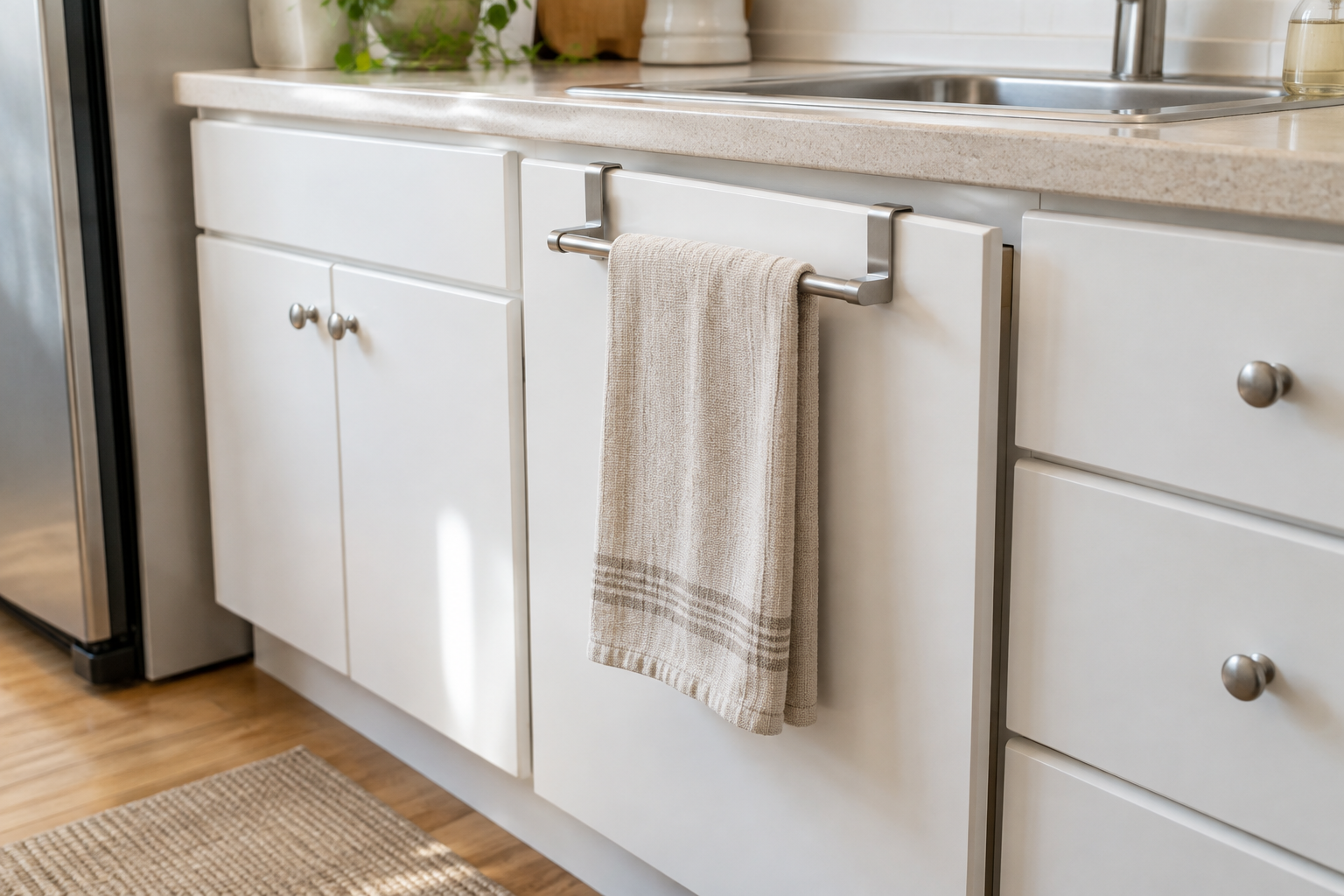
An over-the-cabinet towel bar is worth considering when a dish towel has no convenient home and drilling is off the table. The best type is a padded, correctly sized bar that lets the cabinet operate normally and gives a damp towel room to hang without dragging or crowding the work zone.

As an Amazon Associate, The Good Home Doc may earn from qualifying purchases.
Shop by the available cabinet edge
- Browse category: Compare padded over-cabinet towel barsCheck the documented door-thickness range, hanger depth, padding, full projection, bar length, finish care, and stated load.
- Browse category: Compare short cabinet-door towel barsStart here when adjacent drawers, pulls, appliances, or a narrow door limit usable bar width.
Quick answer: choose the simplest padded bar that fits
Start with a single fixed bar whose two hangers fit the measured cabinet edge and whose contact surfaces are padded or smoothly finished. A short bar is often easier to place on a narrow lower door; a longer bar gives a towel more room to spread only when both hangers sit fully on the same flat edge.
This is a product-format guide, not a list of tested winners. Reject listings that omit the hanger opening, installed projection, bar length, contact material, care instructions, or stated load. “Over cabinet” is not a universal fit.
Measure the cabinet with everything in motion
- Door or drawer-front thickness: measure the top edge at both hanger positions, away from bevels, trim, bumpers, and raised panels.
- Hanger depth: confirm each hook can sit flat without striking a shelf, drawer box, sink, or frame behind the front.
- Installed projection: add the bar and folded towel depth, then check knees, appliance handles, walkways, and neighboring doors.
- Usable bar length: compare the straight hanging space—not overall width—with the towel folded as it will actually be used.
- Vertical clearance: keep the towel above the floor, toe kick, pet bowls, trash bin, and anything that could soil or snag it.
- Door travel: open and close the cabinet slowly with the empty bar and then the towel; verify hinges and latches still work normally.
A removable paper template cut to the listed width and projection can reveal collisions before ordering. Check both the closed position and the position used while cooking or washing up.
Choose among three practical formats
Short fixed bar
This is the clearest fit for a narrow door or a single hand towel. Its small footprint can reduce conflicts, but a wide towel may bunch and dry more slowly. Confirm the towel will not cover a knob, hinge area, or neighboring drawer gap.
Long fixed bar
A longer bar can spread a towel and may hold two light dry cloths if the maker permits it. It needs a wide, flat cabinet edge and more side clearance. Skip it when either hanger would sit on trim or the bar would cross a door seam.
Swinging or multi-arm bar
Moving arms can separate towels, but they add projection, joints, and pinch or collision points. Choose this format only when the full movement path is clear and the additional cleaning and hardware checks suit the household.
Must-have features
- A documented hanger opening and enough flat contact area for the exact door.
- Padding or a smooth contact surface compatible with the cabinet finish.
- Complete installed dimensions, including bar projection and hanger depth.
- Rounded, finished edges and a stated load appropriate for light towels.
- Care instructions for both the bar finish and removable pads.
Nice-to-have features
Replaceable pads, a bar that lifts off for cleaning, and a finish that contrasts with the towel can make daily use easier. An adjustable-width design helps only when its joints remain stable and do not snag fabric. Claims about corrosion, scratches, or removal outcomes need product-specific evidence; do not treat them as category guarantees.
Rental, surface, and removal constraints
Check the lease or ask the landlord or property manager when cabinet-mounted accessories are restricted. “No drill” describes the attachment method, not the removal outcome. Grit beneath a pad can mark a finish, a tight hanger can compress an edge, and repeated movement can rub paint or veneer.
Skip a door that is loose, misaligned, damaged, glass-fronted, unusually thin, or already rubbing. Do not bend the hanger, add unapproved adhesive, or force the cabinet closed. Remove the bar if the finish changes, the hardware shifts, or the door stops operating normally.
Setup, maintenance, and storage
- Read the towel-bar instructions and any available cabinet-care guidance before fitting it.
- Clean and fully dry the cabinet edge and pads as directed; trapped crumbs can become abrasive.
- Fit the empty bar and test the entire door or drawer path slowly.
- Add one light towel, then repeat the clearance check when the towel is damp and folded as used.
- Launder towels regularly and let them dry with space around the fabric. A bar does not sanitize a towel or correct a damp room.
- Remove and clean the bar and contact area on the schedule the materials require. Dry all parts before reinstalling.
- For a move, wrap the bar so its hangers cannot scratch cookware, cabinets, or other stored items.
Who should skip this product
Skip an over-the-cabinet bar when no compatible edge exists, the only position blocks a walkway or appliance, the household needs to hang heavy or soaking textiles, or opening the door would swing the towel into food, waste, the floor, or cleaning chemicals. A freestanding towel stand, an existing oven handle when the appliance maker permits it, or a landlord-approved wall solution may fit better.
Also skip the purchase if better towel placement will not address persistent dampness, leaks, swelling cabinetry, peeling finishes, or recurring musty conditions. Report those building or plumbing concerns through the required rental process and use a qualified professional when appropriate.
If you are moving paper towels rather than a reusable dish towel off the counter, compare no-drill paper towel holder mounts for renters; roll clearance and tear direction create a different fit problem.
Bottom line
For most compatible rental kitchens, a simple padded fixed bar is the best starting type. Measure the complete hanger and towel footprint, preserve normal cabinet operation, keep damp fabric clear of contamination and traffic, and choose another location when the fit is forced.