Under-Shelf Basket vs Shelf Riser for Kitchen Cabinets
Choose an under-shelf basket when a sound shelf has unused space below it and you need a reachable home for light, shallow items. Choose a shelf riser when the cabinet floor or shelf can support a stable second tier and you want to separate dishes, mugs, or pantry goods. The better option is the one that improves access after doors, hinges, hands, and the items underneath are accounted for.
As an Amazon Associate, The Good Home Doc may earn from qualifying purchases.
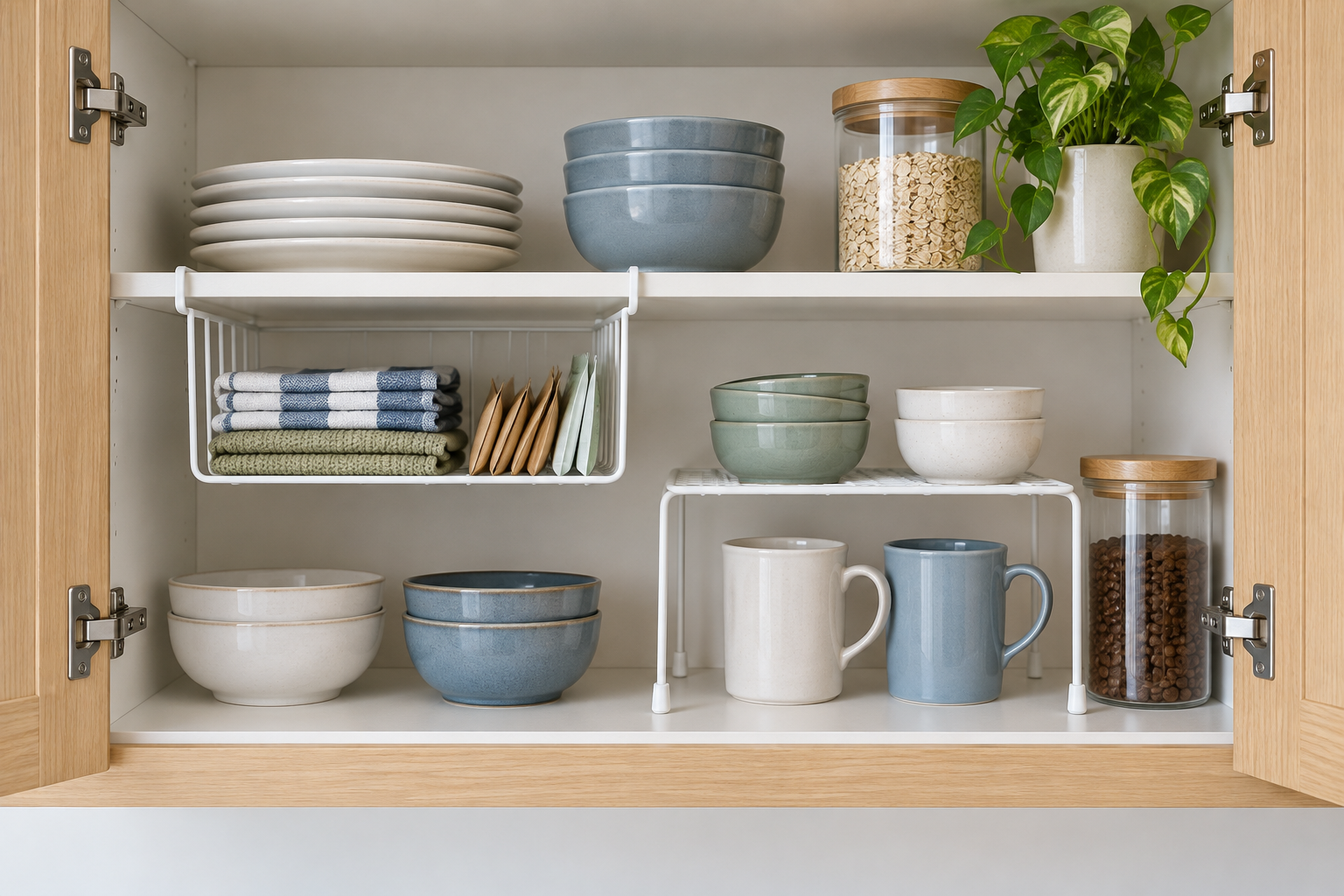
Quick decision before shopping
First measure the available space, identify the setup or surface constraints, and decide who will maintain the item. Skip the category if it blocks access, conflicts with the manufacturer's instructions or lease, or adds more upkeep than the problem justifies.
Measure the installed shape before shopping: These affiliate category links are comparison starting points, not tested winners.
- Browse category: Compare under-shelf cabinet basketsVerify shelf-thickness range, hanger length, complete basket depth, stated load, finish, and door clearance.
- Browse category: Compare freestanding cabinet shelf risersVerify width, depth, height, leg positions, permitted configuration, stated load, and cleanability.
Follow the organizer and cabinet instructions. Do not add either organizer to a damaged, bowed, loose, or incompatible shelf, and do not treat a stated organizer load as proof that the cabinet can support it.
Quick decision
| Decision point | Under-shelf basket | Shelf riser |
|---|---|---|
| Where it uses space | Hangs from the underside of an existing shelf | Stands on the shelf and creates an upper tier |
| Best-fit items | Light linens, packets, wraps, or other shallow items allowed by the maker | Mugs, bowls, jars, or dishes that fit the documented layout and load |
| Main measurement | Shelf thickness plus hanging depth and hanger path | Usable footprint plus height above and below the platform |
| Main tradeoff | Preserves shelf surface but reduces clearance below | Uses shelf surface and leg space but avoids hanging force |
| Renter consideration | Removable, but hangers can rub or mark a finish | Freestanding, but feet can shift or leave contact marks |
Option A: under-shelf basket
An under-shelf basket clips or slides over the front edge of a compatible shelf. It works best when the shelf is sound, its thickness fits the maker's hanger range, and the cabinet has genuinely unused height above short items. Because the basket occupies the space immediately below a shelf, it can make the lower area less useful even while adding nominal capacity.
Its strongest use case is a small category of lightweight items that benefits from being visible and reachable. It is a weak choice for cookware, appliances, tall stacks, fragile objects, or anything that encourages pulling down on the basket. A listed basket load does not establish what an existing cabinet shelf or its supports can carry.
Option B: shelf riser
A shelf riser stands on the cabinet surface and divides one tall opening into two shorter levels. It is usually the clearer choice for stable dish or pantry zones when all feet land flat and the upper and lower items remain easy to lift out. Expandable and stackable designs need to be used only in configurations the maker permits.
The cost is footprint. Legs occupy corners or edges, the platform consumes height, and an awkward width can trap items behind supports. A riser that technically doubles a shelf but forces you to unload the front row has increased density, not useful access.
Who each option fits
Choose an under-shelf basket when
- The current shelf is compatible, level, undamaged, and securely supported.
- There is clear hanging space above short items and the cabinet doors can still close.
- You need one lightweight category within easy reach.
- A riser's feet would consume the exact shelf surface you need to keep open.
Choose a shelf riser when
- You want a stable upper tier for items that can sit safely on a platform.
- The cabinet shelf has enough flat depth for every foot.
- You need access from both the lower and upper levels.
- Shelf thickness, face frames, or hanger contact make a basket unsuitable.
Measure the cabinet in use
For a basket, measure shelf thickness where both hangers will sit, the unobstructed hanger path, the complete hanging depth, and the distance to the tallest item below. Check hinges, a center stile, face-frame lips, shelf pegs, and the real front opening. A basket can fit inside the cabinet box and still stop a door from closing.
For a riser, measure usable width, depth, and height at the actual placement point. Mark the feet as well as the platform. Confirm that every foot sits on a flat surface, not a lip, seam, liner ridge, or shelf-pin opening. Add the riser height to the tallest upper item and preserve enough space to lift it out without scraping the shelf above.
Make a cardboard outline of either organizer using its complete listed dimensions. Put it in position, close both doors slowly, and practice reaching everything that will remain around it. This checks geometry only; it does not replace manufacturer installation or load guidance.
Setup and maintenance tradeoffs
Basket setup is often tool-free, but contact points deserve attention. Do not force hangers over an incompatible shelf or improvise padding that prevents them from seating as designed. Check for shifting, scraping, bent wire, chipped coating, or shelf changes after installation and whenever the load changes.
A riser needs a clean, dry, level surface and correctly seated connectors or adjustment locks. Press lightly at each corner before loading it, then add items gradually. During routine cabinet cleaning, remove crumbs and moisture around the feet and inspect for rocking, loose joints, corrosion, or damaged caps.
Both formats collect dust and kitchen film. Follow their care instructions, dry them fully, and keep food in suitable packaging or containers. Neither organizer belongs where heat, steam, leaks, or another excluded condition affects the cabinet.
Renter and cabinet-finish limits
“No drill” does not mean “no mark.” Basket hangers can rub a finished edge; riser feet can trap grit or transfer pressure to a small area. Use only maker-approved protection, keep the cabinet clean, photograph its condition, and check lease or property-manager rules when contact organizers are restricted. Remove the product if it changes the finish, blocks normal door operation, or shifts during ordinary use.
When to skip both
- The cabinet shelf is bowed, loose, water-damaged, cracked, glass, unusually thin, or otherwise incompatible.
- The intended items are heavy, fragile, unstable, too tall, or difficult to remove safely.
- Either organizer would block hinges, doors, shelf adjustment, appliance ventilation, or the hand path.
- The real problem is deep reach; a shallow handled bin or turntable may fit better.
- The real problem is excess inventory or mixed categories; editing and grouping may restore more access than another layer.
- You cannot verify dimensions, permitted configuration, load guidance, or care instructions for the exact product.
Bottom line
An under-shelf basket is the better starting point for measured empty space below a compatible shelf and a small load of light items. A shelf riser is better when a flat cabinet surface can support a practical second tier without sacrificing hand access. Do not choose by the extra capacity shown in a product photo. Choose by the installed dimensions, cabinet condition, item weight and shape, door movement, cleaning routine, and what you can still reach afterward.