Tiered Counter Organizer vs Lazy Susan for a Deep Bathroom Vanity
Choose a tiered organizer when you want bottles separated by height and visible at a glance. Choose a Lazy Susan when the vanity is deep enough for a full rotation and reaching the back is the main problem. Neither format creates counter space: the better one makes the items you already use easier to reach without crowding the sink, mirror, or cleaning path.
As an Amazon Associate, The Good Home Doc may earn from qualifying purchases.
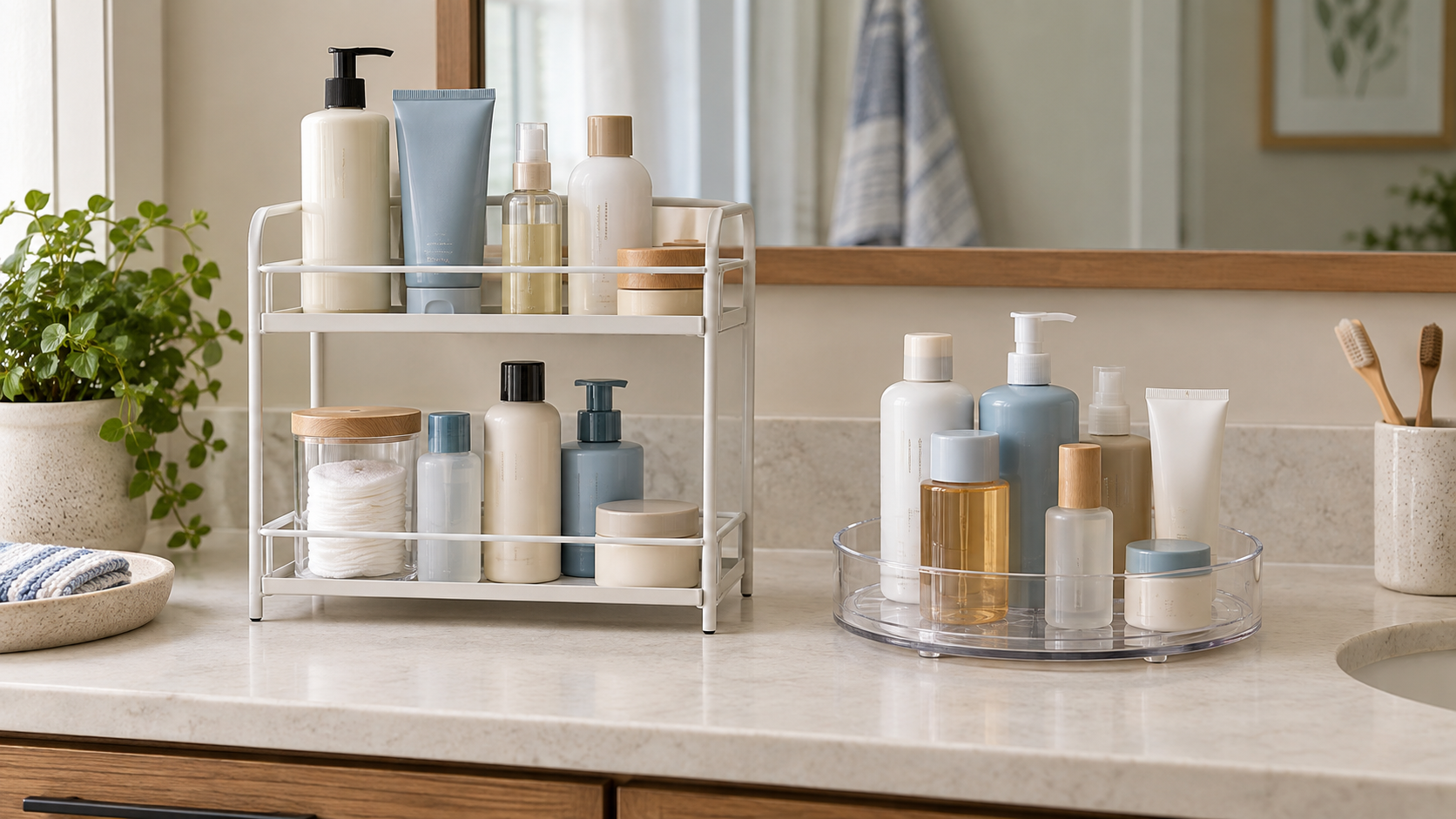
Quick decision before shopping
First measure the available space, identify the setup or surface constraints, and decide who will maintain the item. Skip the category if it blocks access, conflicts with the manufacturer's instructions or lease, or adds more upkeep than the problem justifies.
Compare the two formats: Measure the occupied countertop and your tallest bottles first. These category links are shopping starting points, not tested winners.
- Browse category: Shop tiered bathroom counter organizers on AmazonCheck the complete footprint, usable tier heights, front rail, feet, materials, stated load, and cleaning instructions.
- Browse category: Shop bathroom vanity Lazy Susans on AmazonCheck usable diameter, rim height, base footprint, rotation clearance, non-slip details, and finish-care guidance.
This comparison is specifically about open storage for everyday bottles on a deep vanity. For a broader plan, use the small-home organization systems guide. If your clutter belongs inside a drawer, compare bathroom drawer organizer formats instead.
The short answer
- Pick a tiered organizer when labels need to face forward, bottle heights are predictable, and vertical separation matters more than rotation.
- Pick a Lazy Susan when the counter is deep, the full circle can turn unobstructed, and several similarly sized bottles otherwise hide behind one another.
- Skip both when the organizer would sit in the splash zone, obstruct an outlet or medicine cabinet, narrow the usable sink area, or make the counter harder to wipe.
Side-by-side tradeoffs
| Decision point | Tiered counter organizer | Lazy Susan |
|---|---|---|
| Access pattern | Front-facing rows; pick an item directly | Rotate the item you need to the front |
| Best bottle mix | Different heights that fit below the tier above | Similar upright bottles that remain stable while turning |
| Main measurement | Width, depth, rail height, and clear height on every tier | Full base diameter plus unobstructed rotation and hand clearance |
| Space behavior | Uses height but can create a wide visual block | Uses a fixed circle and leaves corner space outside it unused |
| Main failure point | Tall bottles do not clear the upper tier or labels hide behind rails | Bottles tip, snag nearby objects, or make the loaded tray hard to turn |
| Cleaning routine | Remove rows and wipe several shelf surfaces and rails | Lift off bottles, wipe one tray, and clean beneath the rotating base |
Measure the vanity before choosing a shape
Mark the organizer footprint with painter's tape. Keep it outside the basin rim and faucet-handle sweep, then open every nearby drawer, cabinet, medicine-cabinet door, and outlet cover. Include the baseboard or backsplash lip and any mirror that comes close to the counter. What looks like a deep empty corner may not be usable once a hand must reach around the organizer.
For a tiered unit, record the total width and depth, but also check the usable depth inside each rail and the clear height between levels. A tall pump bottle may fit the overall height yet fail to fit on the lower shelf. For a turntable, compare the product's full base diameter—not only its usable tray—with the taped circle. Leave space for fingertips and for bottles that project past the rim.
Choose by the bottles and the routine
Tiered organizer: better for visible categories
Two levels can separate morning and evening products, face labels forward, or keep shorter jars from disappearing behind pumps. A front rail can reduce casual sliding, but a high rail may cover labels or make low jars awkward to lift. The format works best when each item has a stable spot and the tallest container fits without leaning.
Do not assume more tiers mean more useful storage. Extra height can interfere with a mirror or cabinet, and narrow upper shelves may not fit the products you own. Compare the item's stated load and assembly instructions, place heavier stable bottles on the lower level, and do not build unsupported stacks.
Lazy Susan: better for deep reach
A turntable brings the back of a deep counter forward without requiring you to reach across other bottles. It is most useful when every item remains upright during a slow rotation. A modest rim can contain small shifts, while a non-slip surface may help with smooth-sided bottles; verify these details in the current product documentation.
A round tray is not automatically space-efficient. It leaves unused wedges in a square corner and needs clearance on all sides to turn. Very tall, narrow, top-heavy, or loosely capped containers are poor candidates. If one oversized item stops the rotation, a simple rectangular tray may be easier.
Setup, moisture, and maintenance
Place either organizer on a level, dry surface according to its instructions. Check that feet, fasteners, and rotating parts sit flat before loading. Bathroom humidity and splashes affect materials differently, so follow the maker's finish-care guidance rather than assuming metal is rustproof, wood is sealed, or plastic tolerates every cleaner.
Plan a routine you will actually keep: remove products, wipe the organizer and counter, dry both fully, and inspect feet, joints, rails, and the turntable mechanism before reloading. Wipe bottle leaks promptly. An organizer can contain visual clutter, but it does not solve a leaking package, persistent dampness, damaged finish, or a surface that stays wet.
Keep electrical grooming products and cords in a dry location permitted by their instructions, not mixed among wet bottles. Store medicines, razors, cleaners, and other household hazards according to their labels and the needs of the household; an elevated tier or rotating tray is not secure storage.
Who should skip each option?
Skip a tiered organizer if your bottles change size often, the lower level is too short, the unit blocks the mirror or outlet, or lifting items over rails is awkward. A shallow washable tray or drawer system may suit an irregular collection better.
Skip a Lazy Susan if the counter cannot provide a complete rotation circle, containers are top-heavy or breakable, nearby objects will snag, or household members are likely to spin it abruptly. A fixed divided tray keeps each bottle in a predictable place.
Skip open counter storage altogether if it crowds handwashing, catches frequent spray, creates child-access concerns, or turns every counter wipe into a major reset. Reduce the daily set and move backups into measured drawer or cabinet storage.
Bottom line
A tiered organizer makes distinct rows visible; a Lazy Susan makes the back of a deep counter reachable. Choose only after measuring the complete footprint and the actual bottles, then account for moving clearances, surface care, and weekly cleaning. If the organizer consumes more working space than it saves in effort, a smaller daily set is the better vanity system.