Rechargeable Table Lamp vs Plug-In Table Lamp for a Dining Nook
Choose a rechargeable lamp when the table has no safe cord route and you are willing to charge it routinely. Choose a plug-in lamp when a nearby outlet lets the supplied cord stay out of walking and chair paths and you want dependable light without battery upkeep. Table fit, glare, and stability matter before either power format.
As an Amazon Associate, The Good Home Doc may earn from qualifying purchases.
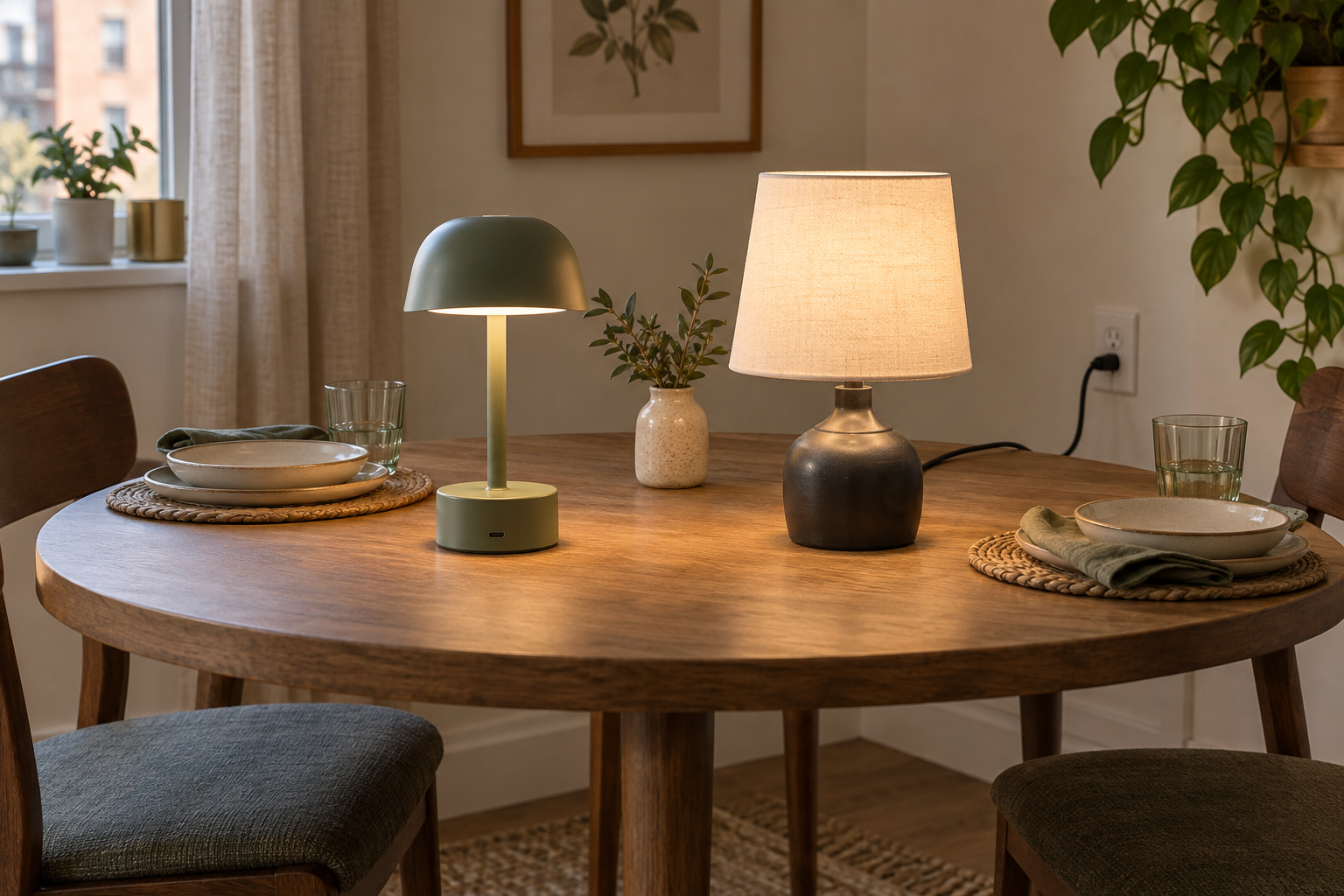
Quick decision before shopping
First measure the available space, identify the setup or surface constraints, and decide who will maintain the item. Skip the category if it blocks access, conflicts with the manufacturer's instructions or lease, or adds more upkeep than the problem justifies.
Compare the power format after mapping the table and outlet: These affiliate category links are shopping starting points, not tested winners.
- Browse category: Compare rechargeable dining table lampsCheck complete dimensions, light direction, charging method, documented runtime basis, battery instructions, stability, and cleaning.
- Browse category: Compare compact plug-in table lampsCheck base and shade footprint, bulb or integrated-light specifications, controls, supplied cord length, stability, and permitted placement.
This is a category comparison, not a judgment about a particular lamp. Verify the current instructions and listing for the exact model, including dimensions, charging equipment, battery warnings, cord length, compatible bulbs, light settings, cleaning, and permitted indoor location.
Quick comparison
| Decision | Rechargeable lamp | Plug-in lamp |
|---|---|---|
| Best fit | No convenient outlet or no safe permanent cord route | Nearby outlet with a protected route for the supplied cord |
| Daily tradeoff | Portable placement, but recurring charging | Steady power, but fixed near its outlet and cord route |
| Output check | Compare brightness and runtime at the same documented setting | Compare integrated light or permitted bulb, shade, and controls |
| Main upkeep | Charging port, cable, battery condition, and storage | Plug, cord, shade, bulb or light source, and outlet access |
| Common skip reason | Charging will be forgotten or the battery is not serviceable enough for the expected use | The cord would cross a walkway, chair path, doorway, or pinch point |
Map the occupied table, not the empty one
Measure the lamp's full base and shade width, then set the table for an ordinary meal. Leave room for plates, glasses, serving dishes, elbows, and the paths people use to sit down. A lamp that fits an empty tabletop may become an obstruction once the nook is occupied.
Check total height and light direction from every seat. The source should illuminate the tabletop without shining directly into diners' eyes or casting a harsh hotspot across one place setting. A broad shade may soften light but occupy more visual and physical space; a narrow downward-facing head saves space but may light only a small circle.
Outlet access usually decides the format
A plug-in lamp makes sense when its manufacturer-supplied cord reaches a sound outlet without stretching, crossing the floor, running beneath a rug, passing through a doorway, or entering a chair's movement path. Keep the plug accessible and follow the lamp's instructions. Do not treat an extension cord as the default plan for permanent dining-nook lighting.
A rechargeable lamp removes the in-use floor cord, but charging still needs a safe location and the specified equipment. Decide whether the lamp can charge away from meals or whether a temporary charging cable can remain completely outside traffic and spill zones. Cordless use changes when the cable appears; do not leave an improvised charging route across the table or walkway.
Stop using an outlet, plug, switch, charger, or cord that is hot, loose, damaged, discolored, sparking, or behaving abnormally. Renters should report fixed-wiring or outlet problems to the property manager; electrical concerns belong with a qualified electrician.
Compare usable light, not a maximum claim
Rechargeable-lamp runtime depends on the tested brightness setting and other documented conditions. Compare runtime only when the basis is stated, then plan around the setting you would actually use. Some battery lamps reduce output as the charge falls; check whether the maker explains dimming, remaining-charge indicators, and behavior while charging.
Plug-in lamps can provide consistent power, but useful light still depends on the permitted bulb or integrated light source, shade, controls, and table position. Confirm bulb base, shape, maximum wattage, and any dimmer compatibility for the exact lamp. Never exceed the marked limit or use a bulb type the instructions do not permit.
Charging chores versus cord management
A rechargeable lamp earns its flexibility only if the household will keep it ready. Estimate how many meals or work sessions occur between charges, choose a repeatable charging spot, and confirm whether the battery can be replaced or serviced under the maker's current policy. Battery aging is a normal ownership consideration, not proof that cordless is a poor choice.
A plug-in lamp avoids charge planning, yet its cord remains part of the room. Check the route whenever the table or chairs move. Use only cord-management methods compatible with the cord, furniture, surface, and instructions; do not tightly pinch, staple, knot, cover, or route a power cord where it can be crushed or heated.
Stability and spill exposure matter for both
Compare base width, total weight, center of gravity, shade overhang, feet, and the actual tabletop. Place either lamp well inside the edge and away from tablecloth pulls. A narrow footprint is useful only if the lamp stays stable during ordinary reaching and place-setting changes.
Neither format should sit where drinks are likely to spill onto controls, charging ports, plugs, sockets, or cord connections. Follow all dry-location and cleaning instructions. Disconnect a plug-in lamp before permitted cleaning. For a rechargeable lamp, follow the maker's shutdown and charging guidance and stop using it if the case, port, cable, or battery area is damaged, swollen, leaking, unusually hot, or otherwise abnormal.
Portability can help—or create more handling
A cordless lamp can move from dinner to homework, a game, or a balcony only when every location is permitted and dry. Frequent carrying also increases opportunities for drops, forgotten charging, and unstable placement. Compare grip points and weight, and carry the lamp only as directed.
A plug-in lamp suits a nook that stays arranged the same way. It is less convenient for a table that folds, rolls, or changes purpose daily. If the lamp must be unplugged and moved constantly, a safely stored rechargeable lamp—or a different room-lighting plan—may create less friction.
Who should choose or skip each format
A rechargeable lamp is the stronger candidate when there is no safe plug-in route, the lamp needs to move between permitted locations, its footprint and glare suit the occupied table, and the charging routine is realistic.
A plug-in lamp is the stronger candidate when a nearby outlet supports a protected cord path, the nook is permanent, dependable output matters more than portability, and bulb or integrated-light specifications are clear.
Skip a rechargeable lamp when documented runtime at a useful setting is unclear, required charging equipment or battery guidance cannot be verified, charging will regularly conflict with meals, or battery upkeep is unwanted. Skip a plug-in lamp when its cord would enter a walking route, chair path, door, rug, pinch point, or other prohibited location.
Skip both when the table is too crowded or unstable, the light creates seated glare, the only outlet is damaged, or the nook needs broader ambient light rather than a tabletop source. A safely placed floor lamp, approved plug-in wall light, or existing overhead fixture may fit better.
Bottom line
A rechargeable lamp buys placement flexibility by adding charging and battery care. A plug-in lamp buys dependable power by tying the light to an outlet and cord route. Measure the fully set table, sit in every chair, and map both the in-use and charging or cord layouts. Choose the format whose routine remains safe and convenient after the novelty wears off.