How to Choose Rechargeable Table Lamps for Dining Nooks
A rechargeable table lamp can add flexible light to a dining nook where an outlet is awkward or a cord would cross the floor. The best fit is a compact, stable lamp that lights the tabletop without shining into diners' eyes—and that has a charging routine you will actually maintain.
As an Amazon Associate, The Good Home Doc may earn from qualifying purchases.
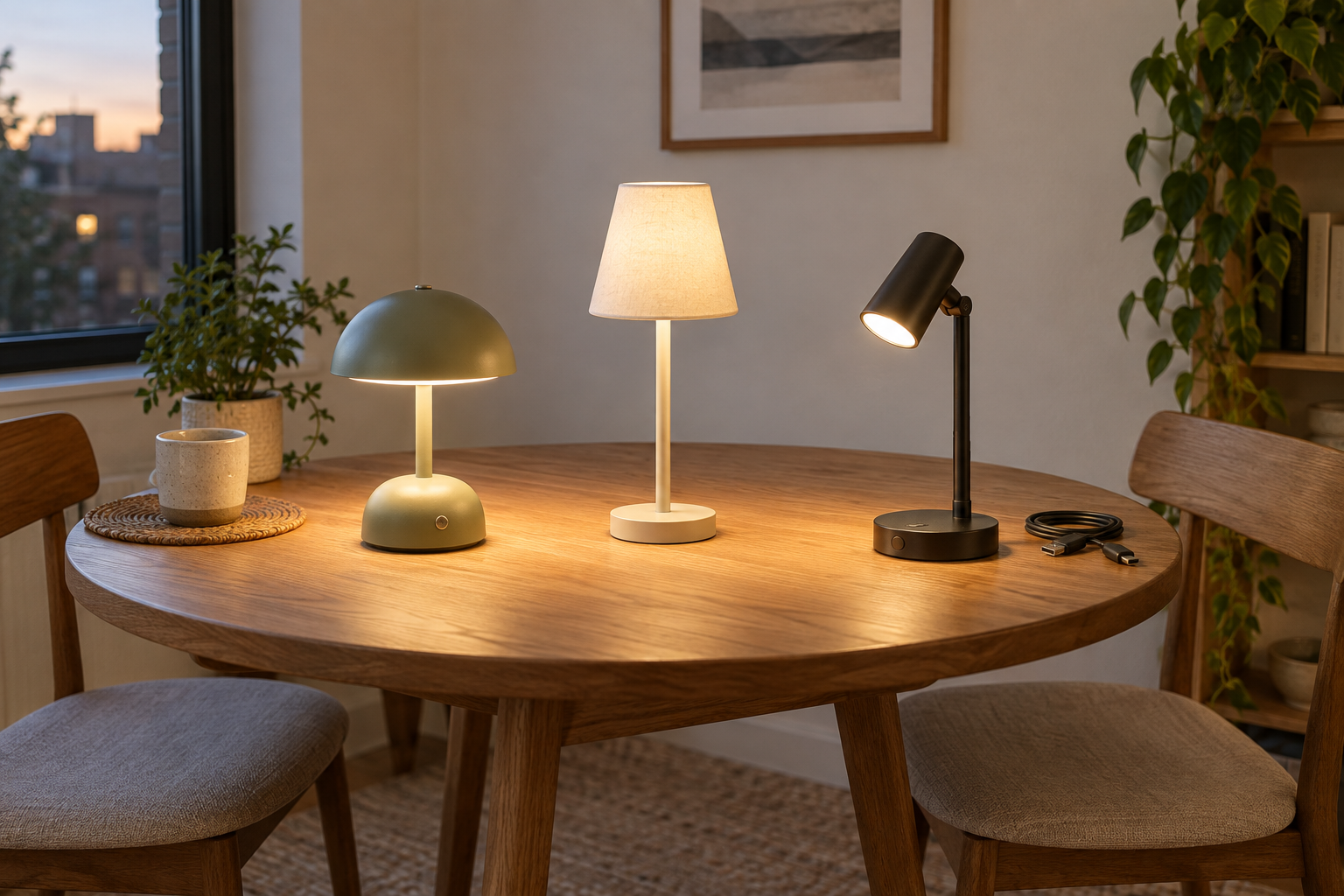
Quick decision before shopping
First measure the available space, identify the setup or surface constraints, and decide who will maintain the item. Skip the category if it blocks access, conflicts with the manufacturer's instructions or lease, or adds more upkeep than the problem justifies.
Compare by table fit first: These affiliate category links are shopping starting points, not tested winners.
- Browse category: Compare rechargeable dining table lampsCheck base width, total height, light direction, controls, charging method, and documented runtime conditions.
- Browse category: Compare compact lamps with stable basesUseful when the nook has a small table or frequent place-setting changes.
- Browse category: Compare adjustable cordless table lampsConsider these when the table also serves as a homework, hobby, or laptop surface.
Verify current dimensions, weight, charging instructions, included cable or adapter, battery and runtime test basis, controls, light settings, permitted placement, cleaning, and damage warnings before buying.
Quick picks by dining-nook problem
| Dining-nook constraint | Best starting format | Main check |
|---|---|---|
| Small round or square table | Short lamp with a compact weighted base | Place settings still fit and the base stays well inside the edge |
| People sit on several sides | Shielded dome or softly diffused shade | The light source is not directly visible at seated eye level |
| Table doubles as a work surface | Adjustable head with controlled beam | It aims at the task without glaring across the table |
| Lamp moves between rooms | Lightweight model with a graspable stem | Its base remains stable despite the lower carrying weight |
| Outlet is safely beside the table | Consider a plug-in lamp instead | A corded model avoids charging and battery aging |
Measure the table after setting it for use
Do not measure an empty table and assume the remaining space is free. Set out the plates, glasses, serving dishes, laptop, homework supplies, or game pieces the nook normally holds. Then mark a lamp zone that leaves room for hands, elbows, hot dishes, and the route used to sit down.
Record the base diameter or width, not just the lamp's overall width. Keep the base fully supported on a level, stable surface and away from the table edge. A narrow pedestal can preserve sightlines, but a tiny base is not automatically stable. Product weight, foot material, center of gravity, and the maker's placement instructions all matter.
Choose light direction before brightness features
For conversation and meals, a shade that directs light downward while shielding the source from seated eyes is often easier to live with than an exposed glowing panel. A softly diffused shade can spread ambient light, while a focused adjustable head is more useful when the table regularly becomes a desk.
Check the lamp's total height against seated eye level and the view across the table. Product photos can hide glare, so look for clear shade dimensions, diagrams, and control descriptions. Dimming and warmer or cooler settings can be helpful, but only after the basic beam shape fits the job.
Read runtime claims in context
Battery runtime is meaningful only with its test setting. A lamp may last much longer on its lowest output than on the setting you would use for dinner or paperwork. Compare documented runtime by brightness level, charging time, battery capacity if stated, charge-status reporting, and what happens as the battery runs down.
Plan from the routine backward: how many evenings will the lamp be used, for how long, and where will it charge? If the answer requires moving furniture, hunting for a cable, or leaving the lamp in a walkway, the cordless convenience may disappear. A replaceable charging cable is helpful only when the connector and power requirements are clearly documented.
Check the controls with the lamp in place
A touch control on top can be convenient in the middle of a table, but it may also be easy to trigger while moving the lamp. A small switch near the base may be hard to find in low light. Confirm how the lamp turns on, cycles through modes, remembers a setting, locks for transport if applicable, and indicates charging.
App control is rarely necessary for a single dining-nook lamp. If a model requires an account, wireless connection, or phone for basic operation, decide whether that extra setup improves the household's routine enough to justify software support and privacy questions.
Treat drinks, cleaning, and charging as separate checks
A dining table is a spill zone. Do not infer water resistance from a metal finish or outdoor-style shape; rely only on the current maker's ingress rating and placement instructions. Keep liquids away from charging ports, cables, and power adapters. If liquid reaches the lamp or the housing, port, cable, or battery area is damaged, stop using it and follow the manufacturer's instructions.
Use the documented cleaning method and allow the lamp to dry as directed before charging. Keep charging equipment away from hot serving dishes and table edges. Do not cover the lamp or charger, substitute an unspecified power supply, or charge where a cable creates a trip or snag route.
Must-have features
- Exact dimensions and weight: Enough information to judge both table footprint and carrying effort.
- Shielded or controllable light: A shade, diffuser, or adjustable head that suits seated use.
- Stable floor contact: A broad base with feet appropriate for the tabletop material.
- Clear charging documentation: Connector, input requirements, charge time, included components, and status indication.
- Runtime tied to settings: A useful basis for comparing the output you expect to use.
- Reachable controls: Simple operation without lifting the lamp or reaching near a hot dish.
Nice-to-have features
Multiple light levels can help a table switch between meals and tasks. A charge indicator reduces guesswork. A removable or commonly available charging cable can simplify replacement when the manufacturer permits it. A carrying grip may help if the lamp travels, while a finish that tolerates the documented cleaning routine is more useful than a decorative surface that shows every fingerprint.
Who should skip a rechargeable table lamp
- Homes with a safe nearby outlet and a permanent lamp location; a plug-in model avoids charging and battery aging.
- Very small tables where the base competes with place settings or serving dishes.
- Busy households where children, pets, tablecloths, or frequent reaching make a portable lamp easy to pull or knock over.
- Anyone who needs dependable whole-room lighting; a small battery lamp is usually an accent or task source, not a ceiling-light replacement.
- People who cannot verify the charging equipment, runtime basis, battery warnings, or permitted placement.
Bottom line
For a dining nook, start with the occupied table footprint, seated glare, and stable placement. Then compare the charging routine and runtime at the light level you will actually use. A compact shielded lamp earns its place when it can stay clear of dishes and edges, recharge without creating a cable problem, and support the nook's real mix of meals and tasks.
If you are still deciding whether cordless lighting is worth the charging routine, first compare a rechargeable table lamp with a plug-in lamp for the dining nook by outlet access, cord routing, steady output, and battery upkeep.