Microfiber Duster vs Lambswool Duster for Furniture and Blinds
Microfiber and lambswool dusters can both handle ordinary dry dust, but the useful difference is not a universal claim about which material “grabs more.” Choose by the head shape you can control, the surfaces and gaps you need to reach, the maker's care instructions, and whether synthetic or animal-derived fibers fit your household preferences.
As an Amazon Associate, The Good Home Doc may earn from qualifying purchases.
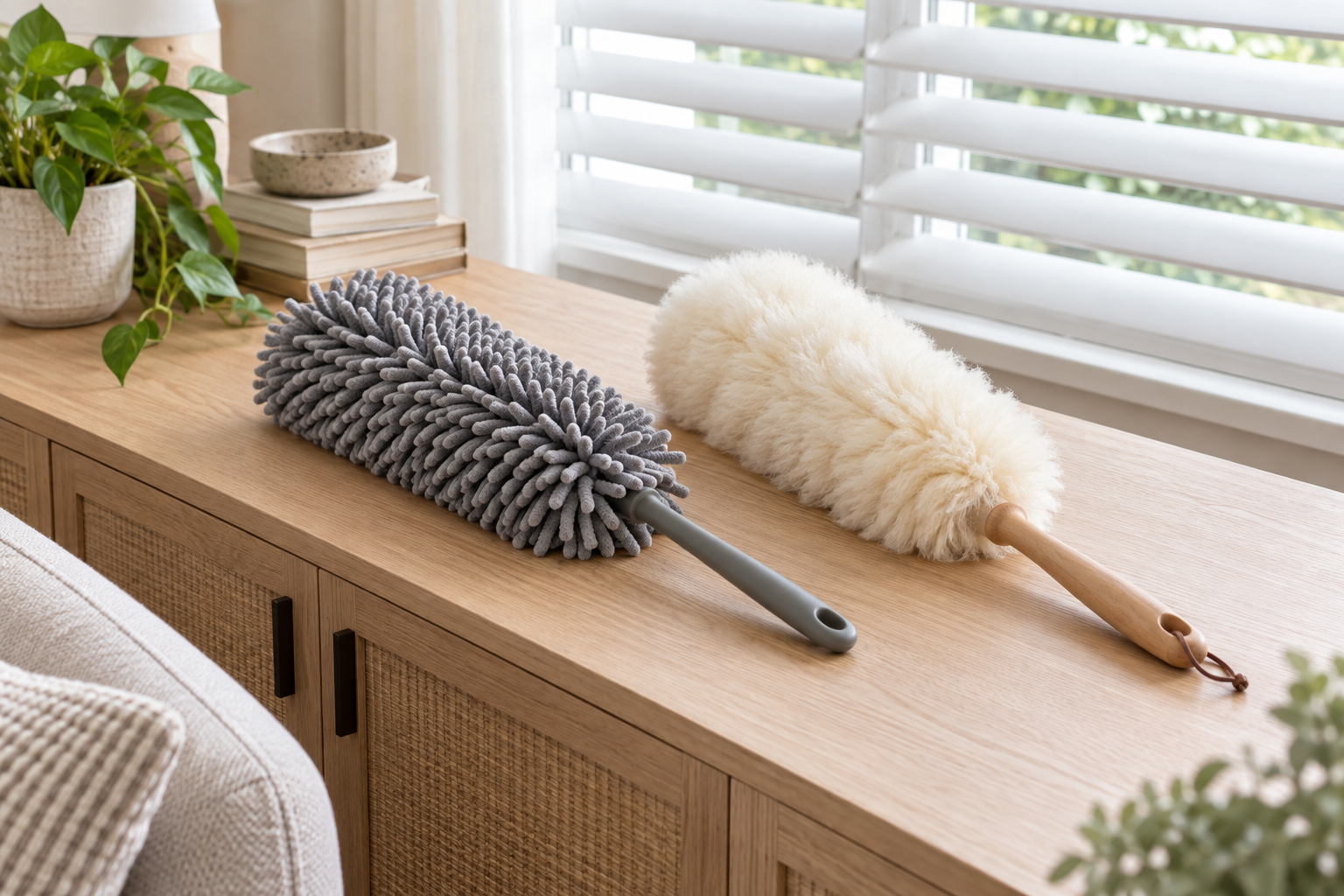
Quick decision before shopping
First measure the available space, identify the setup or surface constraints, and decide who will maintain the item. Skip the category if it blocks access, conflicts with the manufacturer's instructions or lease, or adds more upkeep than the problem justifies.
Compare the complete tool, not the fiber name alone:
- Browse category: Compare washable microfiber dustersCheck the covered-head dimensions, flexibility, handle reach, cover attachment, replacement sleeves, wash method, and drying instructions.
- Browse category: Compare lambswool dustersCheck the stated fiber material, head fullness, handle connection, cleaning method, drying and reshaping directions, and storage needs.
These are category searches, not tested rankings. Confirm current materials, dimensions, intended surfaces, surface exclusions, care directions, replacement parts, warnings, warranty, and return terms before buying.
Quick decision
| Choose | Best fit when | Main tradeoff |
|---|---|---|
| Microfiber duster | You want a removable or washable synthetic cover, a flatter or bendable head, or readily available replacement sleeves | Fiber construction, exposed edges, attachment security, and laundry directions vary by model |
| Lambswool duster | You prefer a full, soft natural-fiber head and are willing to follow its specific cleaning, drying, and reshaping routine | It may need more careful washing and drying, and animal-derived material will not suit every household |
| Different tool | You need a multi-prong blind tool, an ultra-slim gap head, a controlled vacuum brush, or a plain cloth for direct hand control | Job-specific tools add storage or may work more slowly |
Start with the surfaces and route
List the actual jobs before comparing materials: a broad tabletop, narrow trim, sturdy horizontal blinds, lamp shades, or the top of a cabinet each rewards a different head. Measure blind spacing and any furniture gap, then compare those dimensions with the complete covered or fluffed head—not the bare frame.
Check the surface maker's cleaning guidance first, especially for delicate finishes, screens, electronics, artwork, or window treatments. Neither material is automatically safe for every finish. Test a clean tool in a small inconspicuous area and stop if fibers, hard edges, or handle fittings drag against the surface.
Head shape matters more than the label
A microfiber duster may use chenille fingers, a flat sleeve, or a fluffy cylindrical cover. Those shapes do different work. A flat flexible head can pass beneath shallow objects, while a fuller head covers open furniture and trim. Confirm whether bending is permitted and how far; a hidden metal or plastic frame should remain fully covered during use.
Lambswool heads are commonly full and rounded, which can fit open surfaces and irregular trim. Fullness can also make a head too wide for narrow blind spacing or a crowded shelf. Check the working diameter, the way the fibers are secured, and whether the head is replaceable rather than assuming all wool dusters share one construction.
For blinds, control beats speed
Close horizontal slats only as far as their instructions allow and support fragile sections as directed. A single soft head offers deliberate pressure but handles one face at a time. If the slats are sturdy and evenly spaced, a purpose-built multi-prong tool may be quicker than either general duster, provided its prongs and covers actually fit.
Do not force a full lambswool head or thick microfiber cover between narrow slats. Avoid pulling on cords, tilting mechanisms, brackets, or the headrail with the tool. If blinds are loose, damaged, unusually high, or not comfortably reachable from the floor, stop and choose appropriate access or qualified help.
Compare handles and attachment security
Handle length determines reach, but longer is not always easier. A short handle gives better control around objects; an extension pole can reduce control and increase leverage against a fragile surface. Verify the full working and stored lengths, locking method, permitted extension, and whether the head rotates when you do not want it to.
Inspect how the head or cover connects. Threads, clips, elastic openings, and friction fits need different checks. Before each use, make sure the head is secure and that no ferrule, wire, fastener, or frame is exposed. Replace a loose or damaged part rather than wrapping it with an improvised covering.
Care can decide which one stays useful
Microfiber covers may be hand-washable or machine-washable, but detergent, water temperature, fabric softener, bleach, dryer heat, and wash-bag guidance vary. Follow the exact label. Let the cover dry completely before reinstalling or storing it, and keep it separate from items that leave lint if the instructions recommend that.
Lambswool care can require gentle hand cleaning, limited cleaner choices, careful rinsing, reshaping, and air drying away from heat. Do not assume a wool head belongs in a washer or dryer. A household unwilling to follow that routine will usually be happier with a simpler washable cover or cloth.
Think about material preference and replacement
Microfiber is synthetic, while genuine lambswool is animal-derived. That distinction may settle the choice for households avoiding either material. Read the material statement carefully: “wool-like,” blended, and synthetic fluffy heads are not the same as a stated lambswool head.
Check whether replacement heads or sleeves are sold in the exact connection and size, and whether the handle remains useful after the working surface wears out. A reusable tool is less practical if its cover cannot be cleaned thoroughly, takes too long to dry for your routine, sheds noticeably, or has no compatible replacement.
A low-mess dusting routine
- Turn off and let any powered or hot fixture cool; follow its cleaning instructions.
- Remove fragile objects from the route instead of dusting around them.
- Start with a clean, dry, securely attached head.
- Use slow, light passes from higher reachable surfaces toward lower ones.
- Rotate or change the working area when it looks loaded instead of moving dust between surfaces.
- Clean the head exactly as directed and let it dry fully before storage.
This guide is for ordinary dry household dust. Do not use either duster on unknown residue, mold-like growth, pest contamination, wet spills, sharp debris, energized components, hot surfaces, or damaged fixtures.
Who should skip each option?
Skip microfiber if you want to avoid synthetic fibers, the available head exposes hard edges when compressed, the cover does not attach securely, or its required laundry routine conflicts with yours.
Skip lambswool if animal-derived materials do not fit your preferences, the full head cannot enter your cleaning routes, or you do not want its model-specific washing, drying, and reshaping routine.
Skip both general dusters when the job needs a precise detail brush, a fitted blind tool, an ultra-slim gap head, a manufacturer-approved vacuum attachment, or direct control with a clean cloth.
Bottom line
Choose a microfiber duster when a specific washable cover shape, replacement system, and handle fit your surfaces and care routine. Choose lambswool when a full natural-fiber head suits the route and you are comfortable with its stated cleaning and drying needs. Measure the head, inspect every hard edge, and follow the surface and tool instructions; the material name alone does not determine fit or safety.
Next step: Put this decision in context with the home-product buying framework guide.