How to Choose Furniture Dusting Tools for Tight Spaces
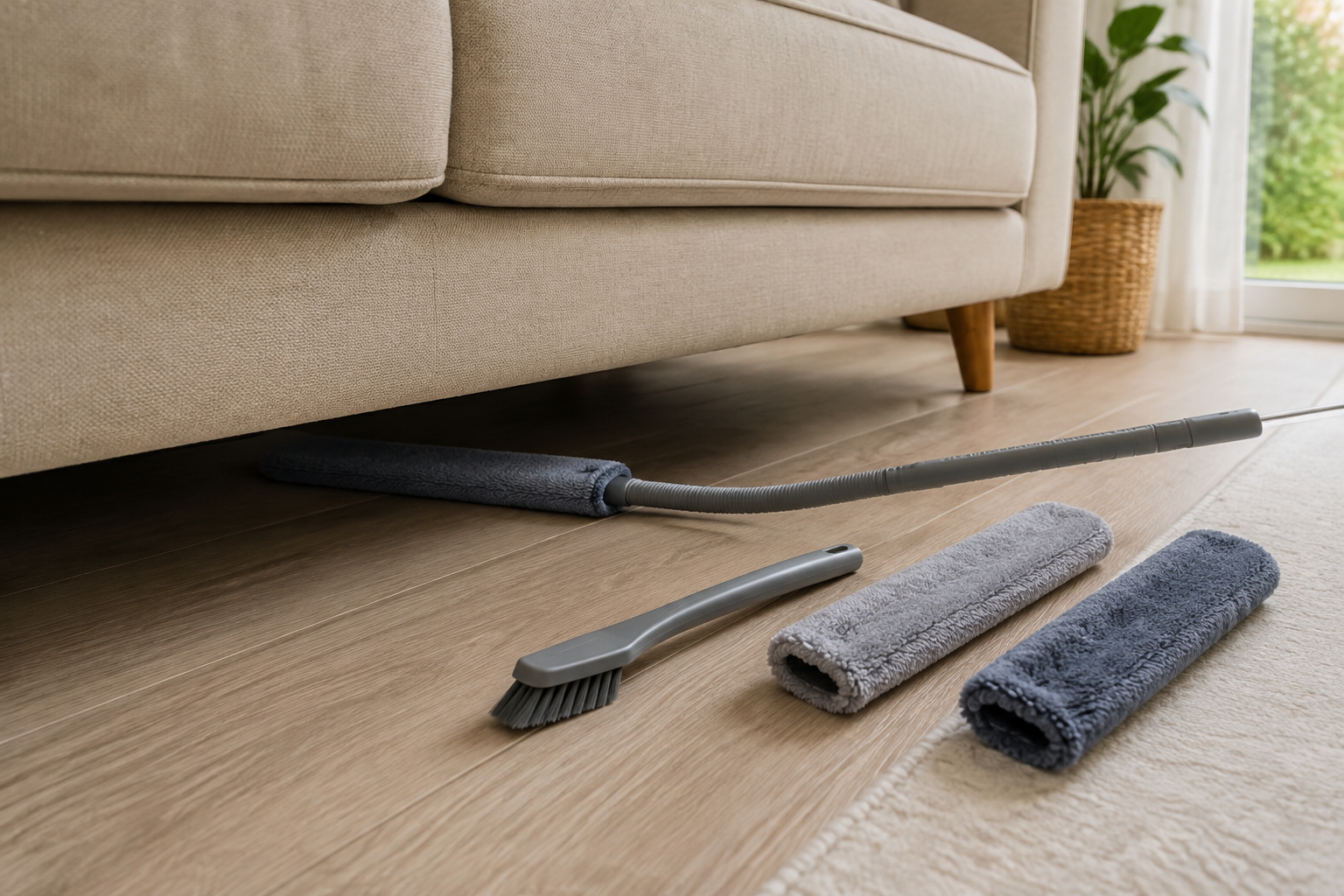
The best tight-space furniture duster is thin enough for the actual gap, long enough to reach its far edge, and soft enough for the nearby floor and finish. A flexible microfiber gap duster fits most low sofas and beds; a narrow crevice brush gives better control beside legs, along edges, and in short vertical gaps.
As an Amazon Associate, The Good Home Doc may earn from qualifying purchases.
Quick decision before shopping
First measure the available space, identify the setup or surface constraints, and decide who will maintain the item. Skip the category if it blocks access, conflicts with the manufacturer's instructions or lease, or adds more upkeep than the problem justifies.
Start with the gap: These affiliate category links are shopping starting points, not tested brand rankings.
- Browse category: Slim microfiber gap dustersFor broad, low-clearance spaces beneath sofas, beds, and cabinets.
- Browse category: Flexible furniture dusting wandsFor routes that bend around a rail, leg, or shallow obstruction.
- Browse category: Narrow crevice brushesFor short side gaps where a broad microfiber head cannot turn.
Measure the smallest gap and full reach first. Confirm covered-head thickness, working width, handle length, bend limits, cover attachment, replacement availability, and wash instructions.
This guide covers ordinary dry household dust and reachable debris around intact furniture. It does not cover pest residue, mold-like growth, sharp broken parts, unknown spills, appliance interiors, or spaces near electrical connections. Do not move or tilt heavy furniture alone merely to use a cleaning tool. Kitchen appliances add distinct heat, clearance, connection, and access limits, so use the under-appliance cleaning tool guide for that job.
Measure the Route, Not Just the Opening
Measure the narrowest vertical clearance beneath the furniture, then the distance from the accessible edge to the farthest area. A head that enters can still stop at a center rail, support, reclining mechanism, rug edge, or crossbar. Check the approach angle too: a rigid handle needs open floor behind you, while a flexible wand may enter from the side.
Look beneath the furniture with a flashlight before inserting anything. Keep tools clear of loose cords, moving mechanisms, floor vents, and delicate rug fringe.
Quick Picks by Gap Type
- Broad space beneath a sofa or bed: a flat microfiber head with a securely attached washable sleeve.
- Route interrupted by rails: a controlled flexible wand with no exposed edge.
- Narrow side gap: a slim crevice brush that can be withdrawn without snagging.
- Delicate hard floor: a fully covered head with no wire, staples, seams, or hard corners.
- One short reachable gap: a clean microfiber cloth may make a dedicated tool unnecessary.
Compare the Main Formats
Flat Microfiber Gap Dusters
A broad, low-profile head collects dust over more floor area per pass. Choose one for straight, unobstructed runs when the complete covered-head thickness clears the gap. Watch for loose sleeves, exposed edges, heads too wide to pass furniture feet, and handles shorter than the furniture depth.
Flexible Dusting Wands
A bendable core can follow a shallow curve or work around an obstruction. Choose one when a rigid head cannot align with the gap. Avoid uncontrolled spring-back, exposed internal wire, sharp bends that weaken the frame, and fluffy heads that compress dirt without collecting it.
Narrow Crevice Brushes
A narrow brush gives precise contact beside legs and in short vertical spaces. Check that its bristle material suits the nearby surface. Avoid stiff bristles on delicate finishes, hard ferrules extending past the bristles, and designs that only push dust deeper.
Vacuum Crevice Attachments
A compatible attachment collects debris immediately, but hose diameter, nozzle thickness, and furniture clearance limit fit. Use one only when the nozzle connects securely and the area is dry and known. Hard nozzles can scrape floors, and suction can catch cords or lightweight items.
Must-Have Features
- Verified working thickness: use the covered-head measurement, not an “ultra slim” label.
- Enough usable reach: reach the far edge without crawling beneath or shifting heavy furniture.
- Covered contact points: no hard corner, wire, or fastener should touch the floor or furniture.
- Secure washable cover: it should stay attached during withdrawal and come off cleanly for washing.
- Controlled flex: a flexible head should hold a useful shape without sharp kinks.
Nice-to-Have Features
- Replacement sleeves in a documented size.
- A hanging loop or short collapsed storage length.
- A sleeve texture that visibly holds dust.
- A removable head that can dry completely after washing.
A Practical Routine
- Use a flashlight to identify obstructions, cords, mechanisms, spills, and sharp objects.
- Measure the narrowest clearance, route depth, and side-to-side opening.
- Start with a clean, dry cover and a short test pass.
- Use slow overlapping strokes toward the opening.
- Collect visible debris with an appropriate vacuum or dustpan instead of sweeping it into another gap.
- Wash the sleeve as directed and let it dry completely.
Who Should Skip a Dedicated Gap Duster
Skip one when a washable cloth or existing vacuum attachment reaches comfortably. Also skip a broad flexible head when the route contains exposed mechanisms, dense cords, delicate fringe, or obstructions you cannot see clearly.
Stop if access requires moving heavy furniture alone, entering an appliance cavity, working near damaged wiring, or disturbing pest residue, damp material, mold-like growth, broken glass, or an unknown spill.
Bottom Line
For a broad straight gap beneath a sofa or bed, start with a fully covered flat microfiber duster whose thickness and reach match your measurements. Choose a flexible wand only when the route needs a bend, and a narrow crevice brush for precise side gaps. Cleanable covers, controlled edges, and honest dimensions matter more than a large attachment bundle.
Next step: Put this decision in context with the home-product buying framework guide.