Is a Towel Warmer Worth It for a Small Bathroom?
A compact towel warmer can be worth it when warming a dry towel is a frequent comfort priority and the exact appliance has a stable, permitted location with a workable outlet and cord route. It is usually not worth giving up scarce floor space when better towel hanging, faster laundry turnover, or ordinary room-comfort changes solve the real problem.
As an Amazon Associate, The Good Home Doc may earn from qualifying purchases.
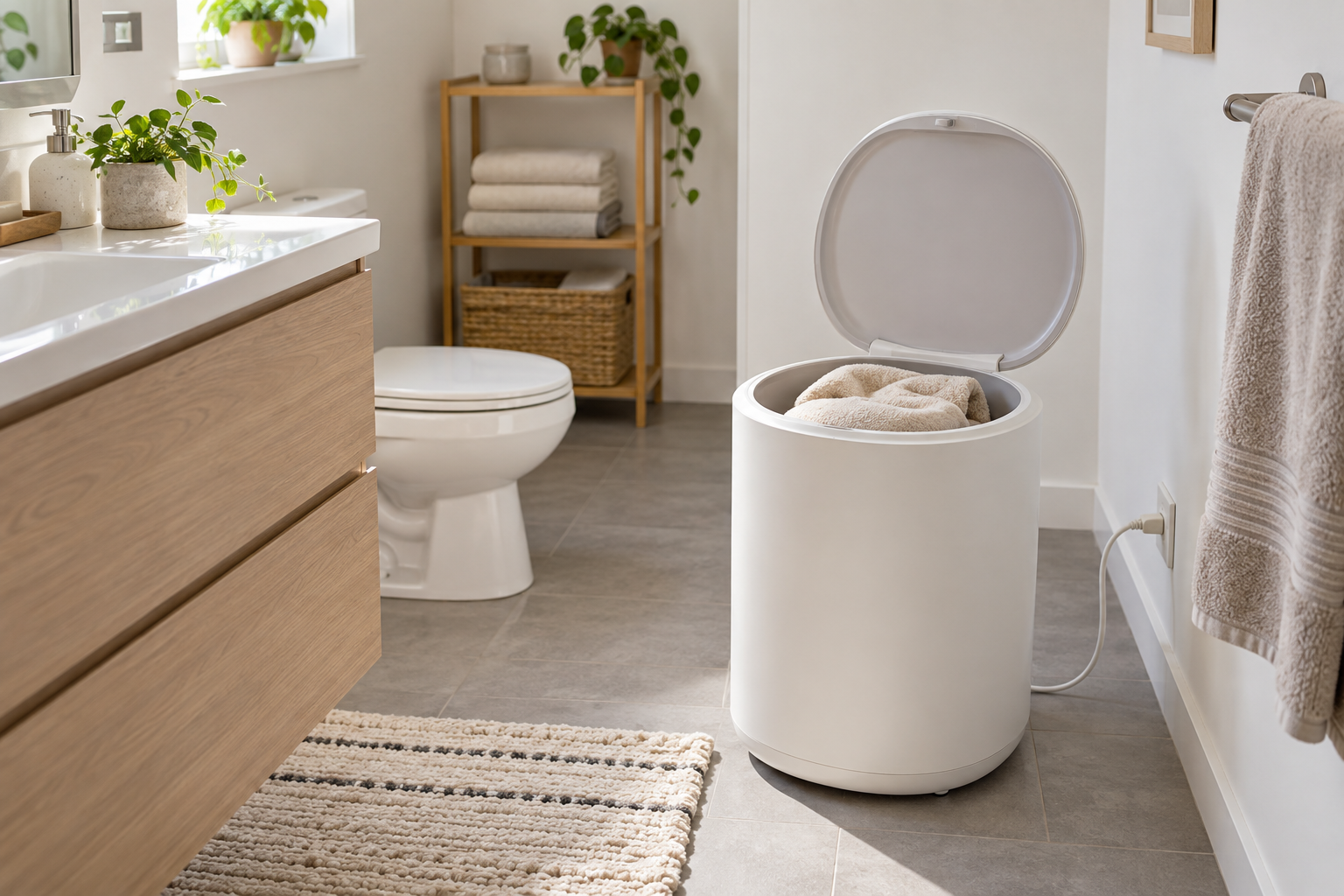
Quick decision before shopping
First measure the available space, identify the setup or surface constraints, and decide who will maintain the item. Skip the category if it blocks access, conflicts with the manufacturer's instructions or lease, or adds more upkeep than the problem justifies.
Compare only after mapping the room: This affiliate category link is a shopping starting point, not a tested ranking or a claim that every appliance is suitable for bathroom placement.
- Browse category: Compare compact bucket-style towel warmersVerify current dimensions, clearances, capacity, cord and outlet instructions, cycle and shutoff behavior, permitted textiles, cleaning, storage, and bathroom-placement restrictions.
This is a category decision guide, not electrical, installation, fire-safety, textile-care, or building-code advice. Follow the current instructions for the exact warmer, towel, outlet, and room. Do not assume a portable appliance is approved for every bathroom location. If an outlet, plug, cord, or breaker is loose, hot, damaged, discolored, buzzing, sparking, or repeatedly tripping, stop and contact the property manager or a qualified electrician.
Quick answer
- Probably worth it: one or more people will use it often, the normal towel load fits, and the closed appliance plus lid path and cord can stay in a stable dry location outside walking and door routes.
- Measure first: the bathroom is tight, the outlet is inconvenient, towels are bulky, or the warmer would need to move before and after every use.
- Probably skip it: the real problem is slow towel drying, room chill, persistent dampness, a missing towel bar, or any placement that conflicts with the product instructions.
Separate warming from drying
A warmer and a drying setup do different jobs. A bucket-style warmer is meant to warm compatible dry textiles as its instructions describe; it should not be assumed to dry a wet bath towel, manage bathroom humidity, sanitize fabric, or replace laundering. If towels stay damp between showers, improve the hanging space, spacing, ventilation routine, and laundry turnover first.
Persistent condensation, musty odor, staining, visible growth, an active leak, or a fan that does not work properly calls for a landlord or qualified professional—not another countertop or floor appliance. Likewise, a towel warmer changes the towel experience, not the bathroom’s air temperature.
Test whether the routine earns the footprint
For a week, note how often a warmed towel would actually be used and who would load and empty the appliance. Then mark its listed footprint on the floor with paper or removable tape. Include the lid at its widest point, ventilation clearances, control access, cord connection, and the space needed to load a towel without leaning over another fixture.
A unit that must be carried from a closet, positioned, plugged in, cooled, cleaned, unplugged, and stored for each shower may add more work than comfort. Count storage space too: the lid and cord should not be crushed, and the appliance needs to be clean, dry, and stored as its maker directs.
Check towel fit, not just stated capacity
Count the textiles used in one normal cycle and compare their size and material with the warmer’s instructions. Thick bath sheets occupy more space than hand towels. Do not compress fabric into the chamber, overload it, or add objects, liquids, oils, fragrances, sprays, or damp textiles unless the exact manual expressly permits them.
Read the care label on every textile. Decorative trim, fasteners, elastic, foam, rubber backing, heat-sensitive finishes, and non-textile inserts may change what is suitable. When either the towel label or appliance instructions are unclear, leave that item out and ask the manufacturer rather than improvising.
Plan placement, outlet, and cord as one system
Start with the warmer’s own bathroom-use and placement restrictions. Measure the route from the appliance to the permitted wall outlet without using an extension cord, power strip, adapter, or a cord beneath a rug unless the manufacturer specifically allows that arrangement. Keep the cord out of door swings, drawers, cleaning routes, and places where someone can pull, pinch, trip over, or wet it.
The appliance needs a stable, level surface and every stated clearance. It should not crowd the toilet, block a cabinet, narrow the exit path, or sit where a towel, shower curtain, bath mat, child, or pet can interfere with it. Renters should not alter an outlet or make a permanent electrical change; placement or outlet questions belong with the property manager or a qualified electrician.
Must-haves versus nice-to-haves
Must-haves: a complete current manual; dimensions for the base, body, lid path, and cord; clear permitted-use and textile rules; controls the intended user can operate; documented cycle and shutoff behavior; cleaning instructions; a stable location; and sensible return terms.
Nice-to-haves: an easy-lift lid, handles permitted for moving a cool unplugged unit, a removable basket when documented, cord storage that does not strain the cord, and simple controls. Treat fragrance discs, “spa” language, large capacity, and fast-warming claims as secondary to fit and instructions.
Compare the simpler alternatives
| Option | Best fit | Main tradeoff |
|---|---|---|
| Bucket-style towel warmer | Frequent dry-towel warming with safe floor space | Footprint, cord, cycle planning, cleaning, and storage |
| Better towel rack | Towels stay folded or crowded and dry slowly | Needs measured hanging space and a suitable mount |
| Extra towel rotation | A clean dry towel is the priority | More laundry and linen storage |
| Ordinary robe or larger dry towel | The goal is simple post-shower comfort | No powered warming |
| Room or building fix | The bathroom is persistently cold, damp, or poorly ventilated | May require landlord or qualified professional involvement |
Cleaning and inspection are ownership costs
Check how the chamber, lid, basket, controls, exterior, and cord are cleaned. Never immerse an appliance or apply a cleaning product unless its instructions permit it. Let the unit cool, unplug it, and follow the specified cleaning and drying sequence. A towel that sheds heavily can leave lint that needs regular removal.
Inspect the lid, hinges, interior, feet, plug, and full cord as directed. Stop using the warmer if it is damaged, has been wet contrary to its instructions, smells unusual, operates differently, or no longer sits securely. Do not open the housing or attempt an electrical repair.
Who should skip a towel warmer?
- A household mainly trying to dry damp towels, reduce humidity, warm the room, or correct a building problem.
- A bathroom without a documented permitted location and direct outlet route for the exact model.
- Anyone who would need to cross a walkway, doorway, wet area, or pinch point with the cord.
- Households where children, pets, or room users could tip, climb on, open, pull, or interfere with the appliance.
- People whose towels or desired add-ins are not expressly allowed by both textile and appliance instructions.
- Anyone unlikely to use it often enough to justify the permanent footprint, cleaning, inspection, and storage.
Bottom line
A towel warmer is worth considering for a narrow comfort job: warming compatible dry towels for a household that will use it regularly. The decision depends less on promotional capacity than on the complete bathroom footprint, lid clearance, towel load, permitted location, direct cord route, cleaning, and storage. If drying, hanging space, room temperature, or persistent moisture is the real issue, solve that problem first and skip the extra appliance.