How to Choose Towel Warmers for Small Bathrooms
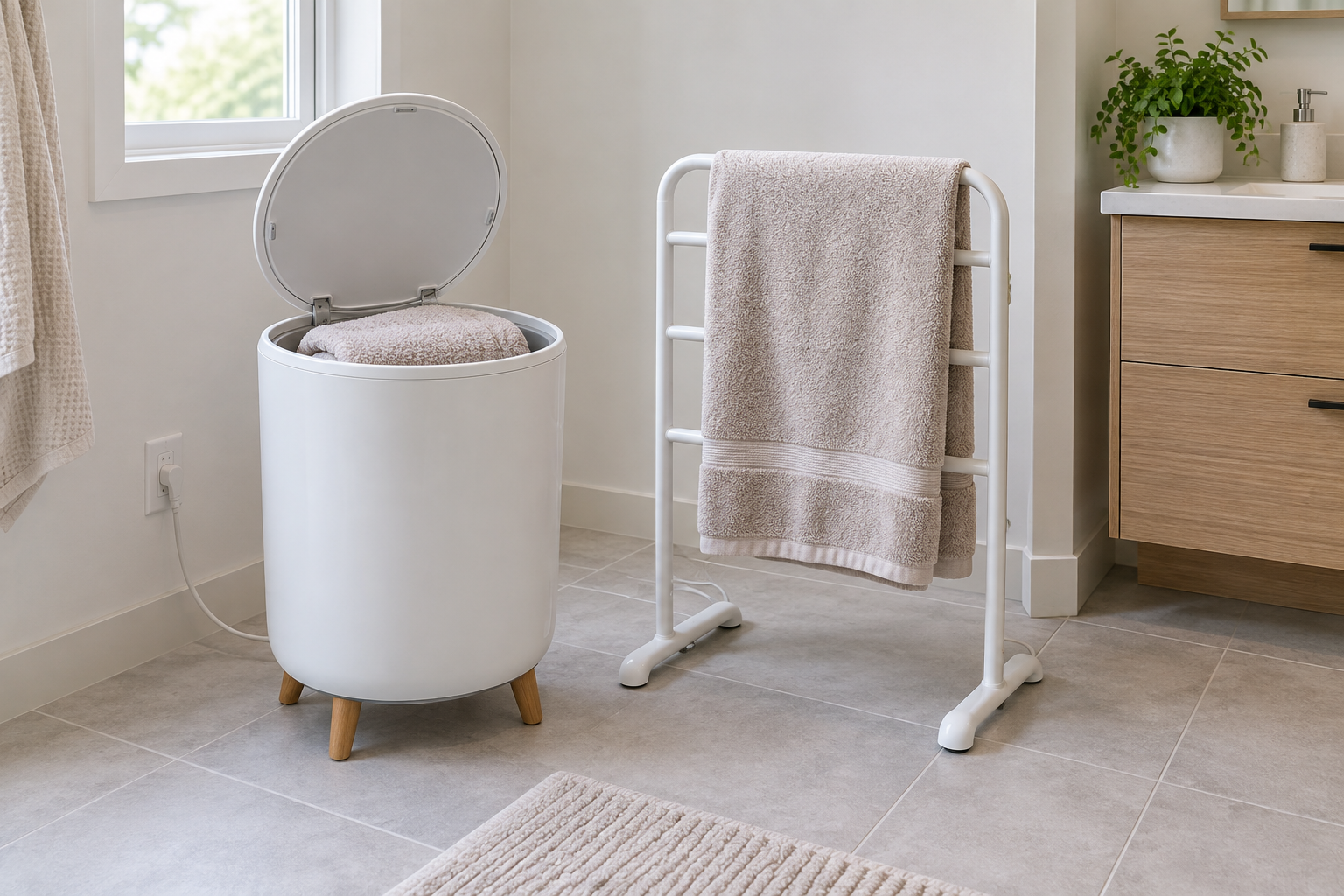
The best towel warmer for a small bathroom is the format that fits one normal towel load, has a stable location explicitly permitted by its instructions, and reaches a suitable wall outlet without putting the cord in a wet or walked-through area. Bucket models concentrate on warming folded dry textiles; freestanding racks keep towels hanging but require a different footprint and placement plan. Neither format should be treated as a towel dryer, room heater, or permanent bathroom fixture.
As an Amazon Associate, The Good Home Doc may earn from qualifying purchases.
Quick decision before shopping
First measure the available space, identify the setup or surface constraints, and decide who will maintain the item. Skip the category if it blocks access, conflicts with the manufacturer's instructions or lease, or adds more upkeep than the problem justifies.
Start with the format that fits the measured room: These affiliate category links are comparison starting points, not tested winners.
- Browse category: Compare compact bucket towel warmersCheck the complete base, lid path, usable textile capacity, permitted location, controls, cord instructions, cleaning, and storage.
- Browse category: Compare freestanding plug-in towel-warmer racksVerify assembled dimensions, stable placement, bar spacing, permitted textile contact, cord route, controls, care, and any assembly requirements.
Verify every current claim in the product manual before buying. A portable product is not automatically approved for every bathroom location, and this guide excludes hardwired and wall-mounted installation.
This is product-category guidance, not electrical, installation, fire-safety, textile-care, or building-code advice. Follow the instructions for the exact warmer, textiles, outlet, and room. Do not alter wiring or mount a product that requires installation based on this article. If an outlet, plug, cord, or breaker is damaged, loose, hot, discolored, buzzing, sparking, or repeatedly tripping, stop and contact the property manager or a qualified electrician.
Choose the format before the features
| Format | Best fit | Main tradeoff |
|---|---|---|
| Bucket-style warmer | One compact floor location and folded compatible dry towels | Lid clearance, loading, chamber care, and between-use storage |
| Freestanding rack warmer | A measured wall-side area where compatible towels can hang | Wider or taller occupied space, exposed bars, assembly, and cord placement |
| Hardwired or wall-mounted warmer | A professionally planned permanent installation | Outside this guide; electrical, wall, lease, and code requirements need qualified review |
A bucket is usually the simpler shopping comparison when the goal is to warm a folded towel shortly before use and there is a permitted dry floor location. A freestanding plug-in rack may fit a household that prefers towels to remain hanging and has suitable open wall-side space. Do not assume that a rack is intended to dry wet towels or that a bucket accepts damp textiles, robes, blankets, oils, fragrance products, or other items; the current manual controls.
Measure the complete occupied space
Mark the product's listed width and depth on the floor with paper or removable tape. For a bucket, include the widest lid position, control access, ventilation clearance, and the space needed to lift and fold a towel. For a rack, mark the full feet, frame height and width, towel overhang, control location, and any clearance required from walls or fixtures.
Then test the room with the door, vanity drawers, shower door or curtain, toilet area, cabinet doors, bath mat, hamper, and normal walking route in use. The warmer should not narrow the exit route, sit where it can be splashed, or require someone to step over its cord. Product photos rarely show this complete working envelope.
Match the normal towel load
Count the towels one cycle actually needs to serve, then compare their dimensions, thickness, construction, and care labels with the warmer instructions. A bulky bath sheet can consume more usable space than a standard bath towel. A rack also needs enough bar length and spacing for the towel to hang as directed without bunching against controls, feet, walls, or the floor.
Do not shop by a vague capacity label alone. Look for a usable chamber or bar arrangement and explicit textile limits. Decorative trim, elastic, fasteners, foam, rubber backing, heat-sensitive finishes, and non-textile inserts may change suitability. When the warmer manual and textile label do not clearly support the intended combination, skip it or ask the manufacturers.
Plan the permitted outlet and cord route
Read the warmer's bathroom-use and placement restrictions before choosing a location. Confirm that its cord reaches a permitted wall outlet in the normal setup without an extension cord, power strip, adapter, cord beneath a rug, or tension at the plug unless the manufacturer explicitly allows that arrangement. Measure the actual route rather than relying on the listed cord length alone.
Keep the cord away from doors, drawers, cleaning paths, water, hot surfaces, and places where a person, child, or pet could pull, pinch, chew, or trip over it. A longer cord is not automatically better in a small room. Renters should not change an outlet or create a permanent mount; placement questions belong with the property manager or a qualified electrician.
Controls should fit the routine
Compare the documented cycle options, control sequence, indicators, and shutoff behavior. The intended user should be able to read and operate the controls without reaching behind a hot, crowded, or unstable product. If a product has delayed start, memory, app control, or several modes, check what happens after a power interruption and whether those extras genuinely simplify the routine.
Treat warming-speed language cautiously unless the maker states the test basis and it matches the intended towel load and room conditions. A timer or automatic shutoff does not remove the need to follow loading, placement, supervision, cooling, unplugging, and inspection instructions.
Separate must-haves from nice-to-haves
Must-haves
- A complete current manual with clear permitted location, textile, loading, operating, cooling, and cleaning instructions.
- Dimensions for the entire working setup, including the bucket lid or rack feet and towel overhang.
- A stable location and direct cord route that do not conflict with the bathroom's wet areas or walking path.
- Controls and documented cycle behavior that fit the household's actual routine.
- A realistic place to keep or store the cooled, clean product between uses.
Nice-to-haves
- An easy-to-handle lid or clearly spaced rack bars.
- A removable basket or other part only when the manual explains its use and cleaning.
- Simple cord storage that does not kink or strain the cord.
- Handles that the maker permits for moving a cool, unplugged appliance.
Cleaning and storage are part of the price
Check access to the bucket chamber, lid, basket, rack bars, feet, controls, exterior, plug, and cord. Follow the maker's cooling and unplugging sequence before care. Do not immerse the product or apply a cleaner unless its instructions allow it. Lint, dust, hair products, and bathroom residue can turn an awkward-to-clean design into a poor fit.
Inspect the warmer as directed and stop using it if the housing, bars, lid, feet, plug, or cord are damaged; if it has been wetted contrary to its instructions; or if it smells or operates differently. Store it only after it is cool, clean, and dry, with the cord protected rather than wrapped tightly.
Who should skip a towel warmer?
- Anyone mainly trying to dry damp towels, reduce humidity, heat the room, or correct a ventilation or building problem.
- Bathrooms without a stable, permitted dry location and direct outlet route for the exact product.
- Households where the product or cord would crowd a doorway, fixture, walking route, child, or pet.
- People whose desired towels or add-ins are not clearly permitted by both the textile label and appliance instructions.
- Renters considering permanent mounting, new wiring, or an outlet change without property approval and qualified help.
- Anyone unlikely to use the warmer enough to justify its footprint, loading, cooling, cleaning, inspection, and storage.
Bottom line
Choose a bucket-style towel warmer when folded dry-towel warming is the specific job and a compact permitted floor location works. Choose a freestanding plug-in rack only when its larger hanging footprint, towel contact rules, assembly, and cord route all fit the room. In either case, measurements and the current manual matter more than capacity slogans or spa-style extras. If the real problem is damp towels or a cold, humid bathroom, improve the hanging routine or involve the property manager or an appropriate qualified professional instead.