Is a Microwave Splatter Cover Worth It?
A reusable microwave splatter cover can be worth it when uncovered reheating regularly leaves sauce or grease on the microwave walls and you will wash, dry, and store the cover after use. Skip it when your existing microwave-safe plate cover already works, the cover will not clear your usual dishes, or one more bulky item will sit unused.
As an Amazon Associate, The Good Home Doc may earn from qualifying purchases.
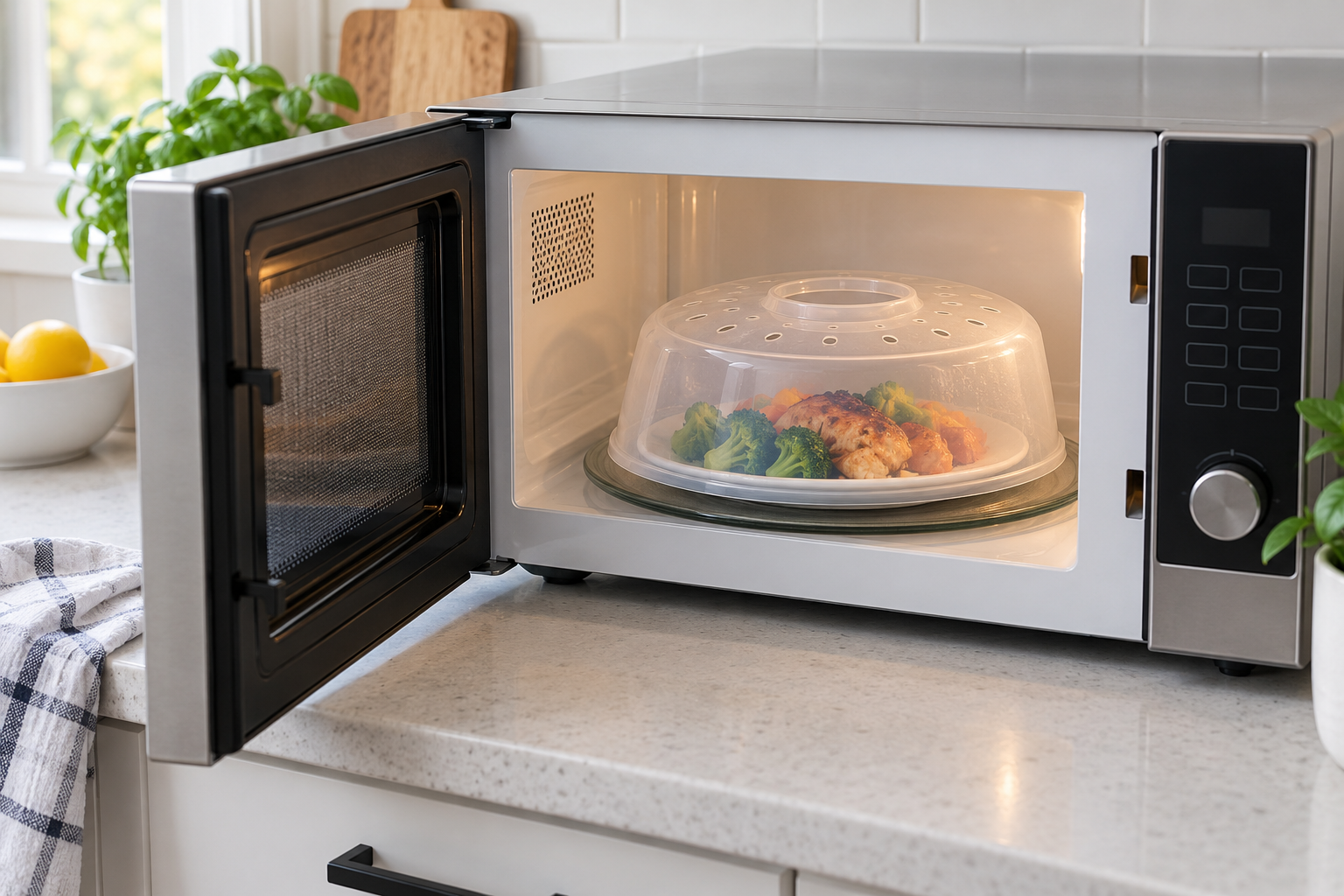
Quick decision before shopping
First measure the available space, identify the setup or surface constraints, and decide who will maintain the item. Skip the category if it blocks access, conflicts with the manufacturer's instructions or lease, or adds more upkeep than the problem justifies.
Shop only after measuring the microwave and your usual dishes: this is a category route, not a tested winner.
- Browse category: Compare reusable vented microwave splatter coversConfirm current exterior dimensions, usable interior height, material documentation, vent design, handle guidance, microwave and dishwasher instructions, excluded uses, and return terms.
This guide answers whether the category fits your routine. It does not rank models or claim that a cover prevents every splatter, makes food safer, protects against steam, or is compatible with every microwave, dish, food, or cooking mode. Follow the current instructions for the microwave, dish, food, and cover.
Quick answer
Buy one when you reheat splatter-prone food often, your most-used plates fit beneath a documented microwave-compatible vented cover, the assembled cover clears the microwave interior while the turntable rotates, and washing it is easier than wiping the cavity.
Delay until you measure the plate, cover, turntable, and usable height and decide where the clean, dry cover will live.
Use an alternative when a compatible microwave-safe plate or another method specifically permitted by the microwave and food instructions already covers the dish adequately.
Skip it if the product documentation is unclear, the cover crowds the food or microwave walls, you frequently use modes the cover does not permit, or the cleanup and storage routine adds more friction than it removes.
Start with the mess you actually make
For a week, note what you reheat, which dishes create residue, and how much cleanup follows. A cover makes a stronger case for frequent sauce, soup, or oily-food splatter than for occasional gentle warming. It cannot replace a suitable dish, correct fill level, or the appliance and food instructions.
If the microwave needs a quick wipe only once in a while, an item that must be washed and stored after every use may not reduce the total chore. If residue repeatedly dries on the ceiling and walls, a cover that fits the routine may shift cleanup to one removable item.
Measure four things before shopping
- Usual plate or bowl: measure its widest point and its height with a normal portion.
- Cover exterior: compare the full diameter and height—not just the advertised plate size—with the appliance interior.
- Usable space: confirm the turntable and cover can rotate without touching walls, door, rack, sensor, or interior fittings.
- Food clearance: leave the spacing required by the cover and food instructions rather than letting the cover rest on the food.
Collapsible covers also need measurements in both working and stored positions. A folding mechanism saves space only if it stays in the permitted operating position and can dry completely before it is collapsed or put away.
Vents and handles are instructions, not decorations
Choose only a cover documented for microwave use, and follow its vent-position and power or time limits. A visible vent does not establish compatibility with every food or program. Do not block vents, seal the dish unintentionally, or use the cover with convection, grill, browning, combination, or other modes unless the product and appliance instructions explicitly allow that use.
A top grip can help with placement, but it is not proof that the cover remains cool or that steam will be harmless. Let food stand as directed, keep your face and hands away from escaping vapor, and lift the cover in the direction and manner specified by its maker. Use appropriate protection when the instructions call for it.
Compare the real alternatives
| Option | Best fit | Main tradeoff |
|---|---|---|
| Rigid vented cover | Frequent reheating with enough fixed cabinet or drawer space | Simple shape, but the full volume always needs storage |
| Collapsible vented cover | Tight storage where the mechanism is easy to open, clean, and dry | Folds smaller but adds seams and moving folds to maintain |
| Compatible microwave-safe plate | An occasional cover when the appliance and dish instructions permit it | Uses something already owned but may be heavier or awkward to lift |
| Compatible vented lid | Reheating in a container with a matching lid and documented vent position | Tied to that container system and its instructions |
| Immediate cavity wipe | Infrequent light splatter | No extra product, but residue must be addressed promptly |
Cleaning and storage decide whether it lasts in the routine
Check whether every surface, vent, seam, and collapsible fold is reachable. “Dishwasher safe” is incomplete without the maker's rack placement, cycle, heat, and drying instructions. Hand-wash-only designs need a brush or cloth that reaches the vents without damaging them.
Let the cover dry fully as directed before storing it. Measure the cabinet, drawer, appliance-top, or vertical slot you plan to use, and keep the cover away from heat and any ventilation clearance the microwave requires. The inside of the microwave is not storage unless the appliance instructions expressly say otherwise—and anything stored there must be removed before operation.
Must-have features
- Clear microwave-use instructions and material identification.
- Exterior dimensions and usable interior clearance that fit your actual plate and food.
- A documented vent arrangement you can operate correctly.
- A grip or lifting method with explicit handling guidance.
- Cleaning access for the vents, underside, rim, and any folding seams.
- A realistic place to dry and store the complete cover.
Nice-to-have features
- A transparent body that lets you view the food without lifting the cover.
- A shape that nests with your common plates after it is clean and dry, when permitted.
- Dishwasher instructions that match the cycles and rack space you actually use.
- A collapsible profile when storage is the deciding constraint and the folds remain easy to inspect.
Red flags
- The listing says “universal” but does not provide complete dimensions or excluded modes.
- Microwave use, vent position, temperature limits, or cleaning instructions are missing or contradictory.
- The cover touches the food, walls, door, rack, or interior fittings during a test fit.
- The handle or vent requires reaching through visible steam without clear guidance.
- Grease or food residue collects in seams that cannot be opened, reached, or dried.
- The product makes broad food-safety, chemical-safety, burn-prevention, or total splatter-prevention claims without precise documentation.
Who should skip a microwave splatter cover?
- People who rarely create microwave residue and can wipe it promptly.
- Households whose usual tall bowls or wide plates leave inadequate clearance.
- Anyone who will not wash and dry the cover according to its instructions.
- Users who need a one-handed or low-force solution but cannot safely lift the documented cover; seek an appropriate setup rather than assuming any handle is accessible.
- People whose microwave or cooking modes exclude the product.
- Anyone dealing with a damaged, sparking, smoking, unusually noisy, or malfunctioning microwave; stop using it and follow the maker's service guidance instead of adding an accessory.
Bottom line
A microwave splatter cover is worth it when frequent residue makes cavity cleaning a recurring chore and one measured, vented, documented cover is genuinely easier to wash, dry, and store. Measure the complete working setup and read both manuals first. If your mess is occasional or a permitted cover you already own does the job, skip the extra product.
Next step: Put this decision in context with the home-product buying framework guide.