Is a Countertop Dishwasher Worth It for a Rental Kitchen?
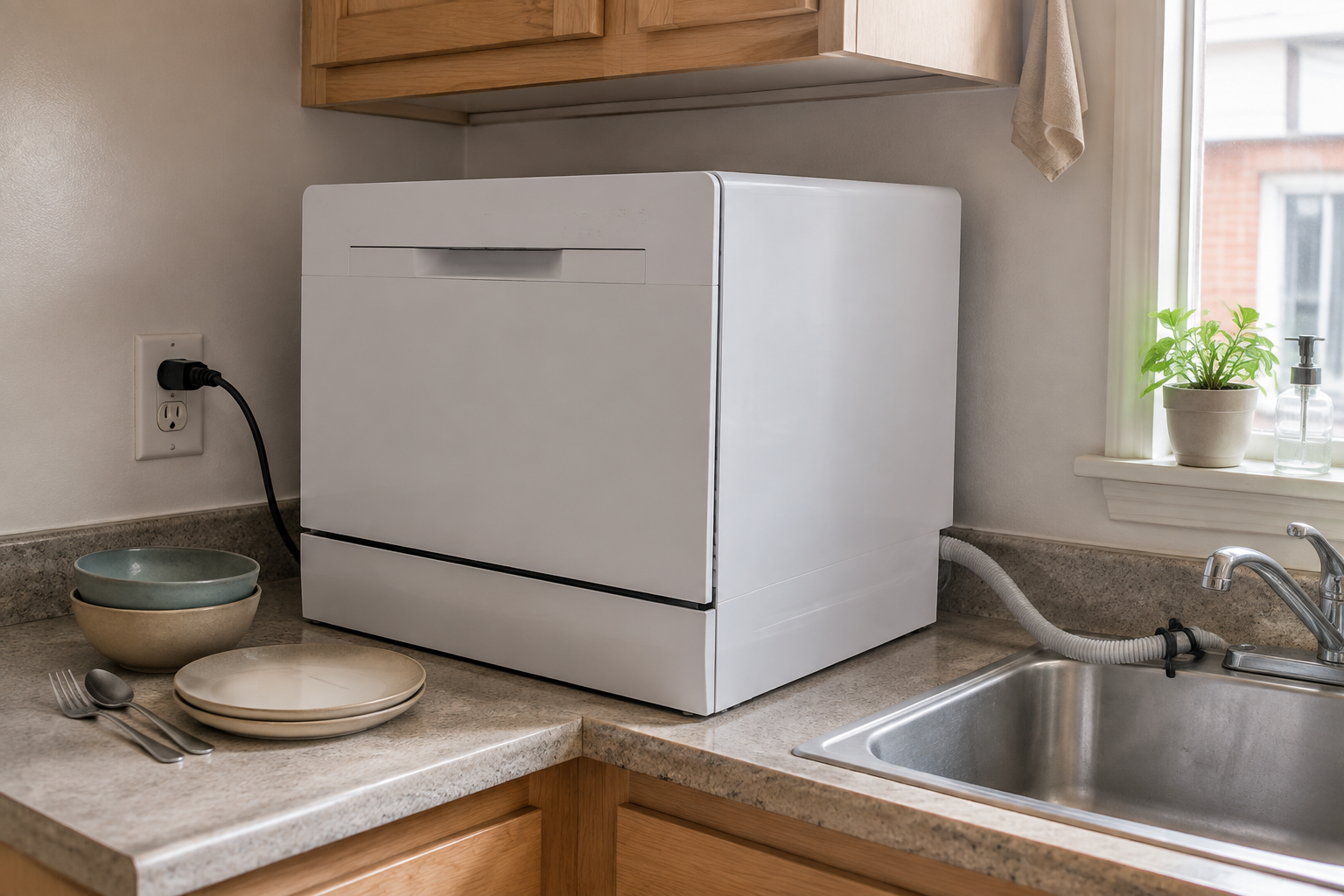
A countertop dishwasher can be worth it when hand-washing is a persistent burden, the machine fits without taking over your prep area, and you have a maker-approved way to supply and drain water without changing the rental. It is a poor fit when faucet compatibility is uncertain, the hose blocks normal sink use, or your largest everyday dishes will not fit.
As an Amazon Associate, The Good Home Doc may earn from qualifying purchases.
Quick decision before shopping
First measure the available space, identify the setup or surface constraints, and decide who will maintain the item. Skip the category if it blocks access, conflicts with the manufacturer's instructions or lease, or adds more upkeep than the problem justifies.
Shop only after measuring the full setup: Browse category: Compare countertop dishwashers on Amazon.
This is a category shortcut, not a tested ranking. Verify the current maker instructions for exterior and interior dimensions, faucet-adapter exclusions or fill-tank use, power and drainage requirements, cycle capacity, clearances, cleaning, warranty, and installation limits.
Quick Decision: Buy, Skip, or Delay
- Buy: you wash small daily loads, can give up the measured counter footprint, and have an approved water, drain, and outlet setup that leaves the kitchen usable.
- Skip: most of your washing is oversized cookware, the appliance would remove essential prep space, or setup would require permanent plumbing, an unsafe cord route, or a lease-prohibited change.
- Delay: measure first, read the exact manual, check the faucet or tank-fill method, confirm where every hose will go, and ask the landlord when the lease or building rules are unclear.
Measure the Whole Working Zone
Do not compare countertop width alone. Record the available width, depth, and height below the upper cabinets. Add the space needed to open the door, reach controls, fill a built-in tank if present, connect hoses, and let heat and moisture escape according to the manual. Keep the sink, faucet handle, cabinet doors, windows, and nearby appliance doors usable.
Interior dimensions matter just as much. Compare your normal dinner plates, bowls, mugs, food-storage pieces, and utensils with the rack layout and stated dish-size limits. Published place-setting counts are not a promise that your particular dishes will nest well. Large pans and mixing bowls may still need hand-washing.
Choose the Water Setup Before the Machine
Faucet-connected models depend on a compatible faucet and the exact adapters allowed by the manufacturer. Pull-down sprayers, unusual threads, sensor faucets, and some aerator designs may not accept a portable connection. Do not improvise a fitting or modify rental plumbing to force compatibility.
Models with a manual fill tank can avoid a faucet adapter, but they still need repeated filling, level placement, and an approved drain route. Some machines support more than one fill method; verify what is included and what the manual permits rather than relying on listing photos.
Drainage, Power, and Rental Limits
The drain hose must remain secure in the approved position throughout a cycle. Check its length, routing, and attachment instructions, and make sure it does not create a trip path or prevent ordinary sink access. Never assume an unattended hose will stay put. Stop using the machine if a hose, fitting, cord, plug, outlet, or cabinet surface shows leaking, damage, overheating, or another abnormal condition.
Use only the electrical setup in the appliance instructions. Water, cords, adapters, and overloaded outlets are not a place for guesswork. Renters should avoid drilling, permanent supply connections, cabinet modifications, or electrical changes without written approval and qualified help where required. A countertop appliance also does not override building rules, lease terms, or the need to report faulty plumbing or outlets.
What the Routine Actually Looks Like
A compact machine can reduce repetitive washing, but it does not eliminate kitchen work. You still scrape dishes as directed, load within spray-arm clearance, measure the approved detergent, unload, clean filters and spray parts, manage hoses or tank water, and leave the interior as the maker recommends between uses. A smaller rack can also mean more frequent cycles.
Compare that routine with your current alternative. A well-sized rack or mat may be cheaper, faster, and easier to store for one person with a small dish load. A countertop dishwasher becomes more persuasive when dishes accumulate daily, the load fits the rack, and consistent machine washing is worth the lost counter space and upkeep.
Must-Haves and Nice-to-Haves
Must-haves: verified counter and door clearance, a compatible water method, secure drainage, a compliant outlet arrangement, a rack that fits your dishes, understandable filter access, and permission for the planned rental setup.
Nice-to-haves: a fill-tank option, a useful cycle indicator, delayed start when appropriate, a removable rack or cutlery basket, and controls you can read under the cabinet. Treat cycle names as labels; compare the documented water, temperature, time, and loading guidance behind them.
Who Should Skip a Countertop Dishwasher?
- Households that mainly wash stockpots, sheet pans, large cutting boards, or unusually tall plates.
- Very small kitchens where the measured footprint removes the only practical prep surface.
- Renters whose faucet is incompatible and who do not want the repeated work of a fill-tank model.
- Anyone without a secure, maker-approved drain route and suitable electrical setup.
- People expecting a zero-maintenance appliance or full-size dishwasher capacity.
When a Simpler Setup Wins
If space or hookups fail the check, improve the hand-washing workflow instead of forcing the appliance. A compact rack, over-sink rack, roll-up rack, or drying mat can preserve more counter area and has no water connection. Start with the small-kitchen drying-rack guide and compare a rack versus a drying mat by dish volume and storage.
Bottom Line
A countertop dishwasher is worth it for a renter only when the complete setup fits: appliance, open door, dishes, water supply, drain hose, outlet, daily counter use, maintenance, and lease rules. Measure those constraints against your real dish routine. Buy when the burden it removes is larger than the space and setup it adds; skip it when the kitchen must be rearranged around an appliance that still cannot hold your everyday load.