How to Choose Countertop Dishwashers for Rental Kitchens
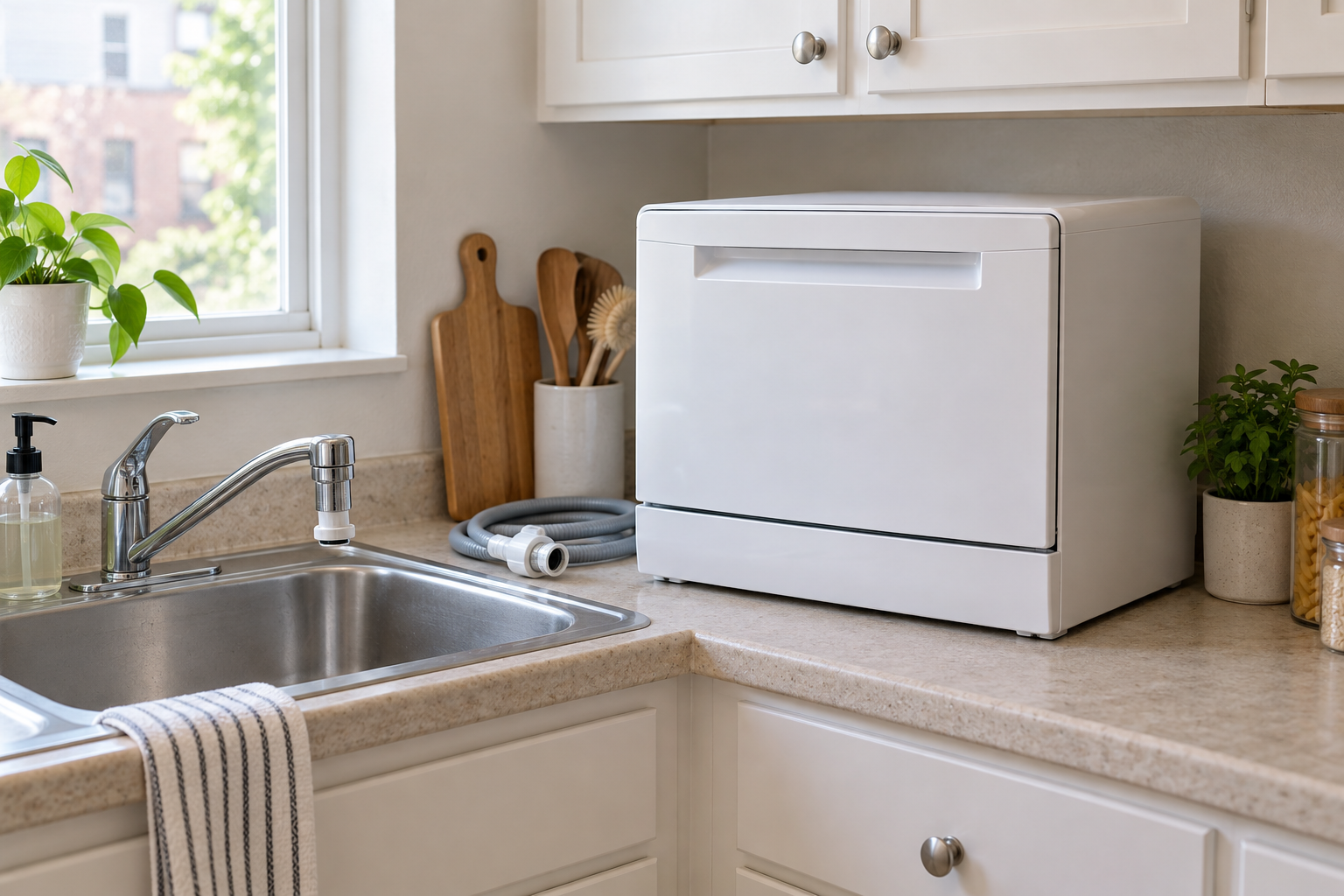
The best countertop dishwasher for a rental is not automatically the smallest one. It is the format that fits beneath the cabinets, holds the dishes you actually use, has a manufacturer-approved water and drain route, and can be removed without altering the apartment. Compare the complete working setup before comparing cycles or convenience features.
As an Amazon Associate, The Good Home Doc may earn from qualifying purchases.
Quick decision before shopping
First measure the available space, identify the setup or surface constraints, and decide who will maintain the item. Skip the category if it blocks access, conflicts with the manufacturer's instructions or lease, or adds more upkeep than the problem justifies.
Compare only after measuring the full setup:
- Browse category: Compare faucet-connected countertop dishwashersConfirm the exact faucet connection, included adapter, hose reach, drainage instructions, and lease fit.
- Browse category: Compare built-in-tank countertop dishwashersCheck fill access beneath cabinets, tank capacity, level placement, drain routing, and the repeated filling routine.
- Browse category: Compare dual-fill countertop dishwasher formatsVerify both water methods in the current manual rather than assuming every listing accessory is included or compatible.
These are category searches, not tested rankings. Verify the current manufacturer manual for exterior and rack dimensions, supported dish size, water supply, drainage, electrical setup, detergent, clearances, cycles, cleaning, installation limits, and warranty terms.
This guide compares formats, not named winners. Product dimensions and instructions vary by exact model, and marketplace labels are not a substitute for the current manufacturer manual.
Quick Best-Fit Guide
- Faucet-connected model: best when the faucet is explicitly compatible and you want to avoid filling a tank by hand.
- Built-in-tank model: best when the faucet cannot accept an approved adapter but repeated filling and open-top access are practical.
- Dual-fill model: best when you value flexibility and have verified that both documented setups work in the kitchen.
- Larger countertop format: useful when dish fit matters more than preserving counter space and every clearance still works.
- Skip the category: when the drain cannot be secured, the outlet or faucet setup is unsuitable, the lease prohibits the arrangement, or everyday dishes do not fit.
Measure the Appliance in Working Mode
Measure available counter width, depth, and height beneath the upper cabinet, then compare those numbers with the complete exterior dimensions. Add the open-door projection, handle or control clearance, hose bends, plug and cord route, fill opening, and any ventilation space required by the manual. Keep the sink, faucet controls, nearby doors, and food-prep area usable.
Use painter's tape or a cardboard box to model the footprint and door swing. A unit that technically rests on the counter can still be a poor fit if it blocks the faucet, hangs over the edge, cannot be filled beneath the cabinet, or has to be moved while connected.
Compare the Three Water-Supply Formats
Faucet-Connected Models
A quick-connect hose can make repeated cycles easier, but only when the exact faucet and adapter are supported. Pull-down sprayers, sensor faucets, hidden aerators, and unusual threads can be incompatible. Check what the product includes and follow the manual; do not improvise fittings or modify rental plumbing.
Choose this format when: compatibility is documented, the hose reaches without strain, and temporary sink access is acceptable. Skip it when: connection details are unclear or normal faucet use would be too disruptive.
Built-In-Tank Models
A manual tank avoids a faucet connection, but it replaces that constraint with repeated filling. Check how much lifting or pouring is required, where the fill opening sits, whether the supplied container fits under the faucet, and whether upper cabinets leave enough access. The appliance still needs an approved drain route.
Choose this format when: a faucet adapter will not work and filling is manageable. Skip it when: the fill point is awkward, carrying water is difficult, or the household expects hands-off operation.
Dual-Fill Models
Dual-fill designs can adapt to a move or changing kitchen, provided both methods are actually documented for the exact model. Flexibility does not excuse a poor current setup, and included hoses or adapters may differ by listing.
Choose this format when: both options are useful and verified. Skip it when: you would pay for an alternate method that cannot be used in the present kitchen.
Check Rack Fit, Not Just a Place-Setting Claim
Measure the diameter and height of your everyday plates, bowls, mugs, food containers, utensils, and one or two frequently washed cooking pieces. Compare them with the stated rack dimensions, loading diagrams, spray-arm clearance, and maximum dish size. A place-setting count does not guarantee that your shapes will nest well.
Look for a rack and utensil holder that make ordinary loading straightforward. If most washing involves sheet pans, stockpots, large cutting boards, or tall stemware, a countertop machine may leave too much hand-washing to justify its footprint.
Drainage and Electrical Fit Are Must-Haves
The drain hose needs the route and secure placement specified by the maker for the entire cycle. Check hose length, sink position, bends, and whether the setup prevents ordinary sink use. Do not treat a loose hose balanced over a basin as a reliable plan.
Follow the appliance instructions for the outlet, plug, cord, placement, and surrounding water exposure. Do not use an improvised extension, alter wiring, or ignore a damaged outlet. If the planned setup raises electrical, plumbing, leak, or lease questions, pause and ask the landlord, manufacturer, or an appropriately qualified professional.
Cycles, Controls, and Noise
Cycle names are less useful than the documented load type, duration, water method, temperature, and detergent instructions behind them. Prioritize controls that remain visible under the cabinet, a clear cycle-status indicator, and a routine that matches how often you expect to run the machine.
Compare published noise information only when manufacturers use a stated, comparable basis. Room surfaces, cabinet placement, loading, and background sound affect what you hear. If the kitchen opens directly to a work or sleep area, return policies and verified documentation matter more than vague “quiet” labels.
Cleaning and Ongoing Work
Check how the filter, spray arms, rack, tank, seals, and hose connections are accessed and cleaned. Confirm approved detergent type and amount, maintenance intervals, nonuse instructions, and any steps for moving or storing the machine. A compact appliance with awkward filter access can create more routine work than expected.
Stop using the unit and follow the maker's guidance if it leaks, drains abnormally, shows cord or plug damage, overheats, or behaves unexpectedly. A countertop dishwasher is a convenience appliance, not a fix for faulty plumbing, outlets, or water damage.
Must-Haves Before Nice-to-Haves
Must-Haves
- Complete dimensions that fit the counter, cabinets, door swing, controls, hoses, plug, and fill opening.
- A manufacturer-approved water connection or tank-filling method.
- A secure, practical drain route and suitable electrical arrangement.
- A rack that fits the household's recurring dishes.
- Accessible cleaning parts and instructions the household will follow.
- A removable setup permitted by the lease and building rules.
Nice-to-Haves
- Two documented water-supply choices.
- A clear remaining-time or cycle-status display.
- A rack or utensil basket suited to the household's dish mix.
- Simple access to filters, spray arms, and hose connections.
Who Should Skip a Countertop Dishwasher?
- Renters who cannot confirm permission for the planned connection and drainage setup.
- Households whose normal dishes exceed the documented rack or dish-size limits.
- Kitchens where the appliance removes the only useful prep area or blocks the sink.
- Anyone without a secure drain route, compatible water method, or suitable outlet arrangement.
- People expecting full-size dishwasher capacity or a maintenance-free appliance.
Buying Checklist
- Measure counter width, depth, height, edge support, cabinet clearance, open door, and control access.
- Measure recurring plates and tall items against rack dimensions and loading guidance.
- Verify the exact faucet connection, tank-fill method, included parts, and hose reach.
- Plan a secure drain route and manufacturer-approved electrical setup.
- Read cycle, detergent, cleaning, nonuse, and troubleshooting instructions.
- Confirm lease and building rules before ordering or altering anything.
- Compare the return policy after all fit checks; do not rely on listing photos alone.
Bottom Line
For a rental kitchen, start with water compatibility, drainage, electrical fit, dish dimensions, and the full working footprint. Faucet-connected models reduce manual filling, tank models avoid faucet adapters, and dual-fill models preserve options. The best format is the one whose documented setup fits the apartment without improvisation—and whose rack and maintenance routine solve enough hand-washing to earn the counter space.