Is an Appliance Sliding Tray Worth It for a Deep Counter?
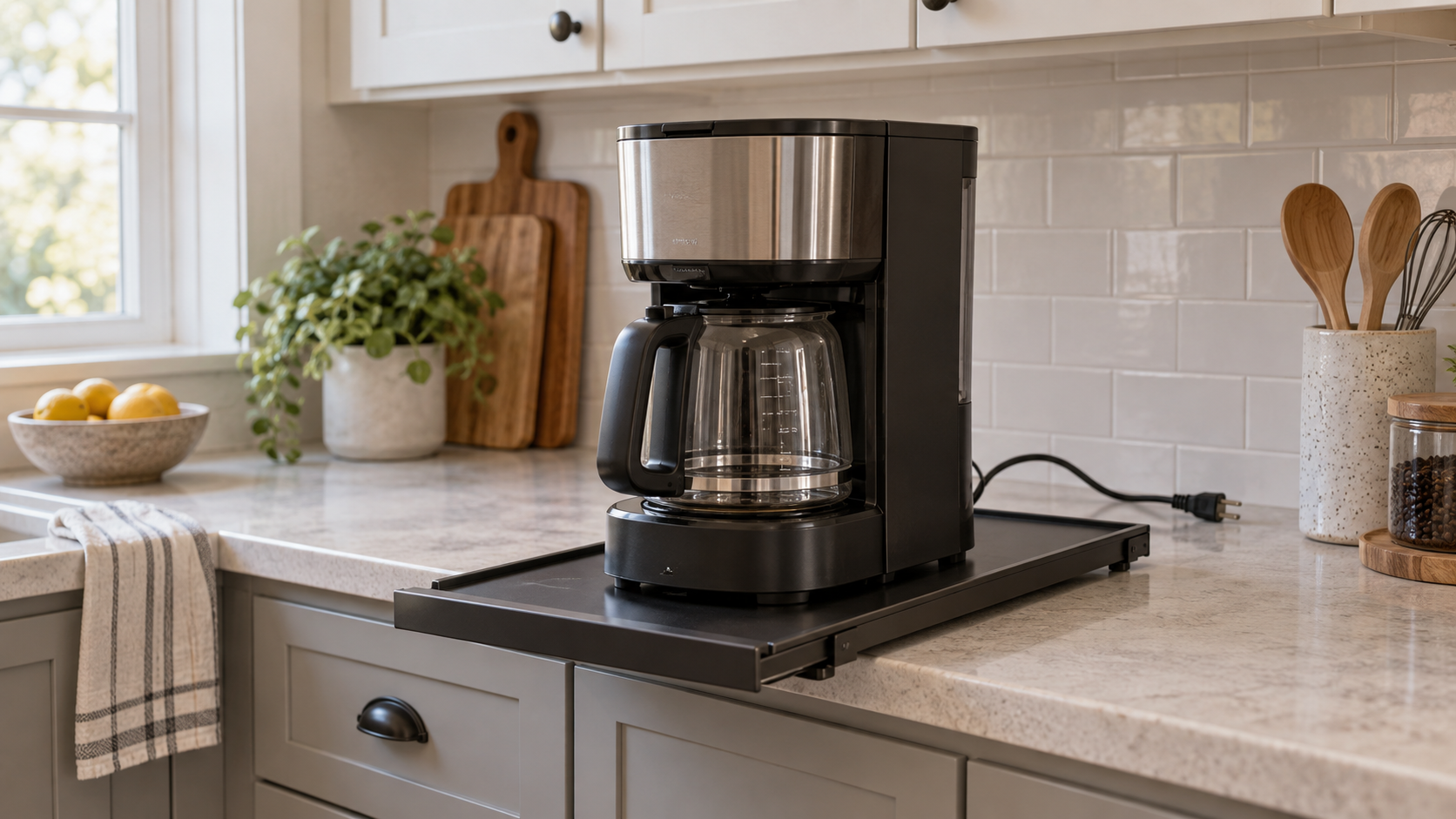
An appliance sliding tray can be worth it when you pull the same permitted countertop appliance forward often, its entire base fits a compatible tray, and the tray reaches a maker-approved working position without straining the cord. Skip it when rearranging the counter solves the access problem or the added height and movement create new clearance or stability concerns.
As an Amazon Associate, The Good Home Doc may earn from qualifying purchases.
Quick decision before shopping
First measure the available space, identify the setup or surface constraints, and decide who will maintain the item. Skip the category if it blocks access, conflicts with the manufacturer's instructions or lease, or adds more upkeep than the problem justifies.
Shop only after the two-position test: this is a category route, not a tested winner.
- Browse category: Compare countertop appliance sliding traysVerify the usable platform, intended appliance use, stated load basis, total height, travel, counter compatibility, cleaning, and return terms.
This guide covers removable manual trays for compact countertop appliances. It does not cover built-in pullout shelves, furniture dollies, cabinet modification, accessibility equipment, or moving major appliances. The appliance and tray instructions control the final setup.
Quick answer
Buy one when access or filling requires the same short forward movement several times a week, the full setup passes the measurements below, and a controlled tray reduces an awkward but ordinary repositioning step.
Delay the purchase until you mark both positions, trace the cord, and confirm the appliance may be stored and used where planned.
Skip it when the appliance rarely moves, can live in a better spot, or cannot stay fully supported and clear throughout the tray's travel.
Start with the problem, not the accessory
For a week, note why the appliance moves. Common reasons include reaching a rear water tank, opening a lid beneath an upper cabinet, cleaning behind the appliance, or moving it to a permitted operating location. Record how often this happens and whether the appliance is cool, empty, and unplugged at the time.
A tray has a stronger case for frequent, repeatable straight-line access. It is less convincing for rare deep cleaning, for an appliance that should live elsewhere during use, or for a task that still requires lifting, turning, or carrying.
Run the two-position test
Mark a stored position and the farthest necessary access or operating position with removable tape. At both points, check the backsplash, upper cabinet, counter edge, sink splash, nearby heat sources, drawers, reservoirs, lids, baskets, vents, steam path, and every maker-required clearance.
The complete tray must remain supported on the counter throughout its documented travel. Do not treat an open lid as proof of adequate operating clearance. If the appliance instructions require another location for heat, steam, ventilation, or surface protection, that location is the real destination.
Measure what actually touches the tray
Measure the outside position of every appliance foot or support point, not only the appliance shell. Compare those numbers with the tray's usable flat platform. A raised rim, handle recess, hinge, or roller opening can make the usable area smaller than the overall dimensions.
Add the tray's height to the appliance height, then reopen every lid and remove every tank or basket used in the routine. Skip trays that leave a foot overhanging, require improvised shims, or make top access worse.
Check movement and stability together
A lower-effort glide is useful only when travel starts, stops, and returns predictably on the actual counter. Read how the tray is intended to move and how its base, feet, rollers, locks, or lift mechanism should contact the surface. Texture, seams, moisture, crumbs, and grit can change that behavior.
Confirm the maker's intended appliance category and stated load, including how weight should be distributed. A capacity number alone does not establish fit. Stop using a setup that rocks, bows, skews, rolls unexpectedly, sheds material, or lets the appliance shift.
Trace the cord before deciding
With the appliance unplugged, trace the cord through the complete movement path. It should stay relaxed and clear of the tray mechanism, appliance feet, hot or wet areas, and the counter edge. Movement should not pull at the plug, bend it sharply, or loosen the receptacle.
A tray does not justify an extension cord or a different electrical arrangement. Follow the appliance maker's outlet guidance. If the cord cannot reach the required working position, relocate the appliance or ask an appropriate qualified professional about the setup.
Decide when the appliance should move
Do not assume a powered, hot, or liquid-filled appliance should slide simply because a platform allows it. Follow both manuals. Unless they explicitly support the exact routine, move the appliance only when unplugged, cool, stable, and prepared as directed.
For coffee makers, kettles, multicookers, and similar appliances, consider water, steam, hot contents, and removable parts. A tray that helps with cold filling may still be a poor choice for movement during or immediately after operation.
Count the upkeep
The underside and mechanism can collect crumbs, grease, water, and grit. Check whether the platform or top layer removes, which cleaning products are permitted, and whether any part may be immersed. Clean and dry the counter and tray as directed before putting the appliance back.
Inspect the travel stops, feet, rollers, surface pads, and platform regularly. If cleaning requires lifting an appliance you cannot comfortably handle according to its instructions, a different counter layout may be the better answer.
Must-haves versus nice-to-haves
Must-haves: complete foot support, compatible intended use, sufficient stated load and distribution, controlled travel, full counter support, a relaxed cord route, required operating clearance, and clear care instructions.
Nice-to-haves: a reachable front pull, removable top liner, marked travel limits, or a low profile. None makes an incompatible appliance, counter, outlet, or operating position acceptable.
Tray versus simpler alternatives
| Option | Best fit | Main tradeoff |
|---|---|---|
| Manual sliding tray | Frequent short straight-line access with a fully measured setup | Adds height, movement, cleaning, and another compatibility check |
| Rearrange the counter | A better permanent spot provides full access and clearance | Uses a different section of workspace |
| Move by the appliance's approved method | Rare access and a manageable cool, empty appliance | Still requires careful handling |
| Use another appliance format | Rear tanks, top lids, or deep footprints repeatedly conflict with the kitchen | Replacement cost and a new fit decision |
Who should skip an appliance sliding tray?
- Anyone who cannot keep every appliance foot on the usable platform.
- Setups where the tray raises the appliance into a cabinet or blocks a lid, tank, vent, or required clearance.
- Counters that are uneven, cracked, regularly wet, or excluded by the tray maker.
- Appliances with damaged feet, cords, plugs, tanks, or unstable bases.
- People expecting a tray to make hot, powered, leaking, or liquid-filled movement acceptable.
- Anyone who needs lifting, accessibility, repair, or built-in cabinet help rather than ordinary countertop access.
Bottom line
An appliance sliding tray earns its space when it solves a frequent, clearly measured access problem and the appliance remains fully supported, controlled, correctly placed, and connected without cord strain. Mark both positions and read both sets of instructions before shopping. If rearranging the counter removes the conflict, that simpler fix is usually better.