Folding Chair vs Stackable Chair for Occasional Small-Space Seating
Folding chairs usually win when storage is narrow and setup is truly occasional. Stackable chairs often make more sense when you can spare a compact floor area, want fewer moving joints, and expect to bring seats out regularly. The better format is the one that fits both the occupied room and its measured storage spot without creating a difficult lifting or setup routine.
As an Amazon Associate, The Good Home Doc may earn from qualifying purchases.
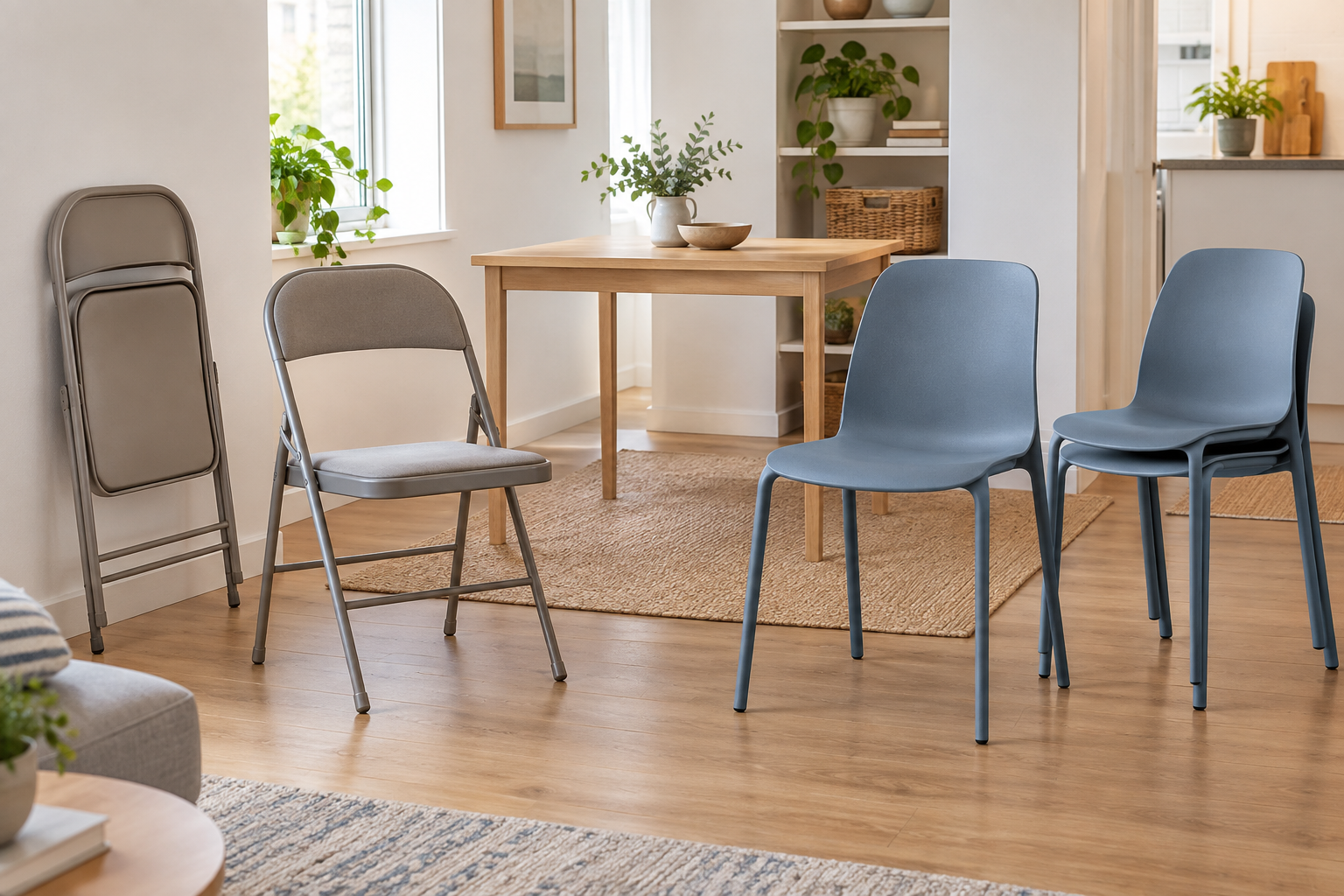
Quick decision before shopping
First measure the available space, identify the setup or surface constraints, and decide who will maintain the item. Skip the category if it blocks access, conflicts with the manufacturer's instructions or lease, or adds more upkeep than the problem justifies.
Compare the two formats after measuring both use and storage: Browse category: browse compact folding chairs or Browse category: browse indoor stackable chairs.
These are category shortcuts, not tested rankings. Verify open and stored dimensions, product weight, usable seat size, stated capacity and use limits, hinge or locking instructions, documented stack limit, feet, materials, care, assembly, and manufacturer warnings.
The short answer
- Choose folding chairs when the set must fit in a shallow closet or narrow storage wall and you are comfortable operating the folding hardware.
- Choose stackable chairs when you have enough floor area and vertical clearance for the documented stack, use the chairs often, and prefer a lift-and-place routine.
- Skip both when the setup blocks a walkway or exit, the storage route is awkward, or the intended user needs mobility, transfer, accessibility, or medical-support seating.
Side-by-side decision table
| Decision point | Folding chair | Stackable chair |
|---|---|---|
| Stored shape | Thin when folded, but still needs full stored height and safe orientation. | Keeps its full footprint; several chairs share it but build upward. |
| Setup | Each chair must open fully and engage any required brace or lock. | Each chair must be lifted clear of the stack and placed on a level surface. |
| Moving parts | Hinges and braces create pinch areas and inspection points. | Usually fewer moving joints, but stacking contact can mark frames or seats. |
| Best fit | Rare use and narrow storage. | More frequent use and a dedicated storage corner or closet floor. |
Measure the room in occupied mode
Mark one chair’s complete open footprint, then repeat it for the number of guests you expect. Leave space to pull out each seat and keep door swings, cabinets, radiators, curtains, outlets, and circulation routes clear. At a table, compare seat height with the tabletop, apron, and crossbars, and check usable knee room.
Both formats consume their full seating footprint once deployed. If the room only works when guests squeeze past occupied chairs or a seat narrows an exit route, neither format solves the layout problem.
Compare the stored footprint honestly
For folding chairs, measure folded height, width, depth, protruding feet, and hardware. Multiply the folded depth by the number of chairs, then allow room to grip and remove one without toppling the set. Follow the maker’s storage orientation; do not invent a wall-hanging or leaning method.
For stackable chairs, measure the base footprint and total height of the number you will store. Use only the documented stack quantity and orientation. A taller stack can become harder to lift from and may not clear a shelf, light, or closet rod. Never treat an unspecified stack as stable.
Setup, handling, and pinch points
A folding chair adds a repeated mechanical step. Read the opening and closing sequence, keep fingers away from hinges and braces, and confirm any lock or support is fully engaged before sitting. Stop using a chair that is bent, cracked, loose, incomplete, or will not open and secure as instructed.
A stackable chair removes the folding step but adds lifting. Check chair weight and where your hands can safely grip it. Separate chairs rather than dragging one frame across another, and do not lift a stack unless the manufacturer permits it. Keep children and pets away during setup and storage.
Comfort and fit are model questions
Format alone does not decide comfort. Compare usable seat width and depth, seat height, front-edge shape, back support, flex, upholstery, and the length of a typical visit. A rigid stackable shell can fit one person better than a padded folding chair, while another reader may prefer the opposite.
If possible, sit in the exact chair before buying. A documented stated capacity is a use limit, not a comfort score or proof that every body shape will fit. Never use either chair as a step stool, ladder, child restraint, or support for an unstated activity.
Floor contact and maintenance
Inspect every foot or glide for full contact, trapped grit, wear, and missing parts. Added pads can change contact, catch during folding, or interfere with stacking, so use only compatible parts. Lift chairs instead of dragging them and follow the floor and chair makers’ care guidance; no format can promise a mark-free floor.
Clean with the approved method and let materials dry before folding or stacking. Folding chairs need hinge, brace, fastener, and frame checks. Stackable chairs need checks at the points where seats and frames contact in storage. Both need inspection for cracks, loose parts, corrosion, worn feet, and damage named in the instructions.
Who each format fits
Folding chairs fit best when
- The storage area is tall and shallow rather than wide.
- Seats come out only occasionally.
- Each user can open, secure, close, and carry the chair as instructed.
- A low stack would waste scarce floor area.
Stackable chairs fit best when
- A dedicated floor footprint and enough vertical clearance are available.
- Seats move in and out often enough that unfolding feels burdensome.
- The documented stack height remains easy to reach and manage.
- Fewer moving joints are more useful than thin storage.
Who should skip each option
Skip folding chairs if hinges or locks are difficult to operate, the only storage method requires unapproved hardware, or fingers are likely to enter the folding path. Also skip them when folded dimensions do not fit the measured route.
Skip stackable chairs if you lack a permanent floor spot, cannot comfortably lift the top chair, or the maker does not state that the chairs stack and document a limit. Do not assume visually similar chairs can be mixed in one stack.
Skip both formats for daily seating when a permanent chair would be more comfortable and simpler, or when the setup creates a trip hazard or obstructs an exit. Anyone needing specialized support should choose an appropriate product with qualified guidance.
A practical pre-purchase check
- Tape out every chair in the room’s actual guest layout.
- Measure the closet, nook, and entire carry route.
- Record open and stored dimensions, product weight, seat measurements, and documented use limits.
- For folding chairs, review the hinge, brace, lock, and closing sequence.
- For stackable chairs, verify stack compatibility, limit, total stored height, and separation method.
- Check feet, floor guidance, cleaning, assembly, inspection, and replacement-part instructions.
Bottom line
Choose folding chairs when narrow storage is the binding constraint and occasional setup is acceptable. Choose stackable chairs when a fixed storage footprint and manageable lift are available and the seats will be used often enough to value faster setup. Measure both modes, follow the exact model’s instructions, and reject either option if storage, handling, or circulation is not workable.