Digital Kitchen Scale vs Measuring Cups for Home Baking
A digital kitchen scale measures ingredients by weight, while cups follow a recipe's volume markings. Neither method automatically improves every bake: the better choice is usually the one the recipe was written and tested to use, with a workflow you can read, reset, clean, and repeat without awkward conversions.
As an Amazon Associate, The Good Home Doc may earn from qualifying purchases.
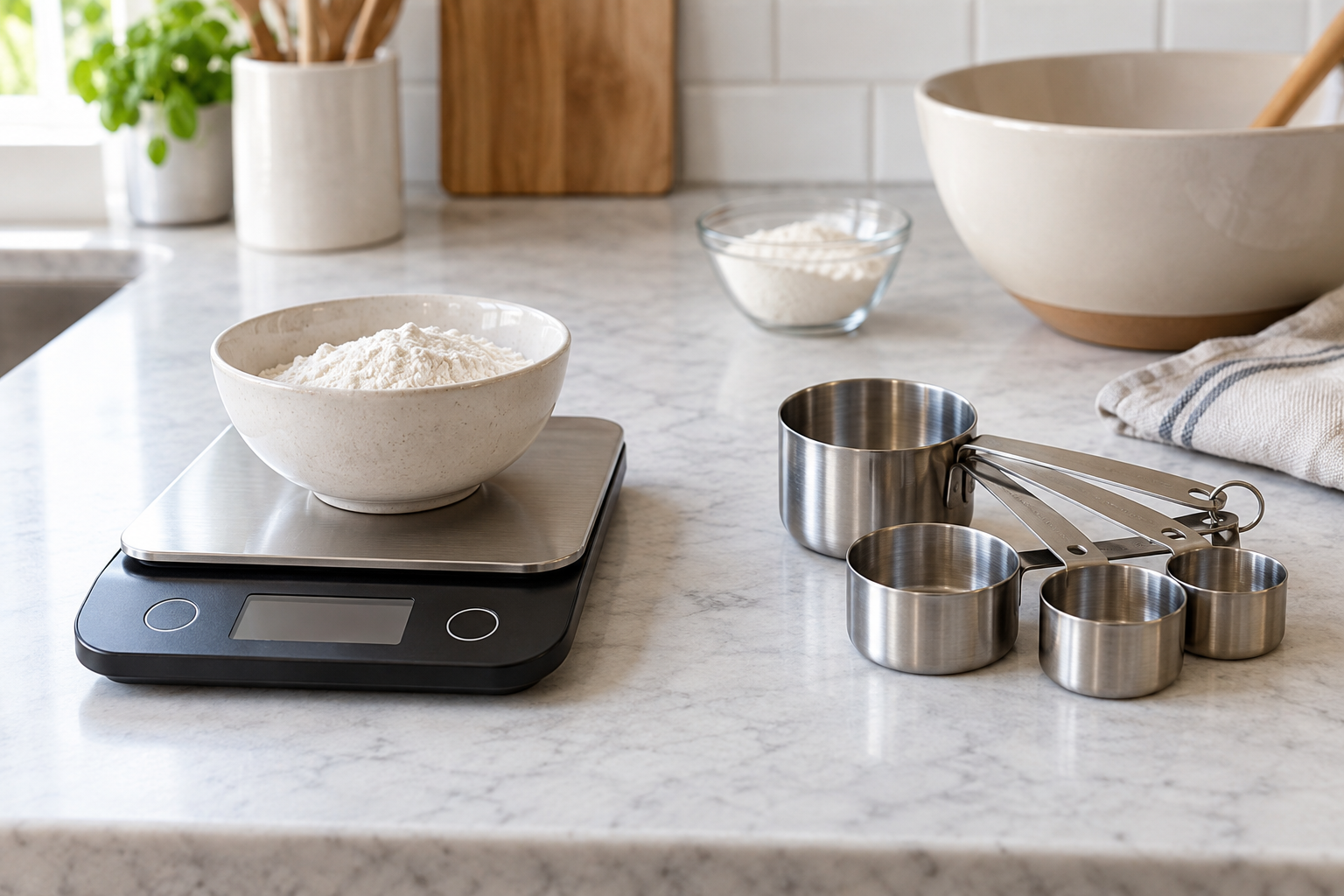
Quick decision before shopping
First measure the available space, identify the setup or surface constraints, and decide who will maintain the item. Skip the category if it blocks access, conflicts with the manufacturer's instructions or lease, or adds more upkeep than the problem justifies.
Compare each format against the recipes you actually make:
- Browse category: Compare digital kitchen scales for bakingCheck stated capacity and increment, supported units, platform and display size, tare operation, auto-off behavior, battery type, cleaning, and storage.
- Browse category: Compare dry and liquid measuring cupsCheck included sizes, legible markings, level-sweep rims, handle fit, nesting, materials, and current care and use instructions.
These are category searches, not tested rankings. Confirm current dimensions, units, capacity, increments, materials, included pieces, care instructions, warnings, warranty, and return terms before buying.
Quick decision
| Choose | Best fit when | Main tradeoff |
|---|---|---|
| Digital kitchen scale | Your recipes give ingredient weights and you want to add ingredients to one bowl with tare between them | You must verify capacity, units, readability, batteries, and the effect of auto-off on your routine |
| Measuring cups | Your recipes are written in volume and you prefer a familiar scoop, level, and pour routine | A full set takes storage space, and technique matters for ingredients that settle or compress |
| Keep both | You use a mix of weight-based and volume-based recipes or frequently measure small liquid quantities separately | You maintain and store two systems |
Follow the recipe's measurement system first
A recipe written in grams or ounces is a natural match for a scale. A recipe written in cups, tablespoons, and teaspoons is usually simplest to follow with those measures. Avoid converting by a single generic chart: equal volumes of different ingredients do not necessarily have equal weights, and packing, grinding, or settling can change how much fits in a cup.
If a trusted recipe provides both systems, use the author's stated values rather than making your own conversion. When it provides only one, changing systems may add uncertainty instead of removing it. This comparison is about choosing a tool that fits the instructions, not declaring one universal method more accurate.
A scale can simplify multi-ingredient bowl work
With a compatible bowl on the platform, tare resets the displayed value before the next ingredient. That can reduce the number of cups that touch flour, sugar, or other dry ingredients. It also lets you stop at a listed weight instead of judging whether a cup is overfilled.
The workflow depends on the scale. Check that the tare control remains visible with your widest bowl, that the display is not hidden by the rim, and that the platform supports the complete bowl without rocking. Review how quickly the display updates and what happens if the scale turns off between ingredients. Do not assume a scale preserves a running total or resumes a recipe after auto-off.
Capacity and increment are different checks
Stated maximum capacity tells you whether the scale can accept the bowl plus everything added to it. The displayed increment tells you the smallest step the manufacturer says the scale shows. A high-capacity model is not automatically the right tool for very small quantities, and a compact fine-increment model may not fit a large mixing bowl.
Add the empty vessel's weight to the expected batch before comparing capacity. Leave a reasonable margin rather than working at the stated limit. For tiny amounts that a recipe lists by spoon, the recipe's measuring spoon may remain the clearer choice unless the scale documentation and recipe both support weighing that quantity.
Check units before assuming a scale fits
Confirm the exact units shown in the current documentation. Grams and weight ounces are common; fluid-volume modes, when offered, rely on the model's programmed assumptions and should not be treated as universal ingredient conversions. Follow the recipe's unit and the scale instructions rather than switching modes because a label looks familiar.
A unit button should also be difficult to press accidentally under the bowl. Before adding an ingredient, glance at the unit indicator and verify the display returned to the intended starting point. If several people bake in the home, a clear display and simple reset routine may matter more than extra modes.
Measuring cups still need the right technique
Dry measuring cups are generally intended to be filled and leveled at the rim. Liquid measuring cups provide a marked vessel with room to pour and read the level according to the recipe and cup instructions. One format should not automatically stand in for the other simply because the labeled quantity matches.
For flour or another ingredient that can compact, follow the recipe author's measuring method when one is given. Scooping directly, spooning into the cup, sifting first, and packing are different actions. Brown sugar or another intentionally packed ingredient is a separate case defined by the recipe. The cup cannot correct a technique that conflicts with the instructions.
Readability can make either system frustrating
For a scale, place the largest planned bowl on the platform and check whether you can still see the digits straight on. Backlighting, contrast, digit size, and a display that projects beyond the platform can help, but confirm how each feature actually operates. A light that times out quickly may be less useful during a slow recipe.
For cups, look for markings you can identify under normal kitchen light. Embossed, etched, printed, or molded labels wear differently, so follow the maker's care guidance. A complete set is only useful if the commonly needed sizes are easy to distinguish and the handles remain comfortable when the cups are full.
Compare cleanup and counter routine
A scale often keeps ingredients in one bowl, but the scale itself still needs protection from spills and flour around buttons or seams. Clean the platform and body only as directed; do not immerse an electronic scale unless its documentation explicitly permits it. Remove the bowl before wiping, and keep liquid away from the battery compartment.
Cups create more separate food-contact pieces, especially when several ingredients are measured before mixing. Check which pieces are approved for the dishwasher and whether nested cups trap wash water. A liquid cup needs a stable place to stand and a controlled pouring route to the mixing bowl.
Storage, power, and maintenance
A slim scale may store vertically or flat, but only if the manufacturer allows that position and the platform will not be loaded or bent. Do not stack heavy cookware on it. Check the battery type, access door, low-battery indication, and any long-term storage instructions. Replace batteries as directed and remove a scale from use if the compartment or contacts are damaged.
Nested cups need less shelf area than a loose set, though a connecting ring can make it slower to grab one size. Confirm the handles clear the drawer and that metal rims or hooks do not catch nearby tools. Replace cups when markings become unreadable, pieces crack, or damage prevents normal use.
Who should skip each option?
Skip a scale if your regular recipes give only volume measures, the display disappears beneath your bowls, auto-off interrupts your pace, you do not want battery upkeep, or the model's verified capacity and increments do not fit your batches.
Skip a large cup set if nearly all of your trusted recipes use weight, your drawers cannot hold the full set without jamming, the markings are difficult for you to read, or you already own the sizes you use.
Keep both when your recipe collection uses both systems. A scale and a modest set of dry cups, liquid measures, and spoons can complement one another without requiring every possible size or conversion mode.
Bottom line
Choose a digital kitchen scale when your recipes provide weights and its capacity, increment, units, bowl fit, display, and tare behavior match the way you bake. Choose measuring cups when the recipes are written in volume and a readable, easy-to-clean set fits your storage and technique. When your recipes mix systems, keeping both is more practical than forcing conversions that the recipe did not provide.