Countertop Compost Bin vs Freezer Container for Food Scraps
A countertop caddy keeps scraps close while you cook and preserves freezer space. A freezer-safe container moves the holding area out of sight and slows the changes that happen at room temperature, but it uses cold-storage capacity and adds a thaw-and-wash routine. Start with your actual collection destination and pickup or drop-off schedule; those decide more than the container label.
As an Amazon Associate, The Good Home Doc may earn from qualifying purchases.
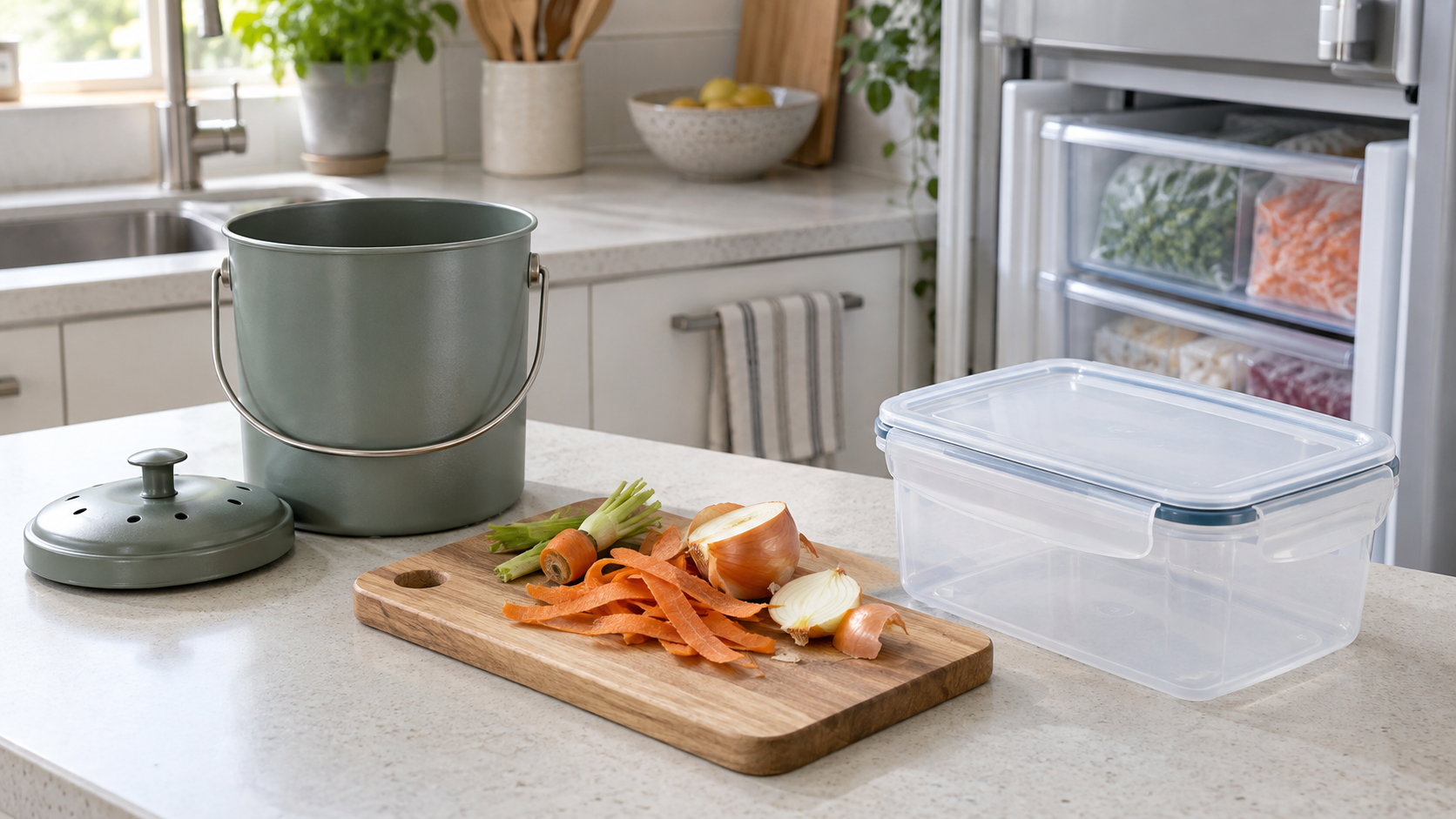
Quick decision before shopping
First measure the available space, identify the setup or surface constraints, and decide who will maintain the item. Skip the category if it blocks access, conflicts with the manufacturer's instructions or lease, or adds more upkeep than the problem justifies.
Compare the container and the routine together:
- Browse category: Compare countertop compost caddies and freezer-safe food-scrap containersCheck exterior dimensions, stated freezer suitability, lid design, carrying handle, liner guidance, cleaning instructions, and the usable capacity after the lid is fitted.
This is a category search, not a tested ranking. Confirm current product dimensions, materials, temperature limits, care instructions, included parts, warnings, and return terms before buying.
Quick decision
| Choose | Best fit when | Main tradeoff |
|---|---|---|
| Countertop compost bin | You empty scraps frequently, have a measured counter spot, and want one-handed access during prep | Room-temperature storage makes lid fit, cleaning, and emptying discipline especially important |
| Freezer-safe container | You have reliable freezer space, collect for longer between trips, and accept moving and washing a cold container | It competes with food storage and may collect exterior condensation during emptying |
| Skip a dedicated container | Your destination accepts very little material, you generate few scraps, or an existing approved container already fits the routine | Confirm the destination rules before buying another household item |
Check the destination before the container
Municipal curbside service, a community drop-off, and a home compost system may accept different materials. Get the current accepted-material list from the program or system you actually use. A package marked “compostable” does not establish that your destination accepts that item, and a container does not make an unaccepted scrap suitable.
Write down where the scraps go, how often they leave the kitchen, and how you carry them there. A short daily walk to an outdoor bin supports a different setup from a weekly drive to a collection point. If you do not yet have a confirmed destination, solve that route before purchasing a specialized caddy.
Counter space versus freezer space
Measure the full operating space, not just the product footprint. A countertop bin needs room for the lid to lift or come off, for a hand to reach the handle, and for nearby cabinet doors and small appliances to operate. Keep it away from heat and food-preparation areas according to the product directions.
For a freezer container, measure the shelf or drawer with the freezer loaded normally. Confirm the container can sit level, the lid can close fully, and the drawer can travel without catching. A tall container may waste the space above it; a wide shallow one may block access to other food. Do not count space that is already needed for routine groceries.
Compare lids without expecting guarantees
A close-fitting lid can help contain loose scraps and make carrying easier, but no lid should be treated as an odor-free or pest-proof guarantee. On a countertop model, compare hinge or lift-off operation, rim cleanup, handle access, and whether any filter is optional, replaceable, and supported by current instructions. A vented or filtered lid and a sealed lid create different maintenance routines; neither is universally better.
For freezer use, rely on the manufacturer's freezer-suitability and temperature guidance. Look for a lid that remains secure in normal handling and can be removed without awkward force. Leave any headspace the maker requires, especially when contents may contain liquid. Do not repurpose a container if its material, lid, or care directions do not support freezing.
Emptying and carrying are part of the fit
Imagine the fullest load you would realistically carry. A countertop caddy with a bail or side handles may be convenient, but confirm the handle does not interfere with the lid and that the filled weight remains comfortable for your route. A removable inner bucket can simplify carrying while adding another seam and piece to wash.
A freezer container may need a brief release period before frozen scraps come out. Follow its instructions rather than twisting, striking, or pouring hot water over cold material. Carry it in a way that contains drips, and return frozen scraps to the destination promptly according to that program's guidance. Freezing is a storage choice, not a substitute for cleaning the container.
Plan the cleaning loop
Choose a shape you can reach with your normal sink tools. Rounded corners and a wide opening are generally easier to wipe than narrow seams, but the maker's care directions decide whether a dishwasher is allowed. Check whether filters, gaskets, hinges, and inner buckets detach and how each part must dry before reassembly.
Room-temperature caddies usually reward a shorter emptying interval. Freezer containers may look cleaner between trips but can develop condensation outside when moved into warm air. Set the container on a washable surface while emptying, wipe moisture promptly, and let every washed part dry as directed before it returns to the counter or freezer.
Do you need a liner?
A liner can simplify transfer, but only if the container maker and final destination both permit it. Check the exact bag material, size, closure method, and accepted-material rules. Do not assume a bag labeled biodegradable or compostable belongs in a curbside or community stream. When liners are not accepted, a fitted washable container may be the simpler route.
For freezer collection, some households use paper or another permitted barrier to help release contents, while others place scraps directly in a container. Follow the destination and container instructions. Avoid adding a liner merely to compensate for a shape that is difficult to empty or clean.
Who should skip each option?
Skip a countertop caddy if counter space is already congested, emptying will be infrequent, the lid cannot open fully, or you are unwilling to clean its rim, handle, filter, and inner bucket as directed. A small container under the sink may be a better room-temperature location if the cabinet stays accessible and the product instructions allow it.
Skip a freezer container if cold-storage space is tight, household members may confuse it with food storage, you cannot reserve a stable level spot, or thawing and condensation make the carry-and-clean loop unrealistic. Clear identification consistent with food-storage and program guidance matters in a shared freezer.
Skip both until you have an accepted-material list and a dependable destination. If scraps are attracting insects or animals, or if local collection and sanitation rules are unclear, contact the collection provider or appropriate local service rather than relying on a container claim.
Keep sink cleanup separate from scrap storage
Whichever storage route you choose, scrape larger scraps before washing dishes. For the small remnants left behind, use the kitchen sink strainer guide to compare removable baskets by drain fit, hole pattern, emptying, cleaning, and disposal compatibility.
Bottom line
Choose a countertop compost bin when quick access and preserved freezer capacity outweigh the need for frequent emptying and room-temperature upkeep. Choose a freezer-safe container when a longer collection interval and out-of-sight storage justify giving up cold space and managing condensation. The useful purchase is the container whose dimensions, lid, carrying method, cleaning directions, and material rules fit the full route from cutting board to the actual compost destination.