How to Choose Sink Strainers for Kitchen Food Scraps
A useful kitchen sink strainer fits the drain opening without rocking, catches the scraps your routine actually produces, lets water pass during normal use, and empties without turning cleanup into a second chore. The right format depends more on measured fit and maintainability than on a claim of being universal.
As an Amazon Associate, The Good Home Doc may earn from qualifying purchases.
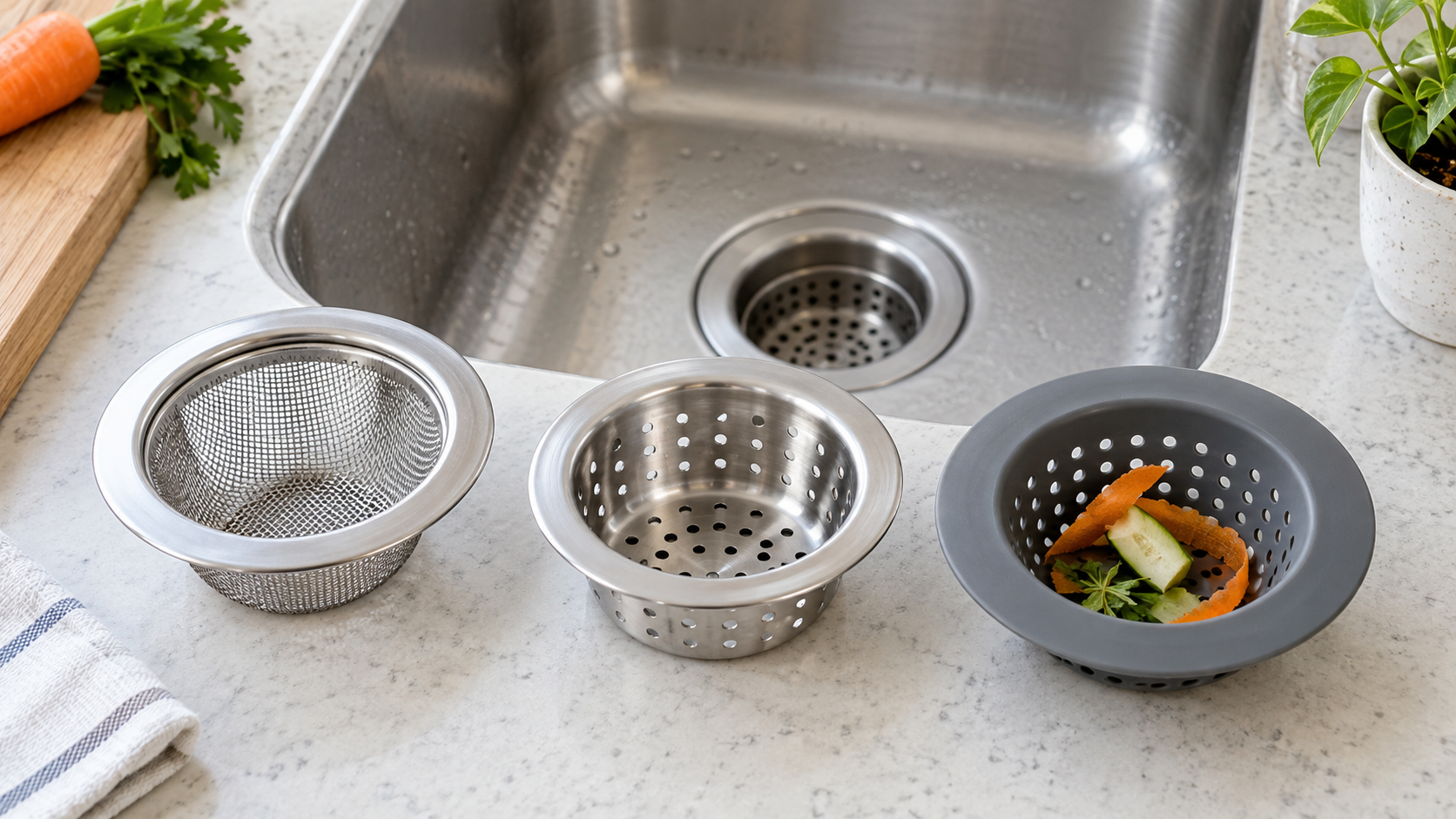
Quick decision before shopping
First measure the available space, identify the setup or surface constraints, and decide who will maintain the item. Skip the category if it blocks access, conflicts with the manufacturer's instructions or lease, or adds more upkeep than the problem justifies.
Measure the drain before comparing products: These affiliate category links are shopping starting points, not tested winners.
- Browse category: Compare fine-mesh sink strainersCheck rim diameter, basket depth, mesh opening, support beneath the rim, emptying method, and cleaning access.
- Browse category: Compare perforated metal basketsCheck drain style, flange fit, hole pattern, stopper behavior, material documentation, and dishwasher instructions.
- Browse category: Compare flexible sink strainersCheck complete diameter, center depth, edge seal, lifting tab, temperature and cleaning guidance, and replacement cues.
Confirm the exact product's dimensions, compatible drain styles, material, food-contact guidance where applicable, cleaning method, dishwasher guidance, and garbage-disposal restrictions. No removable strainer guarantees that a drain will not clog.
Quick comparison by format
| Format | Best fit | Main tradeoff | Reason to skip |
|---|---|---|---|
| Fine-mesh basket | Small particles and a drain with enough basket clearance | Fine openings can need more frequent rinsing and brushing | The mesh deforms, traps residue, or is tedious to clean |
| Perforated metal basket | Routine scraps where easy emptying matters most | Larger holes may let smaller particles pass | The rim rocks or the basket interferes with the drain hardware |
| Flexible strainer | Shallow drains where an easy-to-invert basket fits correctly | Flexibility can make the rim shift or fold | The edge will not stay seated during normal water flow |
| Basket with stopper function | A compatible drain where catching scraps and holding water are both needed | Moving parts and seals add cleaning and fit checks | The drain style or disposal setup is not expressly supported |
Measure the drain, not just the old strainer
Remove the existing loose basket only if it is designed to lift out without tools. Measure the drain opening across the top, the ledge or flange that will support the new strainer, and the available depth before the basket would contact fixed hardware. Note whether the drain has a center post, crossbars, stopper mechanism, or another feature that changes the usable shape.
Compare those measurements with a dimensioned product drawing. A wide rim must rest evenly without blocking nearby sink contours, while the basket must sit low enough to stay put but not press against parts below it. “Universal” is not a measurement. If replacement requires loosening drain fittings or reaching beneath the sink, that is a different plumbing task—not the removable accessory covered here.
Match hole size to the scraps you collect
Fine mesh catches smaller bits, but tight openings can slow when pulp or starch coats them. A perforated basket with larger holes tends to rinse and empty more easily, yet it may pass small particles. Flexible strainers often use a mix of holes and slots, so inspect the whole pattern rather than relying on the material name.
A strainer is a last collection point, not a substitute for scraping plates and cookware into an appropriate waste or organics container first. Keep grease, oils, coffee grounds, fibrous scraps, and other locally restricted material out of the drain according to utility, property, appliance, and plumbing guidance. Choose a basket for small remnants left after scraping, not as permission to send food waste toward the plumbing.
Fine mesh favors capture but asks more of cleanup
A mesh basket can suit households bothered by small loose fragments. Look for an edge that is smooth enough to lift, a basket that keeps its shape, and mesh junctions that are visible and reachable. Deep baskets hold more before emptying, but they can also crowd shallow drains and give wet scraps more surface area to cling to.
Skip mesh when the weave is distorted, sharp, poorly joined to the rim, or difficult to scrub from both sides. If quick emptying matters more than catching tiny particles, a simpler perforated basket may be the more sustainable daily choice.
Perforated baskets are the simple all-purpose format
A rigid perforated basket is usually the easiest format to inspect. Compare the hole diameter and spacing, the transition between base and sidewalls, and the lip used to lift it. Rolled or raised rims can be comfortable to handle, but they also need to sit flat on the sink's supporting surface.
Some metal baskets include a center post or stopper behavior. Do not assume two visually similar designs work alike. Verify whether turning, pressing, or lifting changes the seal, and whether the exact basket is intended for the existing drain assembly. Choose a plain catch basket when you do not need to hold water.
Flexible strainers help only when they stay seated
A flexible center may invert so scraps fall into the bin with less tapping or scraping. That convenience depends on a rim that remains stable during ordinary faucet flow and dishwashing. Check the maker's limits for hot water, contact with cookware, cleaning products, and dishwasher placement rather than assuming every silicone-like material has the same instructions.
Look closely at tabs, seams, underside ribs, and the crease where the basket meets the rim. Those details affect both grip and cleaning. Skip a design that folds into the opening, floats, shifts when the faucet runs, or leaves inaccessible grooves.
Garbage disposals require an explicit compatibility check
A removable catch basket must never enter, contact, or interfere with moving disposal components. Use only accessories that the sink, drain, and disposal manufacturers identify as compatible with the exact setup. Keep the disposal off before placing, removing, or clearing a removable strainer, and never put a hand into the disposal opening.
If the current drain uses a proprietary splash guard, stopper, flange, or sink accessory, start with that documentation. When compatibility is unclear, choose no accessory until the manufacturer or a qualified plumber confirms the fit. Do not modify a basket, force it below the flange, or treat a loose strainer as a repair for damaged drain hardware.
Cleaning and drying decide whether it fits the routine
Empty collected scraps promptly, then wash the strainer according to its instructions. Fine mesh may need a permitted small brush; perforated baskets should be checked around rolled rims and joints; flexible styles should be cleaned on both sides and allowed to return to their intended shape. “Dishwasher safe” is useful only when the required rack position and cycle fit your routine.
Inspect the rim, basket, mesh, seams, tabs, and any stopper parts. Replace the accessory when it is cracked, split, sharply bent, corroded beyond the maker's care guidance, permanently misshapen, or no longer seats as intended. Persistent slow drainage, backups, leaks, odors, or movement in fixed drain parts calls for property management or a qualified plumber rather than a different loose basket.
Must-haves and nice-to-haves
Must-have features
- Complete rim diameter, basket diameter, and depth that match the drain.
- A stable support surface with no rocking or contact below.
- Openings suited to routine remnants without impractical cleaning.
- A lifting edge or tab that can be gripped without reaching into the drain.
- Clear material, washing, drying, and dishwasher instructions.
- Explicit compatibility for any stopper or garbage-disposal setup.
Nice-to-have features
- A shape that inverts or releases scraps cleanly.
- Few seams, rolled edges, or hidden cavities.
- A visible finish that makes residue and damage easy to spot.
- A spare basket only when the exact fit has already been confirmed.
Who should skip each format?
Skip fine mesh when frequent brushing would make you avoid emptying it. Skip perforated baskets when the hole pattern is too open for the remnants you routinely collect. Skip flexible strainers when the drain lacks a broad, level surface to support the rim. Skip stopper combinations when you only need scrap capture or cannot verify the drain assembly.
Skip a new removable strainer entirely if the current one fits, stays intact, and is easy to maintain. A basket is also the wrong response to an active leak, recurring backup, damaged drain, loose fixed flange, or unexplained odor.
Buying checklist
- Identify the sink, drain, stopper, and disposal arrangement.
- Measure the opening, support ledge, available depth, and nearby contours.
- Compare a dimensioned product drawing rather than a universal-fit label.
- Choose an opening pattern for small remnants left after scraping dishes.
- Confirm lifting, emptying, washing, drying, and dishwasher directions.
- Verify exact disposal and stopper compatibility when either applies.
- Check return terms before testing fit without altering the product.
Bottom line
A perforated metal basket is the practical starting point when simple emptying and inspection matter most. Fine mesh fits smaller remnants if you will clean it frequently, while a flexible basket earns its place only when the rim stays seated and the material guidance fits the routine. Measure the drain, verify every compatibility detail, and choose the easiest format you will empty and wash consistently.
Next step: Put this decision in context with the home-product buying framework guide.