Clip-On Pot Strainer vs Colander for a Small Kitchen
A clip-on pot strainer saves cabinet space and keeps food in the cooking pot, but it asks you to control the pot, attachment, lid-free opening, and draining angle together. A freestanding colander takes more room and adds a dish, yet it separates the hot pot from the draining vessel and handles varied cookware and larger batches more predictably. The better choice depends less on kitchen size than on your pots, portions, grip, sink setup, and cleanup routine.
As an Amazon Associate, The Good Home Doc may earn from qualifying purchases.
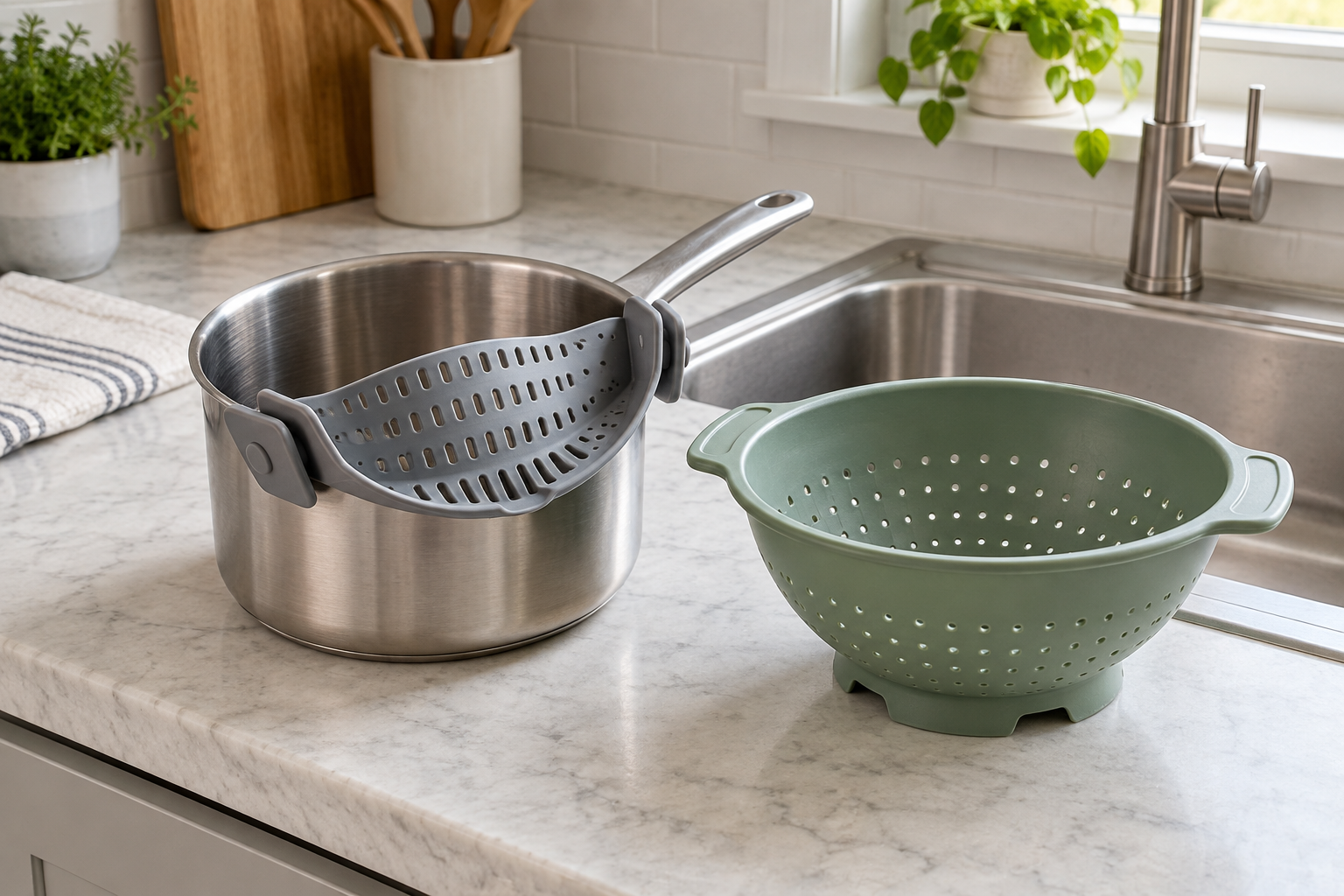
Quick decision before shopping
First measure the available space, identify the setup or surface constraints, and decide who will maintain the item. Skip the category if it blocks access, conflicts with the manufacturer's instructions or lease, or adds more upkeep than the problem justifies.
Compare the two formats after checking your cookware and sink: These affiliate category links are shopping starting points, not tested winners.
- Browse category: Compare clip-on pot strainersCheck the maker's compatible pot diameters, rim shapes, attachment method, material limits, care directions, and draining instructions.
- Browse category: Compare compact freestanding colandersCheck usable capacity, base stability, handle shape, drainage holes, material guidance, dimensions, and cleaning instructions.
This is a category-level decision, not a recommendation of a particular model. Compatibility, temperature guidance, capacity, attachment, food suitability, cleaning, and warnings differ. Read the current manufacturer instructions for the exact strainer and cookware before use.
Quick comparison
| Decision | Clip-on pot strainer | Freestanding colander |
|---|---|---|
| Storage | Usually the smaller item | Needs bowl-shaped cabinet, drawer, or hanging space |
| Cookware fit | Must match the pot diameter, rim, and wall shape | Works independently of the cooking pot |
| Batch size | Best judged by the compatible pot and controlled pour | Usable capacity and sink fit are easier to see |
| Handling | Pot, contents, attachment, and pour move together | Food is transferred into a separate supported vessel |
| Cleanup | One compact tool, but clips and slots may trap residue | An extra large item, usually with open access to its surfaces |
| Best fit | Small routine portions in verified compatible cookware | Mixed pots, larger batches, rinsing, and broader food prep |
Start with the pot, not the drawer
A clip-on model is compact only if it securely fits the cookware you already use. Record the outside diameter at the rim, rim thickness and shape, wall curvature, spouts, and the position of every handle. Compare those details with the product maker's fit guidance. A flexible-looking clip is not evidence of universal compatibility.
Attach and remove the tool only as its instructions allow. It should not interfere with the main handle, helper handle, or the place your hands need to control the pot. If the product rotates, lifts, distorts, or leaves too little unobstructed rim to manage the cookware, it is the wrong pairing. A conventional colander avoids this compatibility gate because the pot and strainer are separate.
Match the format to the food and batch
A clip-on strainer can suit modest portions of larger foods that stay behind its openings while liquid drains. Small grains, delicate foods, thick sauces, or foods that pack against slots may need a different opening pattern or another method. Do not assume one tool is appropriate for every recipe; follow the product directions and use a strainer whose openings suit the food.
A colander gives the contents more space to spread and drain. It is useful when you also rinse produce or need a vessel independent of a particular pot. Its listed overall size is not the same as usable capacity: compare the interior dimensions, base, handles, and the space the food needs without overflowing. A large colander is not automatically safer or easier if it crowds the sink or is difficult to lift and wash.
Plan the complete draining motion
Before buying either format, walk through the task without hot contents. Clear the sink, decide where the tool and pot will sit, keep the route free of dishes, and check that the faucet and handles do not collide. Pot handles should remain away from the counter edge, and the sink should not contain glassware or utensils that make placement uncertain.
With a clip-on tool, you still hold and tip the loaded pot. The attachment does not reduce the weight of the cookware or remove the need to control the pour. With a colander, you transfer the contents, which also requires a deliberate path and stable placement. If either motion exceeds what you can comfortably manage, use smaller batches, let contents cool when the recipe and food-safety guidance permit, or choose another method. Do not improvise a one-handed pour merely because a product is described as compact.
Compare grip and stability honestly
A clip-on strainer's clips should be easy to understand and should engage exactly as documented. Material flexibility, wet hands, the pot's finish, and the attachment position can all change how the setup feels. Product claims about fit or heat resistance do not guarantee that a particular person can control a loaded pot comfortably.
For a colander, inspect the base and handles. The base should sit fully supported in the intended sink or on a stable surface; handles should remain reachable without forcing your hands against the pot or basin. An over-sink model introduces another measurement: its supports must fit the sink geometry as the maker specifies. Anyone with limited grip, reach, balance, or heat sensitivity should choose a setup for their needs rather than relying on a generic format comparison.
Count cleanup and storage together
Clip-on strainers often disappear into a drawer more easily, but their clips, narrow slots, folds, and textured surfaces can collect starch or food particles. Check whether all food-contact areas are reachable and whether the product is dishwasher-safe or hand-wash-only according to its maker. Let it dry fully before closing it in a drawer.
A freestanding colander occupies more volume, though handles, collapsible walls, nesting, or hanging holes can change the stored footprint. Measure it in its storage shape and verify any folding and care instructions. Collapsible construction saves space only if it is easy to clean, dry, open fully, and inspect for damage. A rigid compact colander may be simpler if it nests in a mixing bowl you already store.
Must-have checks before buying
- For a clip-on strainer: documented pot-diameter and rim compatibility, an attachment method you can operate, appropriate openings, accessible cleaning surfaces, and clear material and use guidance.
- For a colander: usable capacity, stable support, manageable handles, a hole pattern suited to your common foods, sink and storage fit, and realistic cleaning access.
- For either: manufacturer instructions for use, temperature, care, inspection, and replacement; a clear draining route; and a format you can control with the batch you actually cook.
Nice-to-have features
A hanging loop, nesting shape, contrasting color that makes residue visible, or dishwasher compatibility may make daily care easier. A pouring lip on the pot or broad colander handles can help only when the complete combination remains compatible and controllable. Treat claims such as “universal,” “heat resistant,” or “space saving” as prompts to inspect the specifications, not as substitutes for fit.
Who should skip each format?
Skip a clip-on pot strainer if your main cookware is outside its documented fit range, has an incompatible rim, or becomes too heavy or awkward to tip while loaded. It is also a weak fit if you regularly drain large batches, rinse foods in the strainer, or cannot reach and clean the attachment areas.
Skip a freestanding colander if you have no stable place to set it, the only available size crowds the sink, or the stored bowl displaces more useful equipment. But do not choose the clip-on format solely to save space when the handling routine feels less controlled.
Bottom line
Choose a clip-on pot strainer when a specific model fits your specific cookware, your portions are modest, and you can comfortably manage the loaded pot and attachment as directed. Choose a freestanding colander when you want cookware independence, more visible capacity, rinsing versatility, or a supported draining vessel. In a small kitchen, the winner is the format that makes the entire task—setup, handling, cleaning, drying, and storage—predictable, not simply the one with the smaller package.