Small-bedside lighting comparison
Clip-On Lamp vs Plug-In Wall Sconce for a Small Bedside
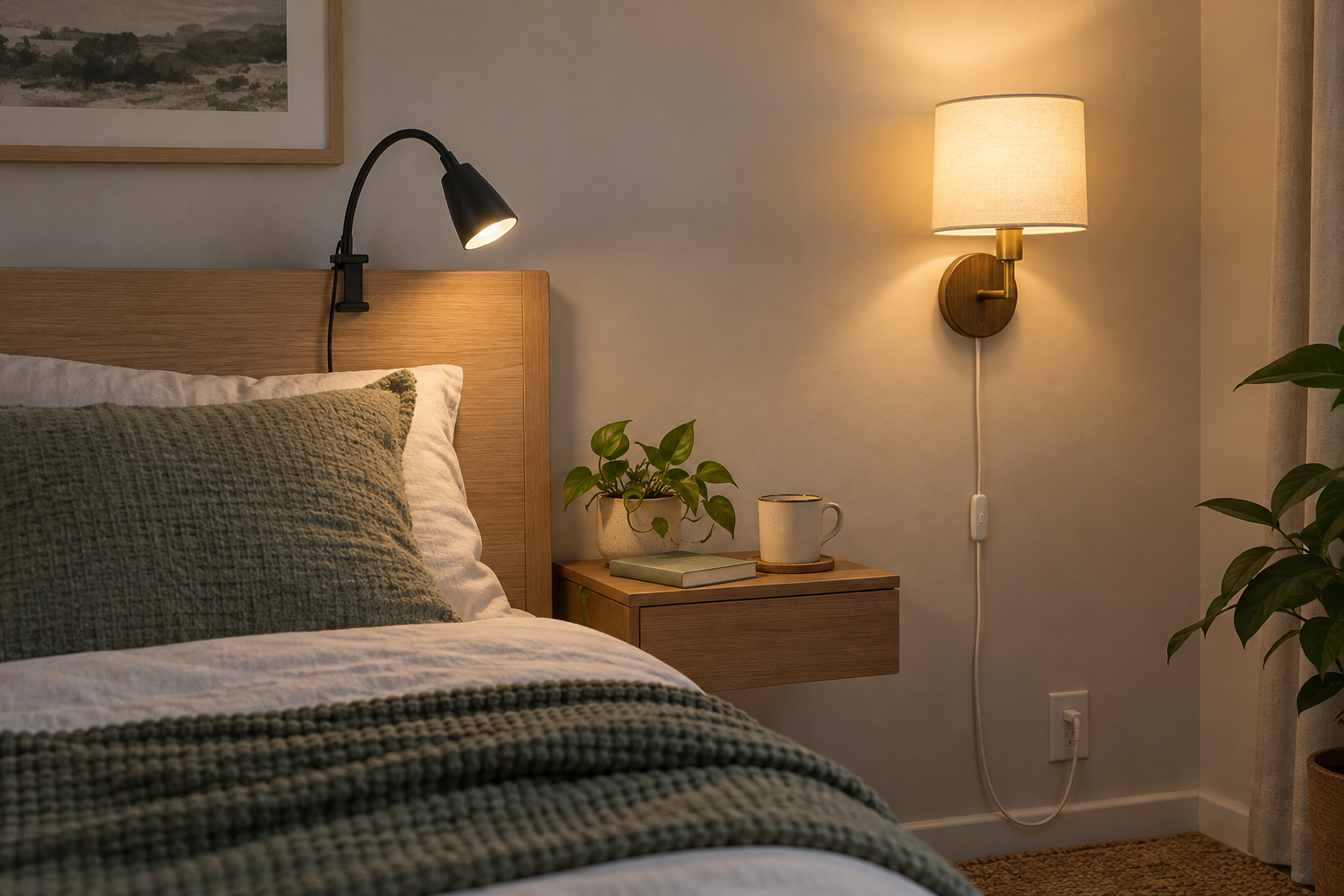
Both formats free the nightstand, but they depend on different parts of the room. A clip-on lamp needs one sturdy, compatible furniture edge. A plug-in wall sconce needs an allowed mounting method, a suitable wall location, and a cord route to the outlet. Choose the support first; style comes later.
As an Amazon Associate, The Good Home Doc may earn from qualifying purchases.
Quick decision before shopping
First measure the available space, identify the setup or surface constraints, and decide who will maintain the item. Skip the category if it blocks access, conflicts with the manufacturer's instructions or lease, or adds more upkeep than the problem justifies.
Compare only the format your room can support:
- Browse category: Compare padded-clamp reading lampsCheck the documented clamp opening, jaw depth, contact pads, neck reach, controls, power setup, and furniture exclusions.
- Browse category: Compare plug-in bedside wall sconcesCheck mounting hardware, wall requirements, fixture projection, cord length, switch position, bulb limits, and maker clearances.
These are category searches, not tested rankings. Verify the current listing, instructions, dimensions, warnings, included hardware, and return terms for the exact lamp.
The short answer
Choose a clip-on lamp when a sturdy headboard or shelf has a flat edge within the maker's clamp range and the lamp can reach the reading position without pulling against the clamp. It is the more portable option and does not need a wall attachment, but clamp pressure can still mark furniture.
Choose a plug-in wall sconce when the wall position is permitted, the specified mounting method suits that wall, and you want the light to stay in one predictable place. It can clear a bulky headboard and offer a longer adjustable arm, but “plug-in” describes power—not no-drill installation.
Choose neither if the only support is fragile or rounded, the wall mounting is not allowed, or either cord would cross a walkway, catch on bedding, or sit where a child or pet can pull it.
Compare the decision that actually matters
| Question | Clip-on lamp | Plug-in wall sconce |
|---|---|---|
| What supports it? | A compatible headboard, shelf, or furniture edge | A suitable wall and the maker-specified mounting hardware |
| Best use | A movable or temporary focused light | A fixed bedside position with repeatable reach |
| Main measurement | Edge thickness, jaw depth, and reach from clamp to page | Mount height, projection, arm reach, cord length, and outlet route |
| Main surface risk | Clamp pressure, pad transfer, scratches, or slipping | Holes, adhesive damage, unsuitable anchors, or wall-finish changes |
| Moving day | Usually easy to pack after inspecting the furniture finish | Requires removal and any permitted wall restoration |
Start with the room, not the lamp
- Mark the useful light position. Sit or lie where you normally read and measure from the page to the possible clamp point and wall point.
- Inspect the support. For a clip lamp, check both faces of the furniture edge. For a sconce, identify the wall material and follow the fixture maker's requirements.
- Map the complete cord route. Include slack for an adjustable neck or arm and keep the route clear of bedding, doors, drawers, pinching furniture, and walking paths.
- Test movement on paper. Mark the full fixture projection and swing area so the lamp will not meet a pillow, curtain, cabinet door, or person getting into bed.
- Check permission. A lease may treat screws, anchors, adhesives, or changes to landlord-owned furniture differently. Get written permission when the rules are unclear.
When a clip-on lamp wins
A clip lamp is the cleaner answer when the headboard or shelf already sits in the right place and the lamp's documented clamp geometry matches it. Shorter rigid or flexible arms put less leverage on the clamp than a long arm, although the actual product design and maker guidance control. Controls on the head or cord should be reachable without tugging the lamp.
It also suits people who expect to move the light between a bed, desk, and reading chair, provided each mounting edge is permitted and compatible. Recheck the pads and furniture finish each time. “Padded” reduces direct contact; it does not guarantee that paint, veneer, laminate, upholstery, or wood finish will remain unmarked.
When a plug-in wall sconce wins
A wall sconce earns the extra setup when you want the same beam position every night and the furniture offers no good clamp point. Fixed shades provide steady general bedside light; directional heads and swing arms can bring a beam closer. Compare projection in both parked and extended positions so the fixture does not crowd the bed.
Confirm whether the exact fixture is designed for screw mounting, another documented method, or a specifically supplied removable system. Do not substitute adhesive strips, anchors, or fasteners that the maker does not permit. If you do not know what is behind the wall or whether the wall can support the specified mount, ask the property owner or an appropriate qualified professional rather than improvising.
Light source and controls
For either format, check the maker's bulb base, maximum wattage, enclosed-shade limits, replaceability, and dimmer compatibility. Integrated LEDs trade bulb replacement for a fixture-specific light source; compare the documented controls and service terms rather than assuming how long it will last. A warm, lower-output setting may be comfortable before sleep, while a directional head can keep more light on a book and out of another person's eyes. Those are fit preferences, not medical sleep claims.
Place the switch where it is easy to reach without stretching across the fixture or pulling the cable. Inline switches can be convenient only if they do not disappear behind furniture. Touch or remote controls add convenience but also create another setup or battery routine.
Setup and maintenance
Read the complete instructions before mounting either lamp. Keep all listed clearances from bedding, curtains, and other materials; use only the specified bulb or power supply; and never modify a cord, plug, lamp holder, mount, or wall connection. Route loose cord length according to the maker's directions without crushing it or tightly coiling it around a heat-producing fixture.
Switch off and unplug the lamp as directed before dusting, tightening allowed hardware, or inspecting it. Periodically check a clamp for movement and marks, or a wall mount for loosening and wall changes. Stop using the lamp if the cord, plug, switch, mount, shade, or housing is damaged, unusually hot, discolored, loose, or unreliable. A plug-in lamp is not a workaround for a damaged outlet; have the property owner or a qualified professional address the electrical problem.
Who should skip each format?
- Skip a clip lamp if the only edge is rounded, tapered, upholstered, glass, fragile, loose, or excluded by either maker.
- Skip a wall sconce if the lease prohibits the required mount, the wall is unsuitable, or you cannot verify the specified attachment.
- Skip a long swing arm if its movement would enter a walkway or contact furniture, curtains, or bedding.
- Skip both if a cord cannot reach the outlet without tension, pinching, or a trip and pull path. A compact table lamp may be simpler when a stable surface is available.
Bottom line
A clip-on lamp is the better small-bedside choice when compatible furniture already provides the mount and portability matters. A plug-in wall sconce is better when an allowed wall position can provide steadier placement and more reach. Measure the support, beam position, fixture movement, and complete cord route before shopping; if either mounting plan requires a workaround, choose the other format or a freestanding lamp.