Renter-friendly lighting
How to Choose Clip-On Lamps for Headboards and Shelves
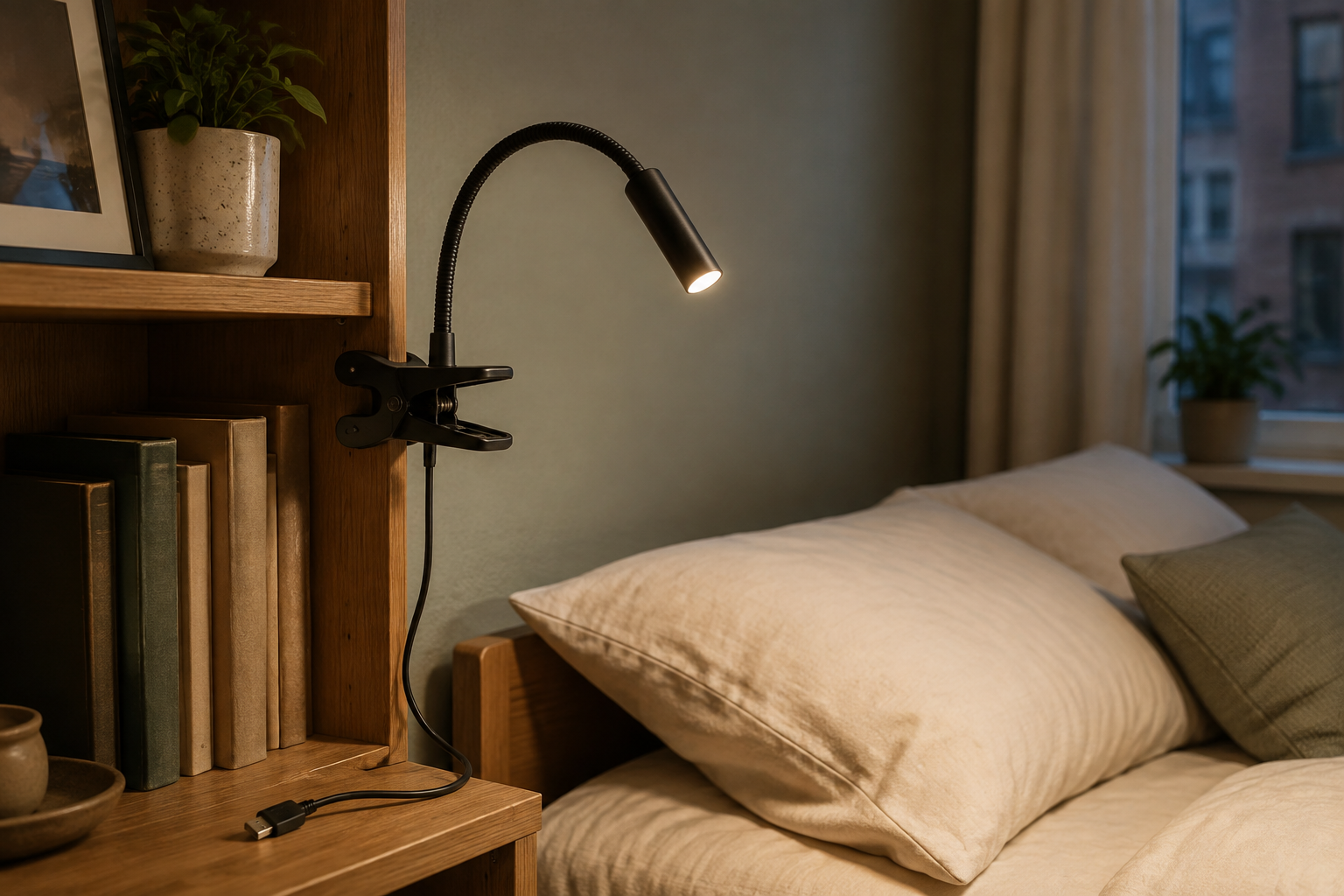
A clip-on lamp makes sense when you need focused light but do not have floor space, a useful tabletop, or permission to install a fixture. The clamp is the real buying decision: it must open wide enough, grip the furniture geometry, protect the finish, and hold the lamp steady through normal adjustments.

If your priority is movable light rather than clamp mounting, compare the broader cordless reading-lamp formats. For other reversible lighting and comfort choices, use the renter-friendly upgrade guide.
The short answer: what product type should you get?
Choose a padded spring-clamp lamp for a flat, sturdy shelf edge that you will use regularly. Choose a rechargeable clip lamp when the nearest outlet would leave a cord across a walkway or when you want to move the lamp between rooms. A corded clip lamp is usually the simpler format for a fixed reading spot where a wall outlet is close and the cord can run without being pinched, stretched, or tripped over.
Skip the category if the only mounting point is rounded, tapered, upholstered, fragile, loose, or expressly excluded by the furniture or lamp maker. A freestanding table or floor lamp is the better choice when a clamp would press on a delicate veneer, painted finish, glass shelf, thin panel, or treasured headboard.
Measure the mounting point before shopping
- Measure thickness. Measure the exact edge where both clamp jaws will land—not the thickest nearby rail. Compare it with the manufacturer's stated clamp opening.
- Check jaw depth. A clamp that barely catches a decorative lip may twist even when its opening is technically large enough.
- Inspect both contact faces. Look under and behind the shelf or headboard for brackets, trim, fabric, fasteners, or an uneven edge.
- Map the lamp's reach. Measure from the clamp point to the page, keyboard, or task surface. Include the direction the neck must bend.
- Plan the cord or charging route. A cord should not cross a walking path, run through a door, or be trapped by furniture. A rechargeable lamp needs an easy place to remove or connect it for charging.
Also check whether the clamp blocks a drawer, shelf access, bedding, or a headboard joint. On a bunk or loft bed, use only products and placements permitted by the bed and lamp manufacturers; do not improvise around guardrails or sleeping-area clearances.
Compare three useful formats
| Format | Best fit | Main tradeoff |
|---|---|---|
| Corded gooseneck clip lamp | A permanent reading or desk spot near an outlet | Needs a controlled cord route and compatible outlet access |
| Rechargeable gooseneck clip lamp | Movable use or furniture away from outlets | Charging becomes recurring maintenance; runtime claims depend on settings |
| Short-arm clip task lamp | A shelf directly above or beside the work area | Less reach, but often less leverage pulling against the clamp |
Must-have features
- A documented clamp range: vague “fits most” language is not a substitute for dimensions.
- Full contact pads: padding should cover the points that touch the furniture. Padding reduces risk but does not guarantee a mark-free finish.
- Controls you can reach: put the switch where you can use it without yanking the neck or cord.
- A head that aims away from eyes: compare neck length, head shape, and light direction rather than chasing brightness alone.
- Clear power specifications: for corded models, check cord length and plug placement; for rechargeable models, check the stated charging connection and how runtime was measured.
Dimming and adjustable color settings can be useful, but they are secondary to a clamp that fits and a light head you can position without glare. Touch controls may be convenient at bedtime; physical buttons can be easier to find without looking.
Renter constraints that matter
Surface compatibility and removal risk
A clip mount avoids drilling, but it is not automatically harmless. Clamp pressure, trapped grit, rubber or foam pads, and repeated movement can mark some paint, wood finishes, laminates, or veneers. Read both the lamp instructions and furniture care guidance. Clean and dry the contact area first, test cautiously in an inconspicuous location when the manufacturer permits it, and inspect the finish periodically. If the furniture belongs to the landlord or came with the rental, get permission before clamping anything to it when the lease or inventory rules are unclear.
Portability and storage
For frequent moves, record the lamp's overall size and weight, not just its head dimensions. A neck that folds compactly and a clamp that stays closed in a storage bin are easier to pack. Protect the lamp head and do not sharply kink a gooseneck or cable. Keep its charger or cable labeled with the lamp.
Noise and shared rooms
A lamp itself should not need a fan, but switches, stiff goosenecks, loose clamp joints, and bedside repositioning can make noise. In a shared bedroom, prioritize a narrow beam, reachable dimmer, and stable placement so you are not repeatedly adjusting it after lights-out.
Setup without overpromising reversibility
- Confirm the furniture is stable, assembled correctly, and suitable for a clamp according to its instructions.
- Wipe grit from the lamp pads and furniture contact area with a method approved for that finish; let it dry.
- Open the clamp fully and place both pads flat on parallel, solid surfaces. Do not force it beyond its stated range.
- Aim the light while supporting the lamp so adjustments do not twist the clamp.
- Route a cord with slack at the lamp and keep it away from bedding, doors, drawers, moving furniture, and walkways.
- After the first few uses, check for slipping, pad movement, heat concerns, or finish changes. Remove it if anything looks wrong.
Follow the manufacturer's electrical, charging, bulb, ventilation, and indoor-use directions. Do not modify a plug, cable, battery, lamp holder, or fixture. If an outlet, cord, plug, or lamp becomes hot, damaged, loose, discolored, or unreliable, stop using it and ask the landlord or a qualified professional to address the underlying electrical issue.
Maintenance
Unplug or switch off the lamp as directed before cleaning. Dust the head, neck, clamp pads, and charging port using the maker's method. Periodically remove the lamp and check both contact surfaces; dust between a pad and the furniture can act like an abrasive. Rechargeable models should be charged and stored within the manufacturer's temperature and battery guidance. Replace damaged cables or power components only with approved parts.
Who should skip a clip-on lamp?
- Anyone without a flat, strong, manufacturer-compatible clamping edge.
- Renters whose only option is landlord-owned furniture and who do not have clear permission.
- Households where the lamp or cord would be easy for children or pets to pull down.
- Readers who need broad room illumination rather than a focused task beam.
- Anyone who cannot route a cord safely or maintain a rechargeable battery routine.
Bottom line
The best clip-on lamp is the one whose documented clamp opening, jaw shape, padding, reach, and power setup match one specific piece of furniture. Measure first, protect the surface, and treat “no-drill” as a mounting description—not a promise that every finish or lease permits the setup. If the bedside could support either approach, compare a clip-on lamp with a plug-in wall sconce before choosing a format.