How to Choose Pedestal Fans for Large Bedrooms
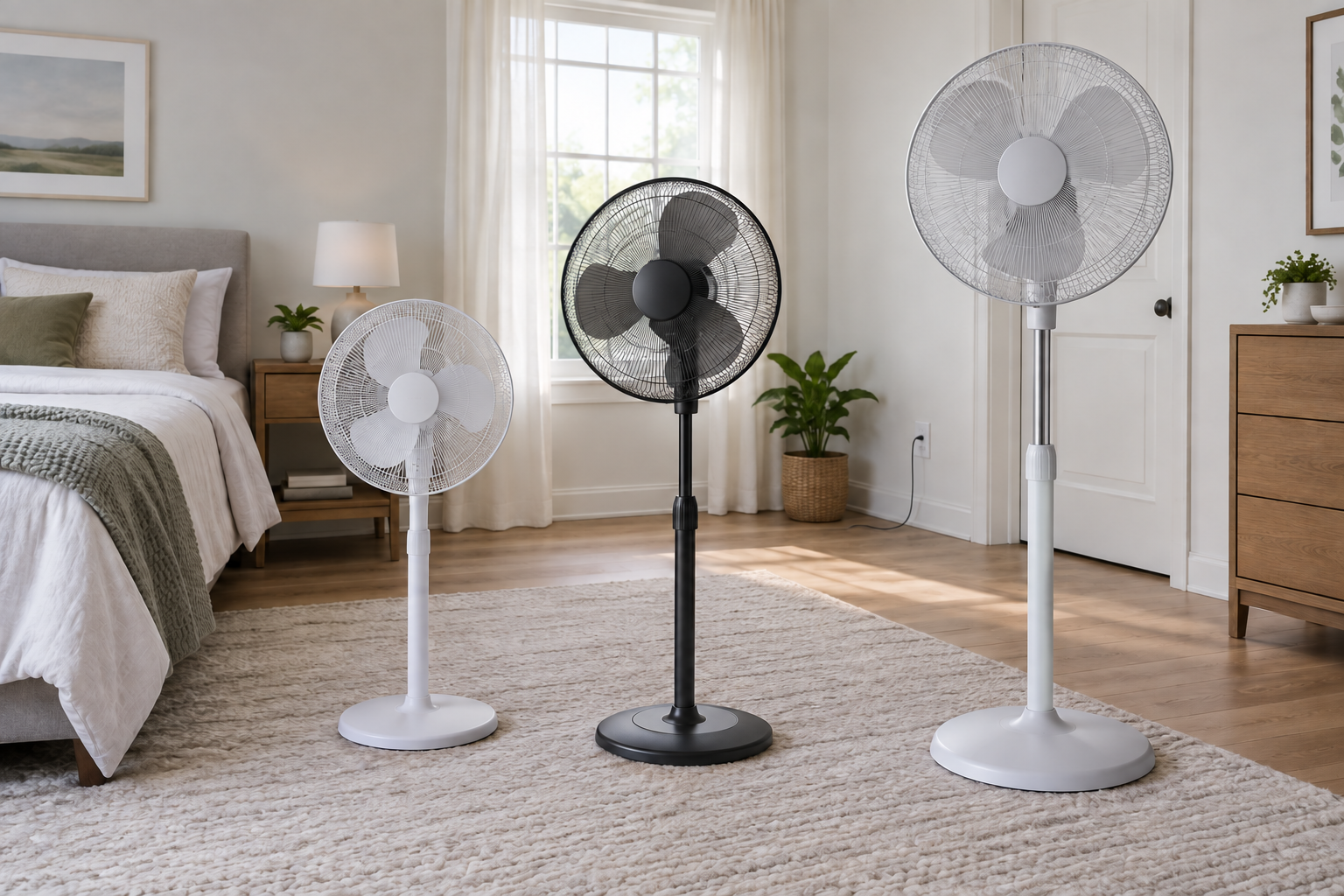
A pedestal fan earns its floor space when its adjustable height and directional airflow can serve the part of a large bedroom people actually occupy. Measure the base and walking path first, then compare usable adjustment, controls, cleaning access, and sound information. A fan moves room air; it does not lower room temperature like air conditioning or correct unsafe heat, humidity, smoke, or a ventilation problem.
As an Amazon Associate, The Good Home Doc may earn from qualifying purchases.
Quick decision before shopping
First measure the available space, identify the setup or surface constraints, and decide who will maintain the item. Skip the category if it blocks access, conflicts with the manufacturer's instructions or lease, or adds more upkeep than the problem justifies.
Compare adjustable pedestal-fan formats:
- Browse category: Shop adjustable oscillating pedestal fansVerify the base dimensions, height and tilt range, oscillation control, speed settings, cord length, grille access, assembly, and storage size.
This is a category comparison, not a hands-on test or ranking of named models. Confirm current specifications, intended use, safety instructions, sound-test basis, warranty terms, and return policy in the listing and manufacturer documentation.
Quick best-fit guide
- For one occupied zone: choose a straightforward adjustable-height model whose tilt can aim across the bed or seating area without needing an improvised stand.
- For two sides of a room: consider independently controlled oscillation, but check whether its full sweep hits curtains, furniture, or a doorway.
- For frequent nighttime changes: prioritize reachable controls, restrained indicator lights, and documented control behavior over a long feature list.
- For seasonal storage: check the minimum height and whether the head or base may be disassembled according to the instructions.
Map the airflow job before comparing fans
A larger bedroom is not one uniform target. Mark the bed, desk, reading chair, doorway, dresser, curtains, and the path used in the dark. Decide whether the fan needs to serve one side of the bed, sweep across two occupied positions, or help circulate air toward an open doorway. Wider oscillation is not automatically better when much of the sweep points at empty wall space.
If the problem is stale air, high humidity, an odor source, or outdoor smoke, moving the same indoor air may not solve it. Use the air-circulator buy-or-skip guide to define the problem before buying. Follow official local guidance during smoke, extreme heat, or other poor-air conditions.
Measure the complete footprint
Record the base width and depth, not only the fan-head diameter. Add room for the head to tilt, the grille to clear curtains and bedding, the oscillation sweep, control access, and a walking path around the setup. Confirm that the cord reaches an appropriate outlet without crossing a doorway, running beneath a rug, or creating a route people will step over at night.
Use the fan only on the level surface and in the orientation the manufacturer specifies. Do not put a pedestal fan on furniture, boxes, or another improvised platform to gain height. Keep the intake and grille clear of curtains, loose bedding, hair, toys, and small objects.
Compare height, tilt, and oscillation as a system
Published maximum height is useful only when the adjustment locks securely and the head can still aim at the intended zone. Check the complete height range, tilt positions, locking method, and whether adjustments require two hands or loosening a collar. If more than one person uses the room, controls that are easy to reset can matter more than an extreme range.
Oscillation spreads airflow over time rather than increasing the fan's underlying output. Look for a sweep that can be turned on and off independently and a head that does not strike nearby objects anywhere in its travel. A fixed direction may be the better choice for one sleeper or a narrow clear path.
Put must-haves before extras
Must-haves
- A base that fits the marked floor area while leaving a clear route through the room.
- A height and tilt range that reaches the occupied zone from a stable floor position.
- Controls that remain practical from the intended location.
- A protected grille and clear instructions for assembly, adjustment, cleaning, and storage.
- A cord route that reaches the outlet without rugs, doorways, pinch points, or trip exposure.
- A return policy suitable for checking sound and airflow fit in the actual bedroom.
Nice-to-haves
- A timer when the documented increments match the household routine.
- A remote with a clear storage spot.
- Indicator lights that can be dimmed or turned off if the maker documents that function.
- Tool-light grille access for routine dust removal.
Treat “quiet” as a documented comparison
Sound changes with speed, distance, room surfaces, grille condition, base contact, and oscillation. If a listing publishes a sound level, look for the speed, distance, and test conditions behind the number. Do not compare an unlabeled minimum from one product with a maximum-speed figure from another.
Also consider the character of the sound: motor tone, blade rush, oscillation clicks, control beeps, and base vibration may matter differently to different sleepers. A workable return policy is useful because a specification cannot reproduce the bedroom or personal sound sensitivity.
Cleaning, assembly, and storage
Pedestal fans collect dust on both sides of the grille and on the blades. Check whether the grille can be opened as directed, which tools are needed, and how every cleaned part must dry before reassembly. Unplug the fan before cleaning and follow the current instructions; do not spray liquid into the motor or controls.
Assembly quality matters because the head sits above a narrow support. Confirm that the base, pole sections, collars, grille, and blade hardware are present and tightened in the specified order. Stop using a fan that wobbles, has a damaged grille, cord, plug, base, or control, or develops unusual noise or heat.
For off-season storage, measure the closet or shelf before assuming the fan will fit. Keep all permitted removable parts and hardware together, and never force disassembly that the instructions do not authorize.
Who should skip a pedestal fan?
- Rooms with no stable floor location that preserves exits, door travel, and nighttime walking paths.
- Households where children, pets, loose curtains, or bedding cannot be kept clear of the fan and cord.
- Anyone who needs outdoor-air exchange rather than circulation; a compatible window setup may be the more relevant format when conditions and building rules allow it.
- Anyone trying to address unsafe heat, smoke, strong chemical fumes, combustion gases, persistent dampness, or a failed building system. Contact the property manager or an appropriate qualified professional and follow official health or emergency guidance.
- Small occupied zones that can be served by a compact bedside or clip-on fan without using permanent floor space.
Buying checklist
- Mark the occupied zone and decide whether fixed direction or oscillation fits it.
- Measure the base, full height range, head clearance, sweep, walking path, and storage spot.
- Plan a direct, protected cord route to an appropriate outlet.
- Compare adjustment locks, controls, indicator behavior, grille access, and assembly instructions.
- Read sound claims only with their speed and test basis.
- Confirm current specifications and a realistic return path before ordering.
Bottom line
For most large bedrooms with a clear floor location, the best pedestal fan is a stable adjustable-height model that can aim at the occupied zone on a useful low setting and oscillate only when the room layout benefits. Base fit, cord routing, adjustment locks, accessible controls, cleaning, and storage matter more than a long list of modes. Skip the category when it crowds the room or when circulation is being asked to solve a heat, air-quality, humidity, or building problem.