How to Choose Over-Door Laundry Organizers for Small Spaces
An over-door organizer can give laundry supplies a home without claiming floor or shelf space—but only if the complete organizer fits the door while loaded. Measure the door, frame, hinges, knob, wall, and baskets before choosing pockets or rigid bins. Then reserve this format for light, contained supplies that will not leak, fall, or keep the door from working normally.
As an Amazon Associate, The Good Home Doc may earn from qualifying purchases.
Quick decision before shopping
First measure the available space, identify the setup or surface constraints, and decide who will maintain the item. Skip the category if it blocks access, conflicts with the manufacturer's instructions or lease, or adds more upkeep than the problem justifies.
Start with the format that fits the supplies: These affiliate category links are shopping starting points, not tested rankings.
- Browse category: Structured over-door laundry organizersCompare these when bottles and small boxes need upright, visible compartments.
- Browse category: Pocket-style laundry door organizersUseful for cloths, mesh bags, dryer balls, and other light supplies that fit fully inside a pocket.
- Browse category: Over-door basket organizersWorth comparing when wipeable open baskets fit the door and keep every container upright.
Confirm door-thickness range, bracket dimensions, installed depth, compartment dimensions, stated load, included padding, material care, and any wall-fastening requirements with the current manufacturer documentation before buying.
This is a format guide, not a claim that one organizer works on every door. Door-hung storage is best treated as a measured use of otherwise empty vertical space. If the organizer rubs the frame, changes latching, obstructs a closer or vent, or swings into a wall, choose a narrow freestanding cart, a shelf bin, or another approved storage location instead.
Quick Picks by Supply Type
- Best for folded cloths and mesh wash bags: deep fabric pockets with visible openings and removable inserts if the maker provides them.
- Best for small upright containers: structured baskets with a solid or closely spaced base and a retaining front lip.
- Best for damp rooms: a maker-approved wipeable material with open airflow and hardware suited to the stated environment.
- Best for frequent door use: a shallow organizer with padded hooks and lower stabilization supplied or approved by the maker.
- Best for heavy detergent, glass, or bulk refills: skip the door and use a stable shelf or floor-supported cabinet.
Measure the Door as a Moving System
Start with door thickness and the gap above the door, but do not stop there. Measure the bracket itself, including any protective pad. Check the top frame, hinge side, latch, knob or lever, trim, nearby wall, washer controls, shelving, and anything behind the door. Slowly move the bare door through its normal swing and note the narrowest clearance.
Next, add the organizer's full installed depth—not just the empty fabric panel. A basket holding a spray bottle can project farther than its listed frame. Confirm that the door can still open, close, and latch normally without forcing it. Do not cover ventilation openings, labels, controls, utility access, or required door hardware. Ask the property owner before using a door-mounted product when lease or building rules are unclear.
Compare the Main Organizer Formats
Soft Pocket Organizers
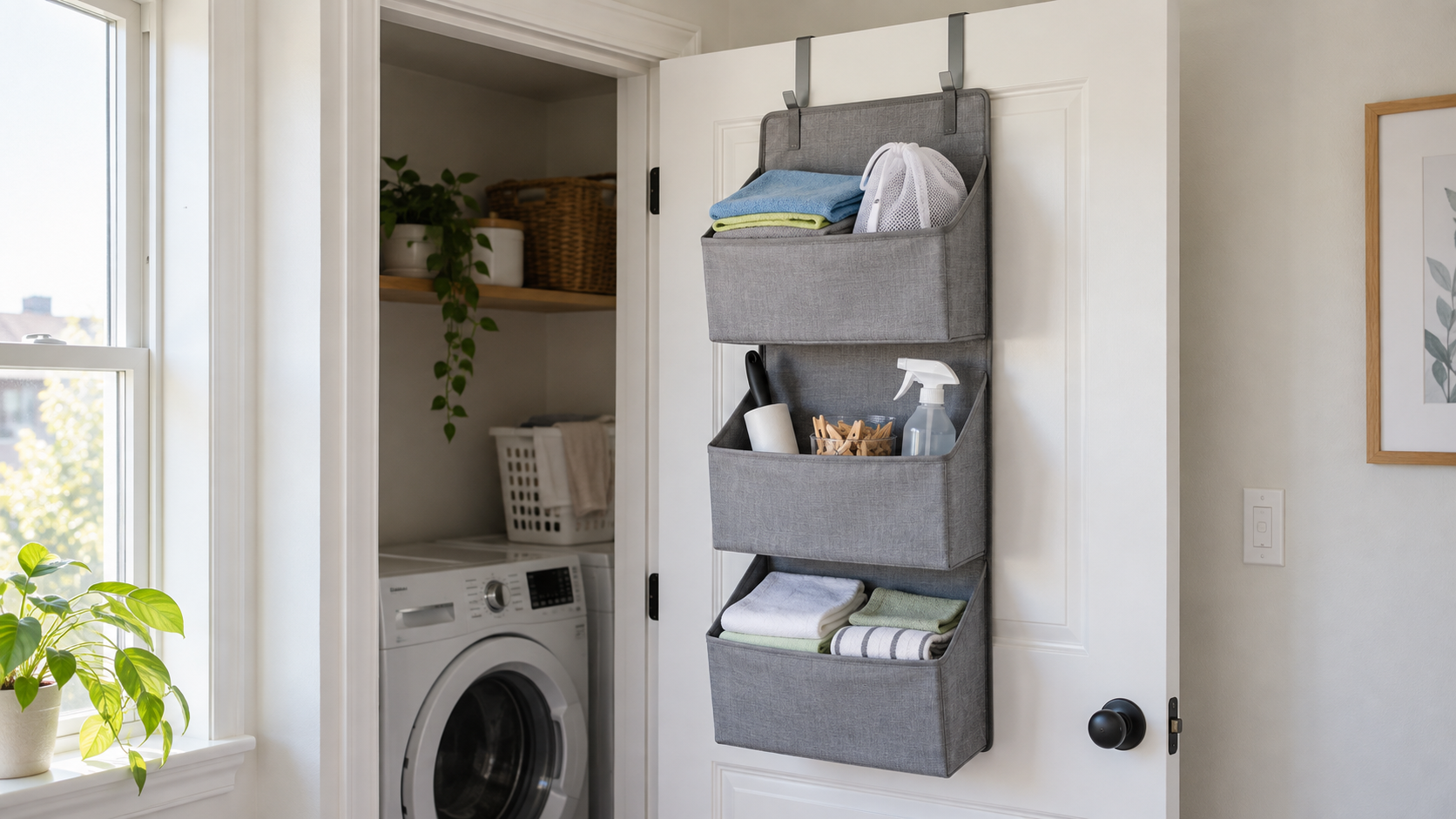
Fabric pockets store light, irregular items without rigid basket hardware. They can work well for wash bags, stain-treatment cloths, lint rollers, clothespins, dryer balls, and empty reusable containers. Pocket depth and opening shape matter: a deep pocket can hide small items, while a shallow one may let tall containers lean out.
Choose one if: most supplies are light, dry, and unlikely to leak. Watch for: sagging that increases installed depth, seams that carry the load, inserts that cannot be removed for care, and items that disappear below the pocket edge.
Rigid or Structured Baskets
Wire, plastic, or reinforced fabric baskets keep their shape and make small containers easier to see. Verify base spacing, front-lip height, and internal dimensions against each container. A basket that looks roomy online may not contain a narrow bottle or box once the door moves.
Choose one if: upright visibility and wipeable surfaces matter. Watch for: wide wire gaps, hard edges near the door finish, corrosion or coating-care limits, noisy movement, and baskets deep enough to strike a wall or appliance.
Mixed Pocket-and-Basket Systems
A mixed organizer can separate soft supplies from small containers, but extra parts add depth and load. Choose this format only when the compartment mix matches what you actually store; unused specialty pockets do not justify a larger panel.
Choose one if: the laundry routine genuinely includes both folded accessories and a few contained products. Watch for: top-heavy loading, hard-to-clean seams, removable pieces without secure retention, and a full system that exceeds the maker's stated use.
Contain Laundry Products Conservatively
Keep every product in its original closed container and follow its label. The organizer does not make a leaking, damaged, or poorly closed package suitable for door storage. Avoid decanting products merely to fit a pocket, and do not place loose pods, powders, liquids, or unlabeled mixtures in an organizer.
Heavy detergent jugs, bulk refill bottles, irons, steamers, glass containers, and anything that could cause harm if it falls belong on stable storage approved for their weight and use. Keep household laundry products out of reach as directed on their labels, especially in homes with children or pets. A higher organizer is not automatically secure storage.
Must-Have Features
- Documented door fit: a stated door-thickness range plus bracket dimensions you can compare with the top gap and frame.
- Usable compartment measurements: internal width, depth, and height that fit the exact supplies without leaning or crowding.
- Contained bottoms and fronts: openings small and tall enough to keep the intended items in place during normal door movement.
- Protected contact points: maker-provided or approved padding where hooks, braces, or stabilizers touch the door.
- Clear load guidance: a stated total limit and any per-pocket or per-basket limits, without treating that number as a durability promise.
- Practical care instructions: a way to wipe, wash, and fully dry the surfaces according to the maker's directions.
Nice-to-Have Features
- Lower stabilization: manufacturer-supplied bumpers or restraints can reduce movement when compatible with the door and lease.
- Removable bins: useful when they detach securely for cleaning and cannot jump free as the door moves.
- Open labeling: simple visible categories can reduce rummaging without adding dangling tags.
- Replaceable hooks or baskets: helpful only when replacement parts are actually documented and available from the maker.
Humidity, Cleaning, and Door Protection
Laundry closets can collect heat and moisture. Follow appliance ventilation and clearance instructions, and do not let the organizer block louvers or airflow. If the room stays damp, smells musty, or shows recurring condensation, address the source or ask the property owner or a qualified professional rather than using storage to cover the problem.
Choose care based on what can spill. Wipeable rigid baskets may suit closed bottles; washable pockets may suit dry accessories. Remove dust and lint, clean spills promptly according to both product and organizer instructions, and let every part dry completely before reloading. Periodically inspect hook padding, seams, fasteners, coating, and the door finish for wear or movement.
Who Should Skip an Over-Door Organizer
- Anyone whose door already rubs, sticks, fails to latch, or has uncertain hardware or clearance.
- Homes where the only available door is an exterior, fire-rated, louvered, folding, sliding, glass, or specialty door without explicit compatible-product guidance.
- Households primarily storing heavy jugs, glass, bulk refills, heated tools, or leak-prone containers.
- Renters who cannot confirm that hooks, padding, stabilizers, and normal door use comply with their lease or property rules.
- Rooms where the organizer would block an appliance, utility, vent, switch, handle, walkway, or required access.
Buying Checklist
- List the exact lightweight supplies and measure the tallest, widest, and deepest container.
- Measure door thickness, top gap, frame, hardware, full swing, wall clearance, and the space behind the door.
- Compare the organizer's complete installed depth and compartment interiors—not only its overall width and height.
- Confirm stated total and compartment loads, intended use, contact padding, stabilization, and door restrictions.
- Choose pocket, basket, or mixed storage based on containment and cleaning rather than maximum capacity.
- Keep heavy, breakable, leaking, or heat-producing items somewhere stable and appropriate.
- Install only as directed, test the empty door slowly, add light items gradually, and recheck normal closing and latching.
Bottom Line
The best over-door laundry organizer is shallow enough for the entire door swing, matched to the door's documented dimensions, and divided for the lightweight supplies you actually use. Choose soft pockets for dry accessories, structured baskets for small contained packages, or a mixed system only when both earn their space. Skip door storage when it compromises normal door function, appliance clearance, product containment, or renter permission.