How to Choose Mesh Laundry Bags for Delicates and Small Items
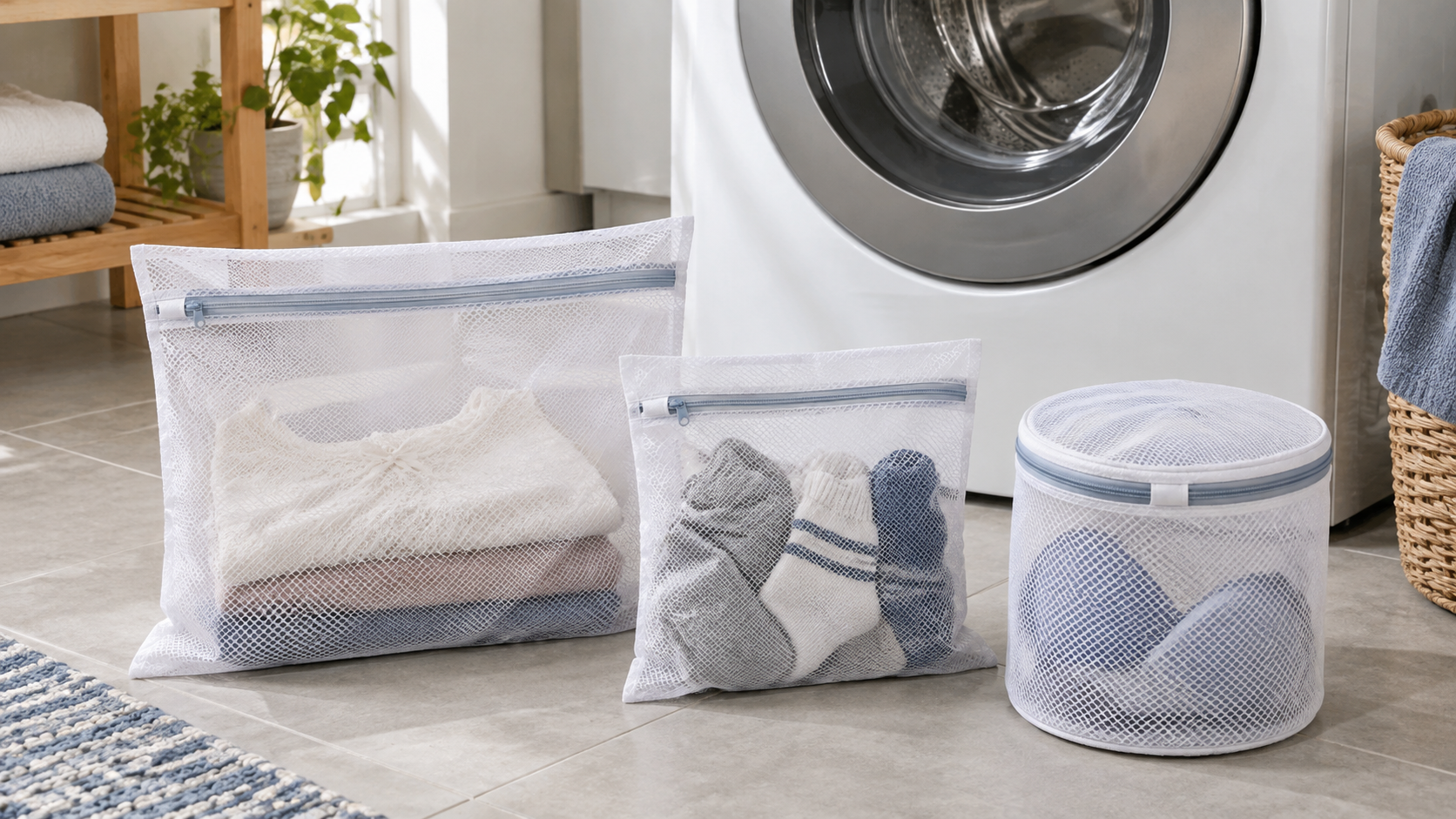
The best mesh laundry bag is not simply the finest mesh or the largest bundle. It fits the item without crowding, stays closed through the permitted wash cycle, and has seams and a zipper cover that do not create a new snag point. Flat rectangular bags suit many lightweight garments, small bags keep socks and removable pieces together, and structured cylinders can give shaped items more room—when both the garment label and bag instructions allow machine washing.
As an Amazon Associate, The Good Home Doc may earn from qualifying purchases.
Quick decision before shopping
First measure the available space, identify the setup or surface constraints, and decide who will maintain the item. Skip the category if it blocks access, conflicts with the manufacturer's instructions or lease, or adds more upkeep than the problem justifies.
Start with the shape of the actual wash load:
- Browse category: Compare fine-mesh rectangular bagsCheck usable inside dimensions, mesh openness, zipper cover, seams, and permitted cycles.
- Browse category: Compare small bags for socks and loose piecesChoose a size that contains the items without packing them into a dense bundle.
- Browse category: Compare structured cylindrical bagsVerify supported garment shapes, washer guidance, closure, construction, and storage size.
These are category searches, not tested rankings. Confirm the seller or maker's dimensions, materials, closure, wash and drying instructions, and warnings. Follow the garment care label and washer manual even when a bag listing suggests broader use.
Quick picks by load
- For lightweight folded delicates: a flat fine- or medium-mesh rectangle with enough length and width for the item to lie loosely.
- For socks and removable washable pieces: a smaller zippered bag that is easy to find and empty after the cycle.
- For shaped machine-washable items: a structured bag only when its shape and dimensions match the item and its instructions.
- For mixed household laundry: several purposeful sizes rather than a large assortment of duplicates.
Comparison framework
| Format | Best fit | Main check | Reason to skip |
|---|---|---|---|
| Fine-mesh rectangle | Lightweight fabrics, straps, and small hardware approved for machine washing | Enough water flow and space without an abrasive or easily snagged surface | Too small, overly dense, or incompatible with the garment or cycle |
| Coarser-mesh rectangle | Sturdier washable items that mainly need separation | Opening size relative to hooks, tabs, trim, and small pieces | Openings can catch or allow a small part through |
| Small sock bag | Socks and compact washable pieces | Closure security and a load that remains loose | It becomes a tightly packed ball |
| Structured cylinder | Compatible shaped garments needing room around their form | Internal diameter, height, frame construction, and care | The structure presses, distorts, or conflicts with maker guidance |
Measure the garment, not the package count
Lay the largest intended item in its natural washing shape and measure its length, width, and depth. Compare those measurements with the bag's usable interior, not only its outside dimensions. Leave room for fabric to move rather than folding or compressing it until the zipper barely closes.
A multi-size set is useful only when the sizes match distinct loads. Before buying six or twelve pieces, identify where each will dry and be stored, and whether the seams and closures are consistent across every size.
Choose mesh by the item
Fine mesh can better contain small parts and reduce direct contact with other laundry, but “fine” is not a standardized promise and dense fabric can restrict flow when overloaded. More open mesh admits water readily but may be a poor match for hooks, decorative trim, or tiny components. Inspect documented material details, then check the bag against the specific garment.
A bag does not prevent every snag, color transfer, abrasion, shape change, or hardware problem. Fasten hooks and closures only as the garment maker directs, separate colors when needed, and do not put incompatible items together merely because the bag has space.
Check the zipper, cover, and seams
Look for a zipper that closes fully without trapping fabric and a pull cover or elastic keeper designed to hold the pull in place. The cover should remain usable when the bag is loaded normally. Inspect seam binding, corners, and any structural frame for rough or unfinished contact points.
Hook-and-loop closures can collect lint or contact delicate fabric if not completely covered. Drawstrings and loose cords add parts that can tangle. Retire the bag if the closure opens, a seam separates, or the mesh develops a hole.
Washer and care compatibility
Choose temperature, cycle, detergent, spin, and load size from the most restrictive applicable instruction: the garment label, washer manual, or bag directions. Keep the overall machine load balanced and do not wedge several packed bags into the drum. A containment bag cannot make a hand-wash-only, dry-clean-only, color-bleeding, heavily decorated, or damaged item safe for machine washing.
Check whether the empty bag may go in a dryer or should air-dry. Empty it promptly, inspect it, and let it dry fully before storage. Avoid high heat unless the bag maker expressly permits it.
Must-have features
- Documented dimensions that fit the intended item loosely.
- A complete closure with a protected pull or similarly contained design.
- Mesh openings appropriate for the item's hardware and small parts.
- Smooth, finished seams and accessible construction for inspection.
- Clear washing, drying, temperature, and replacement guidance.
Nice-to-have features
A small loop can help air-dry and store an empty bag, while simple color coding can separate household members or load types. Structured shapes are useful only for a verified garment fit. Printed labels, oversized bundles, and novelty shapes do not compensate for unclear dimensions or care instructions.
Who should skip mesh laundry bags?
Skip the category when your garments already wash safely without containment, when the care label prohibits machine washing, or when the only available bag would crowd or distort the item. Also skip a general mesh bag for underwired, molded, embellished, valuable, fragile, or damaged garments unless their maker specifically allows the proposed washing method and bag format.
If you need containment only once, a compatible pillowcase may be a reasonable no-buy fallback, but it has its own closure and loading limits. For uncertain or high-value items, ask the garment maker or a qualified textile-care professional.
Bottom line
Buy by garment shape and usable bag dimensions first, then compare mesh, zipper protection, seams, and care. A small set of correctly sized bags is more useful than a large assortment that encourages overloading. The bag manages approved machine-washable items; it never overrides the garment label or appliance instructions.
Next step: Put this decision in context with the home-product buying framework guide.