Small-bathroom grooming tool storage
How to Choose Hair Tool Organizers for Small Bathrooms
A useful hair tool organizer gives every unplugged, fully cooled tool a stable home without crowding the sink or tangling its cord. In a small bathroom, the best format depends less on compartment count than on the largest tool, the available dry zone, and whether a cabinet door can still open and close normally.
As an Amazon Associate, The Good Home Doc may earn from qualifying purchases.
Quick decision before shopping
First measure the available space, identify the setup or surface constraints, and decide who will maintain the item. Skip the category if it blocks access, conflicts with the manufacturer's instructions or lease, or adds more upkeep than the problem justifies.
Choose a format only after measuring the tools and storage zone:
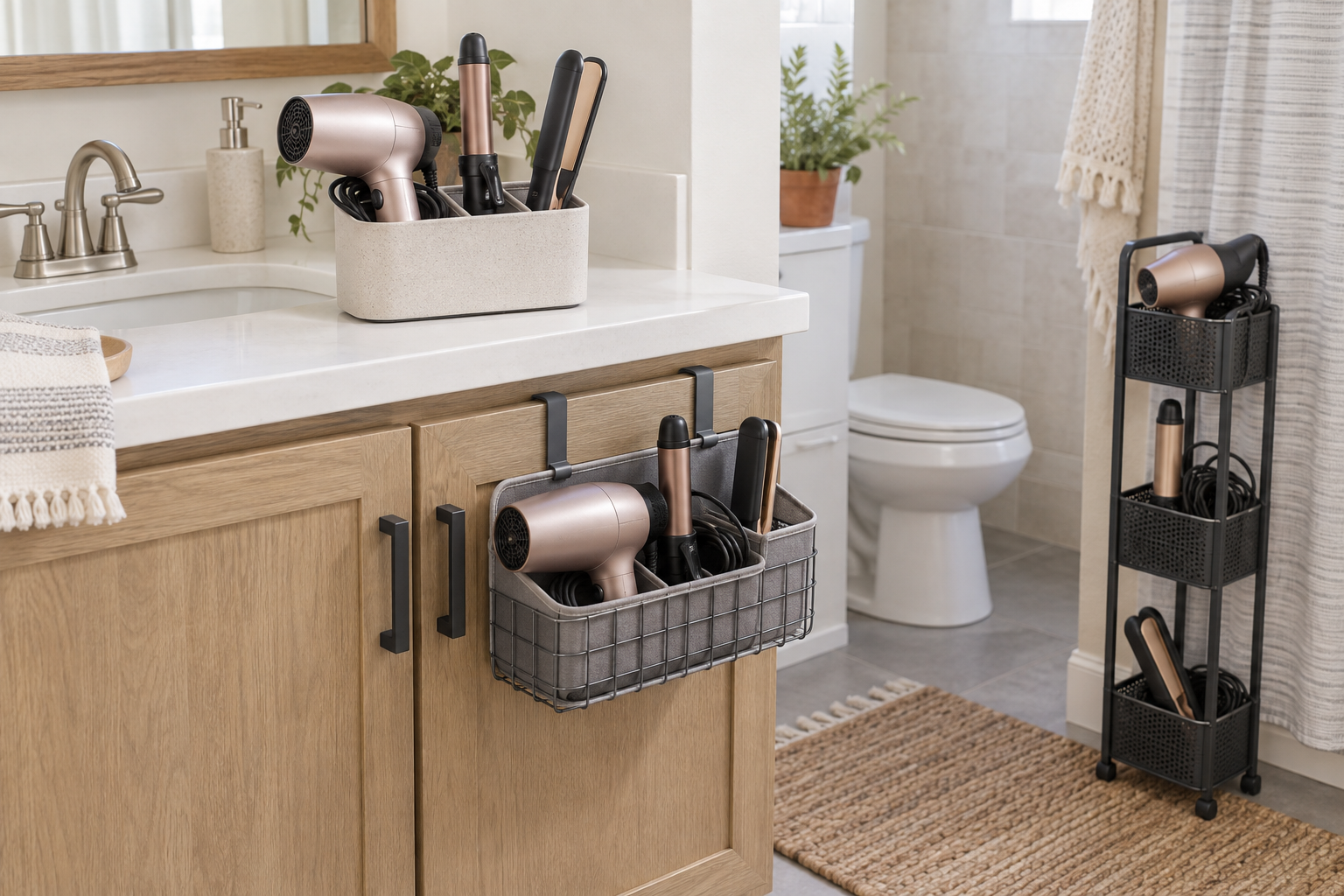
- Browse category: Compare countertop hair tool organizersStart here when daily access matters and a dry, stable counter area remains clear of the sink.
- Browse category: Compare cabinet-door hair tool organizersCheck door thickness, padding, interior clearance, hinge movement, and the loaded basket projection.
- Browse category: Compare freestanding hair tool caddiesUseful when the counter and cabinet door are unavailable, provided the complete footprint stays out of splash and traffic.
These are category searches, not tested rankings. Confirm current compartment dimensions, permitted tool types, material and heat guidance, cord storage, mounting or feet, care instructions, and return terms before buying.
This guide compares organizer formats, not named winners. An organizer is storage, not a license to put away a hot, plugged-in, wet, damaged, or manufacturer-prohibited tool.
Quick best-fit guide
- Choose a countertop organizer when a dry corner is available and tools need to be reached every day.
- Choose a cabinet-door organizer when the measured door and cabinet interior can accept the hanger and loaded basket without interference.
- Choose a freestanding caddy when the other zones are unavailable and a stable, low-traffic floor or shelf position exists.
- Skip all three when the only location is wet, unstable, beside a heat source, or within a route where cords and handles can snag.
Measure the tools before the organizer
Measure the hair dryer's widest body and nozzle, the full length and barrel diameter of each styling tool, and the plug or power block that must be stored. Note where controls, vents, hinges, stands, and cords project. A tall compartment can still fail if a dryer body rests on its edge or a flat iron cannot enter without forcing the hinge.
Then measure the organizer's complete operating zone. Include counter depth, faucet and mirror clearance, drawer travel, cabinet shelves, door swing, baseboard gaps, walking space, and room for a hand to lift each tool straight out. Use exterior and usable compartment dimensions; capacity labels alone do not establish fit.
Compare the three practical formats
Countertop organizers
A countertop bin or divided stand keeps the routine visible and requires no mounting. It also consumes scarce work surface and receives every drip, hair, and product residue nearby. Choose a wide, stable base and compartments that keep heavier tools from pulling the organizer over when one item is removed.
Cabinet-door organizers
An over-door basket moves storage off the counter, but the hanger, basket, cords, and tool handles must clear the cabinet frame, shelf, plumbing, drawer, and contents through the entire door swing. Padding can reduce direct contact; it does not guarantee a damage-free fit. Do not force a door, alter a hanger, or overload the cabinet front.
Freestanding caddies
A narrow tower or portable caddy can hold several tools without using the vanity. Its usefulness depends on a real parking spot. Check base width, balance when the upper compartment is loaded, feet or casters, the pull-out route, and whether the caddy blocks cleaning or becomes a trip or snag point.
Must-have buying checks
- Usable compartments: Each opening must fit the intended tool without pressing controls, vents, hinges, or cords.
- Stable loading: Removing one tool should not tip, lift, or drag the organizer.
- Material instructions: Follow the organizer and tool makers' storage, temperature, and cooldown directions; do not infer heat resistance from appearance.
- Cord control: Store cords loosely, without tight winding, pinching, crushed plugs, or loops that enter a walkway.
- Dry placement: Keep the organizer and tools away from sink splash, wet towels, shower spray, and standing water.
- Cleanable surfaces: Choose removable cups, liners, or open compartments that can be emptied and cleaned as directed.
Nice-to-have features
Separate cord pockets, removable dividers, rounded openings, non-slip feet, and lift-out liners can make a good fit easier to maintain. A carry handle helps only when it remains balanced under the intended load. Heat-resistant sleeves or inserts are relevant only when their product-specific instructions match the exact tool and storage routine; they are not a reason to skip unplugging and cooldown.
Plan a cautious cooldown routine
- Turn off and unplug the tool according to its instructions.
- Place it on the maker-permitted stable, dry, heat-appropriate surface, away from water and anything that can be scorched or melted.
- Let it cool for the required time and keep children and pets away.
- Inspect the cord, plug, housing, plates, barrel, and organizer before storage. Stop using damaged equipment and follow the maker's service or disposal guidance.
- Store the fully cooled tool without pinching the cord or blocking another tool's removal.
Do not use an organizer as a live-tool holster unless both the tool and organizer instructions explicitly permit that exact use. When instructions conflict, choose a separate cooldown location rather than improvising.
Humidity, cleaning, and placement
A bathroom organizer cannot correct a leak, persistent dampness, or inadequate ventilation. Let wet surfaces and cleaning residue dry before replacing tools. Remove hair and product buildup on the schedule and with the method each material allows; dry every part before reassembly.
Keep tools and plugs out of closed storage while damp. If the vanity is swollen, the receptacle or cord is damaged, water is reaching electrical equipment, or the setup raises an electrical concern, stop using the area and contact the landlord, property manager, or a qualified professional as appropriate.
Who should skip this category
- Skip countertop storage when it would crowd handwashing space or sit within regular splash.
- Skip a cabinet-door basket when the door is loose, thin, damaged, misaligned, or unable to close freely with the complete setup.
- Skip a freestanding caddy when no stable dry parking spot exists outside the walking route.
- Skip multi-tool storage when the organizer's openings do not match every tool's shape and instructions.
- Skip the purchase if a decluttered drawer or existing dry shelf already stores the cooled tools without tangling or crowding.
Bottom line
A countertop organizer is the simplest daily-access choice when dry counter space exists. A cabinet-door basket can reclaim that surface only after a complete clearance check, while a freestanding caddy trades counter space for floor or shelf space. Measure the actual tools, preserve normal room movement, and build the decision around unplugging, full cooldown, dry storage, and easy cleaning.