How to Choose Furniture Leg Pads for Hard Floors
Furniture pads work only when the contact material suits the floor, the pad fits the entire leg, and grit is kept out of the contact point. Choose by how the furniture moves—not by a universal “floor-safe” label—and expect every pad to need inspection and replacement.
As an Amazon Associate, The Good Home Doc may earn from qualifying purchases.
Quick decision before shopping
First measure the available space, identify the setup or surface constraints, and decide who will maintain the item. Skip the category if it blocks access, conflicts with the manufacturer's instructions or lease, or adds more upkeep than the problem justifies.
Compare formats after checking your flooring guidance and measuring each leg: Browse category: browse furniture leg pads for hard floors.
This is a category search, not a tested ranking. Confirm current dimensions, attachment method, compatible floor finishes, furniture-leg material, installation instructions, care, replacement guidance, and return terms before buying.
No pad can guarantee a scratch-free floor. A correct-looking protector can still trap grit, slide off-center, react with a finish, compress under weight, or expose a fastener as it wears. Read the flooring maker's care and warranty guidance as well as the pad instructions. If the floor is newly finished, damaged, unusually soft, or warranty-sensitive, ask the flooring maker or installer before adding a contact material.
Quick Best-Fit Guide
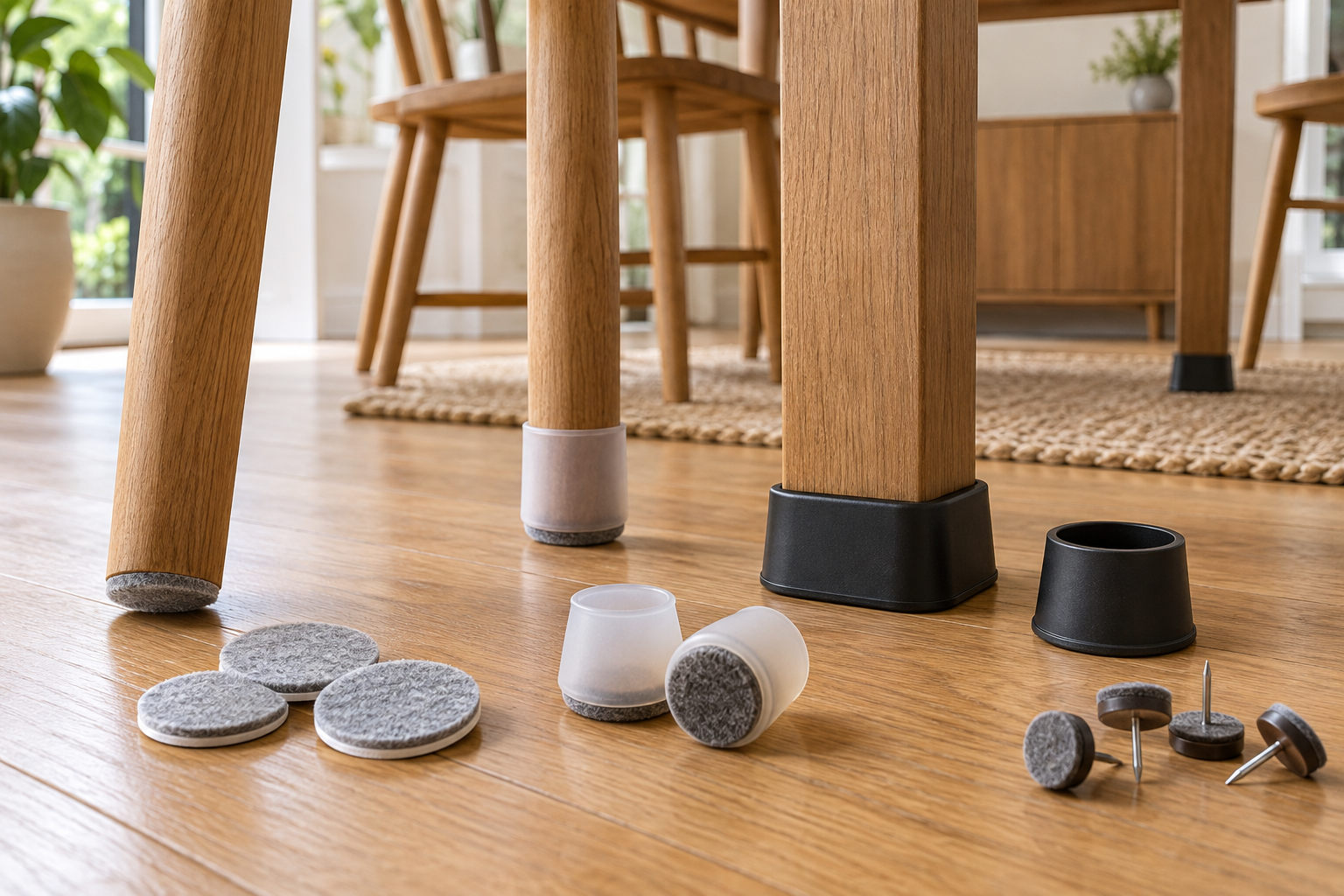
- Dining chairs moved every day: start with snug slip-on caps with replaceable felt bases, provided the cap shape and floor finish are explicitly supported.
- Light furniture moved occasionally: correctly sized self-adhesive felt pads are simple, but the leg bottom must be flat, clean, dry, and large enough for full contact.
- Stationary sofas, tables, and cabinets: rubber or elastomer cups can spread contact and limit ordinary shifting when the material is approved for the floor.
- Wooden legs needing a mechanical attachment: nail-on pads can stay aligned, but only when the furniture maker permits them and the fastener cannot split the leg or wear through toward the floor.
- Heavy relocation: use floor-specific furniture sliders, adequate helpers, or professional moving help instead of treating permanent pads as moving equipment.
Measure the Leg and Check the Floor First
Identify the actual flooring and finish rather than stopping at “wood” or “vinyl.” Solid hardwood, engineered wood, laminate, luxury vinyl, tile, cork, and sealed concrete can have different restrictions. Check whether the flooring guidance excludes rubber, latex, PVC, plasticizers, adhesives, metal fasteners, or materials that can trap moisture or discolor the finish.
Measure every furniture foot at its narrowest contact point. Record width and depth for square or rectangular legs and diameter for round legs. Also note whether the leg is straight, tapered, angled, hollow metal, textured, or uneven. A cap sized only at the visible upper leg may be loose at the floor; an undersized adhesive pad can leave the leg edge exposed.
Compare the Main Pad Formats
Self-Adhesive Felt Pads
Adhesive felt is inexpensive and low-profile. It fits flat-bottomed furniture where the pad can cover the whole contact area without folding around an edge. It is less convincing on dusty, oily, damp, textured, curved, or very small feet.
Best fit: light to moderate furniture on an approved smooth hard floor, especially pieces moved occasionally. Watch for: adhesive creep, compressed felt, collected grit, off-center placement, and residue during replacement.
Slip-On Silicone or Elastomer Caps with Felt Bases
Caps wrap around a chair or table leg, so they can remain aligned better than a small adhesive disc during frequent movement. Fit is the deciding factor: a loose cap can twist or fall off, while an overstretched cap can tear or expose an edge.
Best fit: frequently moved chairs with a leg shape inside the maker's measured range. Watch for: seams, trapped debris, a felt base smaller than the leg, moisture beneath the cap, and materials not approved for the floor finish.
Rubber or Elastomer Furniture Cups
Cups sit beneath a leg instead of attaching to it. Their wider footprint can suit stationary pieces and may reduce casual shifting. They are not automatically safe for every finish, and a deep cup can alter furniture height or stability if only some legs are supported.
Best fit: stationary furniture when all support points fit fully and the cup material is approved for the flooring. Watch for: discoloration, trapped moisture, uneven height, curled edges, and cups left unchecked for long periods.
Nail-On or Screw-On Felt Glides
A mechanical glide can resist sideways movement better than adhesive, but installation permanently changes the furniture. The leg needs enough sound material to accept the specified fastener, and the glide must sit centered and flush.
Best fit: compatible solid-wood legs where the furniture and pad makers permit installation. Watch for: splitting narrow legs, drilling into hidden hardware, loose fasteners, uneven installation, and felt wearing down until the hard base approaches the floor. Do not improvise this format on hollow metal, brittle, antique, rented, or valuable furniture.
Must-Have Selection Criteria
- Specific surface compatibility: guidance that names the actual floor material or finish, not only “all hard floors.”
- Full contact coverage: the pad supports the complete leg bottom without an exposed edge concentrating weight.
- Movement-appropriate attachment: a cap or permitted mechanical glide for frequent chair movement; adhesive only where the surface and routine suit it.
- Inspectable wear surface: felt or another contact layer you can see, clean, and replace before the hard backing is exposed.
- Stable furniture height: equal support at every leg so the furniture does not rock or load one joint unevenly.
- Clear care instructions: a realistic schedule for cleaning, checking adhesion or fit, and replacing worn parts.
Nice-to-Have Features
- Replaceable felt inserts: useful when the cap remains sound but the floor-contact layer wears.
- Multiple measured shapes: better than stretching one nominal size over round, square, and angled legs.
- Neutral or transparent sidewalls: helpful for appearance, though color should never outweigh material compatibility.
- Spare matching pads: lets you replace all pads on one chair together and preserve equal height.
Installation and the First Movement Test
Empty or lighten the furniture when practical, then lift it with appropriate help instead of tipping it farther than its instructions allow. Clean and dry both the floor and furniture contact point. Remove old adhesive without scraping or using a solvent unless the furniture maker approves the method.
Install one complete set according to the pad instructions. Set the furniture down vertically, confirm it does not rock, and leave any adhesive for the specified cure time. Test with a short, slow movement while watching each protector. Stop if a pad twists, peels, squeaks, leaves residue, catches at a floor joint, or exposes part of the leg.
Cleaning and Replacement
Vacuum or wipe the floor around furniture legs as part of routine cleaning. Inspect pads more often on dining chairs, at entryways, in homes with shedding pets, and anywhere sand or crumbs collect. Lift the furniture to inspect—do not drag it aside on a pad you are trying to check.
Replace the full set for one piece when felt is thin, hard, uneven, loose, contaminated, or peeling; a cap is stretched, torn, or rotating; a cup is cracked or discolored; or a mechanical glide is loose or its hard backing is becoming exposed. A cheap pad is not economical after its useful surface has worn away.
Who Should Skip Furniture Leg Pads
- Skip them when the flooring or furniture maker cannot confirm material or attachment compatibility.
- Skip adhesive pads on damp, dusty, oily, textured, curved, crumbling, or too-small contact surfaces.
- Skip nail-on or screw-on glides on hollow, narrow, damaged, antique, rented, or otherwise unsuitable legs.
- Skip soft pads as a fix for loose joints, wobbling furniture, uneven floors, broken legs, or damaged flooring.
- Skip ordinary pads for appliances, exercise equipment, rolling furniture, pianos, safes, or products with their own required feet, casters, leveling system, or installation instructions.
- Skip DIY movement if a piece is too heavy, top-heavy, fragile, attached to a wall, near stairs, or unsafe to lift and control.
If the furniture itself already has a small cosmetic finish mark, the furniture touch-up marker guide explains finish checks, color testing, controlled application, and when a marker is the wrong repair. Pads protect the floor; they do not repair furniture.
Bottom Line
For frequently moved chairs, a measured slip-on cap with a replaceable, floor-compatible felt base is often the most manageable format. Flat adhesive felt suits lighter, less active furniture; cups suit compatible stationary pieces; and mechanical glides belong only on furniture designed to accept them. Whatever the format, full coverage, clean contact, equal height, and routine replacement matter more than a “scratch-proof” promise.