How to Choose Bed Risers for Creating Storage Clearance
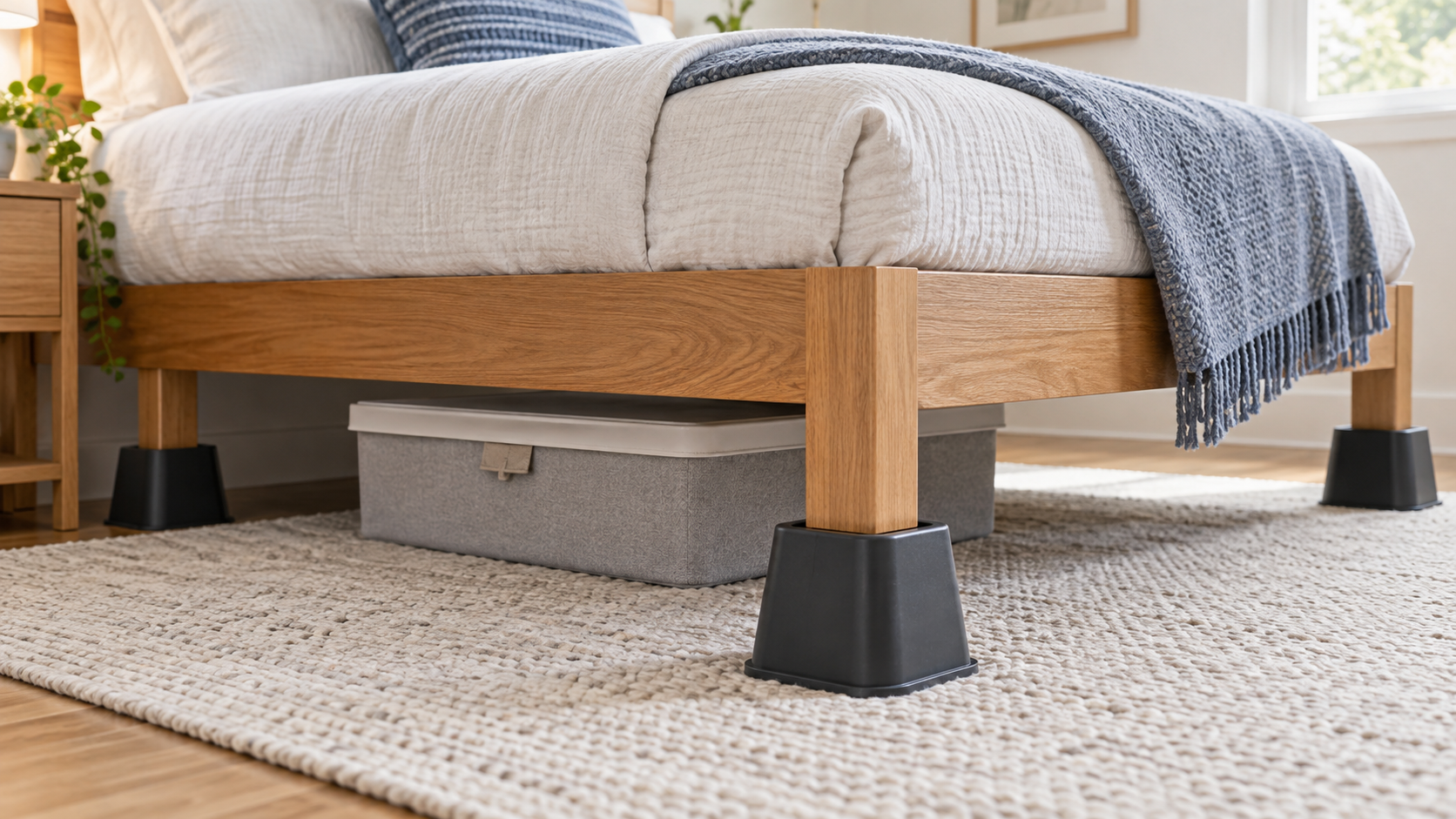
Bed risers can turn a small strip of unusable space into room for low storage bins, but only when the bed frame is compatible and every support point fits correctly. Start with the storage height you actually need, then check leg shape, support layout, final bed height, floor contact, and both manufacturers' instructions.
As an Amazon Associate, The Good Home Doc may earn from qualifying purchases.
Quick decision before shopping
First measure the available space, identify the setup or surface constraints, and decide who will maintain the item. Skip the category if it blocks access, conflicts with the manufacturer's instructions or lease, or adds more upkeep than the problem justifies.
Compare the format that matches every support point:
- Browse category: Compare wide-base bed risers for storage clearanceVerify the recess dimensions, added rise, base footprint, floor compatibility, stated distributed load, and frame-maker restrictions.
- Browse category: Compare adjustable-height bed riser setsUse only documented configurations; never improvise a stack or mix heights, brands, or unsupported parts.
These are category searches, not tested rankings. Confirm current dimensions, intended use, stated load and its basis, included quantity, materials, floor guidance, assembly, warnings, warranty, and return terms. Bed and riser instructions take priority over this guide.
This guide covers purpose-made risers for compatible household bed frames. It does not cover hospital beds, adjustable power bases, bunk or loft beds, makeshift blocks, frame modification, or using risers as repair parts.
Quick Best-Fit Guide
- Wide molded cup risers: the simplest starting point for square or round legs that sit completely inside the recess.
- Shallow risers: useful when a small height increase clears a specific bin without making entry, bedding, or nearby furniture awkward.
- Documented adjustable sets: worth considering only when the approved configuration matches every support point and the final height remains practical.
- No risers: the better answer for casters, sled bases, unsupported center legs, damaged frames, incompatible flooring, or a manufacturer that prohibits them.
Measure the Storage Gap First
Measure from the floor to the lowest fixed obstruction beneath the bed, not merely to the side rail. Center beams, brackets, bolts, slats, fabric decking, and sagging bedding can reduce usable height. Measure the bin at its tallest point with the lid closed, including wheels, handles, or a bowed top, then allow working clearance so it does not scrape the frame.
The difference between those measurements is the minimum extra rise needed. More height is not automatically better: it raises the mattress, changes how your feet reach the floor, may expose more of the bed skirt, and can make a nightstand or headboard sit oddly.
Inventory Every Support Point
Look beneath the complete frame before shopping. Count corner legs, center legs, support feet, glides, and casters. A riser set must address every support point exactly as the bed and riser instructions require. Four risers are not enough for a frame with five, six, or more load-bearing contacts.
Record each leg's width, depth or diameter, and shape at the floor. Tapered feet should be measured at their widest contact area. The leg must sit flat and fully within the product's usable recess rather than on a lip or sloped wall. Do not remove a center support, trim a leg, or substitute a block to make a set fit.
Check Frame Compatibility Before Load Numbers
A stated capacity matters only when its test or distribution assumptions match the setup. Find out whether the number applies per riser or across a complete set, which configuration it covers, and whether weight must be evenly distributed. The combined bed, foundation, mattress, sleepers, bedding, and items placed on the bed all contribute.
Capacity alone does not establish compatibility. A frame maker may exclude risers, restrict additions beneath legs, or require a particular foundation and center-support arrangement. Adjustable bases, frames on wheels, and beds with broad rails or pedestal bases often need a different solution. When either manufacturer is unclear, do not guess.
Choose the Lowest Useful Rise
Use the smallest documented height that clears the chosen container and pull path. A modest rise generally changes the room less than a tall one. Before buying, add the proposed rise to the current mattress-top height and test that height with a stable reference beside the bed—without lifting or propping up the frame.
Consider who uses the bed. If sitting down, standing up, transferring, or reaching the floor is already difficult, changing the height may be a poor fit. This guide cannot determine a medically appropriate bed height; ask an appropriate professional when mobility or caregiving needs are involved.
Base Footprint and Floor Contact
The base must fit completely on a level, sound surface. Measure around each leg for walls, baseboards, heater covers, cords, rugs, and nearby furniture. A wider base may spread contact but can also become a toe obstacle or interfere with a storage bin's pull path.
Check the riser and flooring makers' instructions for hardwood, laminate, tile, vinyl, or carpet. Added pads can change grip or level and should be used only when documented for the combination. Keep grit away from contact points, and do not bridge a rug edge, grout step, damaged board, or uneven transition.
Setup Requires a Controlled Lift
Clear the bed and the area around it before installation. Follow the frame and riser instructions for lifting, helpers, tools, and placement. Do not crawl beneath a raised or partly supported bed, and do not rely on a person, loose object, or temporary prop to hold it up.
After placement, confirm every leg is centered and fully seated, every base lies flat, and the frame has not twisted. Check headboard, wall, outlet, cord, and nightstand clearances. If the frame rocks, a leg sits at an angle, a base shifts, or the instructions cannot be followed at every support point, lower the bed and stop.
Must-Haves Before Nice-to-Haves
Must-Haves
- Documented compatibility with the bed's frame and support layout.
- A recess that fully accepts every leg or foot.
- The correct number of identical supports for the approved configuration.
- A stated load basis that covers the complete expected load.
- A flat base compatible with the actual floor.
- Clear installation, inspection, and replacement instructions.
Nice-to-Haves
- Only enough rise to clear a measured storage bin.
- A base shape that does not block the bin path.
- Visible alignment marks or a recess that makes seating easy to inspect.
- A finish that can be wiped clean without hiding cracks or deformation.
Who Should Skip Bed Risers
- Anyone whose bed or frame maker prohibits them or does not provide enough compatibility guidance.
- Beds with casters, broad sled or pedestal bases, damaged legs, loose joints, missing supports, or an uneven frame.
- Setups where all load-bearing points cannot use the same documented configuration.
- Rooms with uneven, damaged, soft, or incompatible flooring at a support point.
- People for whom the higher mattress would make entering, leaving, making, or assisting with the bed harder.
- Households expecting risers to repair a frame, stop an unexplained wobble, or replace proper storage furniture.
Inspection and Maintenance
Recheck alignment after initial use and at the interval the maker recommends. Remove stored items and inspect for movement, cracking, crushing, bending, loosened frame hardware, floor marks, or a leg no longer centered in its recess. Keep the bases and surrounding floor clean and dry.
Stop using the setup if the bed rocks, shifts, makes a new structural noise, or any riser changes shape. Lower the frame using the documented method and address damage before putting the bed back in service. A riser should never conceal a loose joint or failing support.
Buying Checklist
- Measure the current under-bed clearance and the tallest point of the intended bin.
- Inventory and measure every load-bearing leg, foot, and center support.
- Check the bed or frame maker's restrictions before choosing a riser.
- Select the lowest documented rise that solves the storage problem.
- Calculate the final mattress height and check nearby clearances.
- Verify recess size, base footprint, floor compatibility, included quantity, and stated load basis.
- Plan a controlled installation and a routine for checking alignment and condition.
Bottom Line
The best bed riser is not the tallest or the one with the largest headline load. It is the lowest compatible format that seats every support point fully, rests flat on the actual floor, follows both manufacturers' instructions, and clears a measured storage container without making the bed awkward to use. If any support point, load assumption, floor condition, or instruction is uncertain, keep the bed at its original height and choose lower bins or another storage location.
If you are still deciding whether elevation is appropriate, use the bed riser buy-or-skip guide before comparing formats.