Are Bed Risers Worth It for Creating Storage Space?
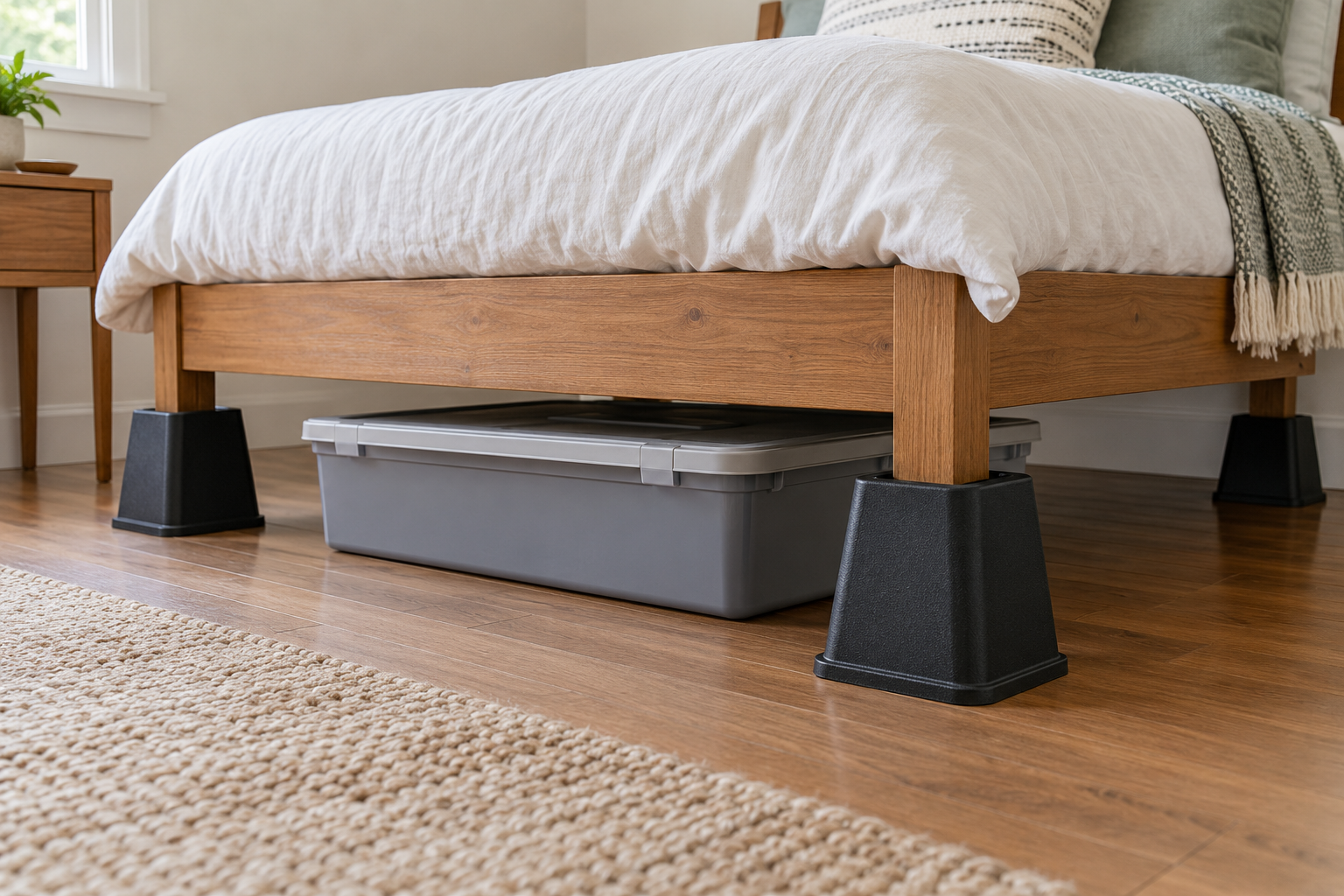
Bed risers are worth considering when a small, measured lift creates genuinely usable storage and the bed maker permits every support point to sit fully in a compatible riser. Skip them when the frame has casters, a pedestal or sled base, uncertain center supports, existing damage, or when the added mattress height makes the bed awkward to use.
As an Amazon Associate, The Good Home Doc may earn from qualifying purchases.
Quick decision before shopping
First measure the available space, identify the setup or surface constraints, and decide who will maintain the item. Skip the category if it blocks access, conflicts with the manufacturer's instructions or lease, or adds more upkeep than the problem justifies.
Shop only after measuring the frame and storage gap: These are category searches, not tested winners.
- Browse category: Compare purpose-made wide-base bed risersCheck recess dimensions, added height, base footprint, number of supports, floor guidance, permitted frame type, and stated load basis.
- Browse category: Compare low-profile under-bed bins insteadA shorter bin may solve the storage problem without changing bed height or support conditions.
Quick decision
| Your situation | Better decision |
|---|---|
| A compatible frame, all support points identified, and one to three inches of extra clearance solves a specific bin-fit problem | Bed risers may be worth it |
| Existing low bins already fit but clutter has not been sorted | Organize first; do not raise the bed yet |
| The frame uses casters, a broad base, unsupported center feet, or instructions that exclude risers | Skip risers and choose another storage zone |
| The proposed height makes sitting, standing, bedding, a headboard, or nearby furniture awkward | Use lower bins or reduce what is stored |
| The frame is damaged, uneven, loose, or its support layout is unclear | Stop and ask the frame maker or a qualified furniture professional |
Start with the storage gain, not the product
Measure from the floor to the lowest fixed obstruction beneath the bed, including center rails, brackets, bolts, slats, fabric, and any sagging foundation. Then measure the tallest point of the container with its lid, handles, or wheels in place. The difference is the minimum added clearance you need, plus a little working room so the bin can move without scraping.
If a shorter container already fits, risers may add cost and complication without adding useful capacity. Before buying, decide exactly what will live below the bed, how often it must be reached, and where the bin will pull out. The under-bed storage guide can help with dust, access, and item-fit questions.
Compatibility is the first red line
Check the bed or frame instructions before adding anything beneath it. Inventory every corner leg, center leg, glide, foot, and other load-bearing contact. Each required support must be handled exactly as the frame and riser makers specify; a four-piece set is not suitable for a frame with additional load-bearing points.
Measure each leg at its widest floor-contact dimension and compare it with the usable riser recess, not the product's outside width. The leg should sit flat, centered, and fully inside the intended seat. Do not use risers as repair parts, remove center supports, improvise with blocks, mix heights, or stack pieces unless the manufacturer explicitly documents that configuration.
Cost and alternatives
The purchase price is only one tradeoff. Risers may also require new bins, a longer bed skirt, floor-protection choices, and time to install and recheck the setup. The payoff is worthwhile only when the added volume replaces clutter somewhere else and remains easy enough to use that stored items do not disappear from the household routine.
- Choose lower bins when the current gap is close to adequate and you want the least disruptive option.
- Declutter first when the planned contents are duplicates, rarely used items, or things that should not be stored near floor-level dust or moisture.
- Use closet or wall storage when frequent access matters more than hidden capacity.
- Delay the purchase when frame documentation, support count, floor condition, or final height is uncertain.
Setup and maintenance tradeoffs
Raising a bed is a controlled furniture-moving job, not a one-person balancing trick. Empty under-bed storage, remove loose bedding, clear the route, and follow both manufacturers' instructions. If the frame is too heavy or awkward to lift without twisting, pinching, or dropping it, stop and get capable help. Never work beneath a partially lifted or unsupported bed.
After installation, verify that every leg remains fully seated, every riser sits flat, and the frame does not rock. Recheck after the bed has been used, after moving it, and during normal room cleaning. Dust, grit, moisture, a cracked riser, a shifted leg, or a compressed floor pad can change the setup. Remove the risers if anything moves, deforms, cracks, or becomes uneven.
Comfort and room-fit tradeoffs
Add the proposed rise to the current mattress-top height. Consider whether users can still sit with control, stand comfortably, reach the floor, and manage bedding. This page cannot determine an appropriate height for someone with a mobility, balance, or medical concern; ask an appropriate healthcare or accessibility professional rather than treating storage hardware as an aid.
Also check headboard attachment, wall contact, nightstand height, outlets, window trim, heating equipment, and the complete bin pull-out path. The best result is usually the lowest lift that clears a measured container without disrupting the rest of the room.
Who should skip bed risers
- Anyone whose bed or riser instructions do not clearly permit the combination.
- People with adjustable power bases, bunk or loft beds, casters, pedestal bases, damaged frames, or support arrangements that do not fit purpose-made risers.
- Households that cannot place every required support on a matching, fully seated riser.
- Anyone for whom the added height creates a difficult transfer, unstable feeling, or mismatch with nearby furniture.
- Rooms with uneven, soft, damaged, or incompatible flooring unless the manufacturers provide an approved solution.
- People hoping risers will fix a sagging, loose, broken, or noisy frame.
When to escalate
Contact the frame or bed manufacturer when compatibility, center-support requirements, load assumptions, or warranty terms are unclear. Ask a qualified furniture professional to evaluate a damaged, modified, loose, or persistently uneven frame. If the decision involves mobility or transfers rather than storage alone, seek individual guidance from an appropriate professional before changing the bed height.
Bottom line
Bed risers are worth it only when a modest, documented lift unlocks storage you will actually use and every support point, floor surface, and room clearance checks out. Buy after measuring the container, frame, support layout, and final mattress height. Skip or delay when the compatibility is uncertain, the bed already has a stability problem, or lower bins and decluttering solve the same problem with less risk and maintenance.