Vacuum Storage Bags vs Lidded Bins for Bulky Bedding
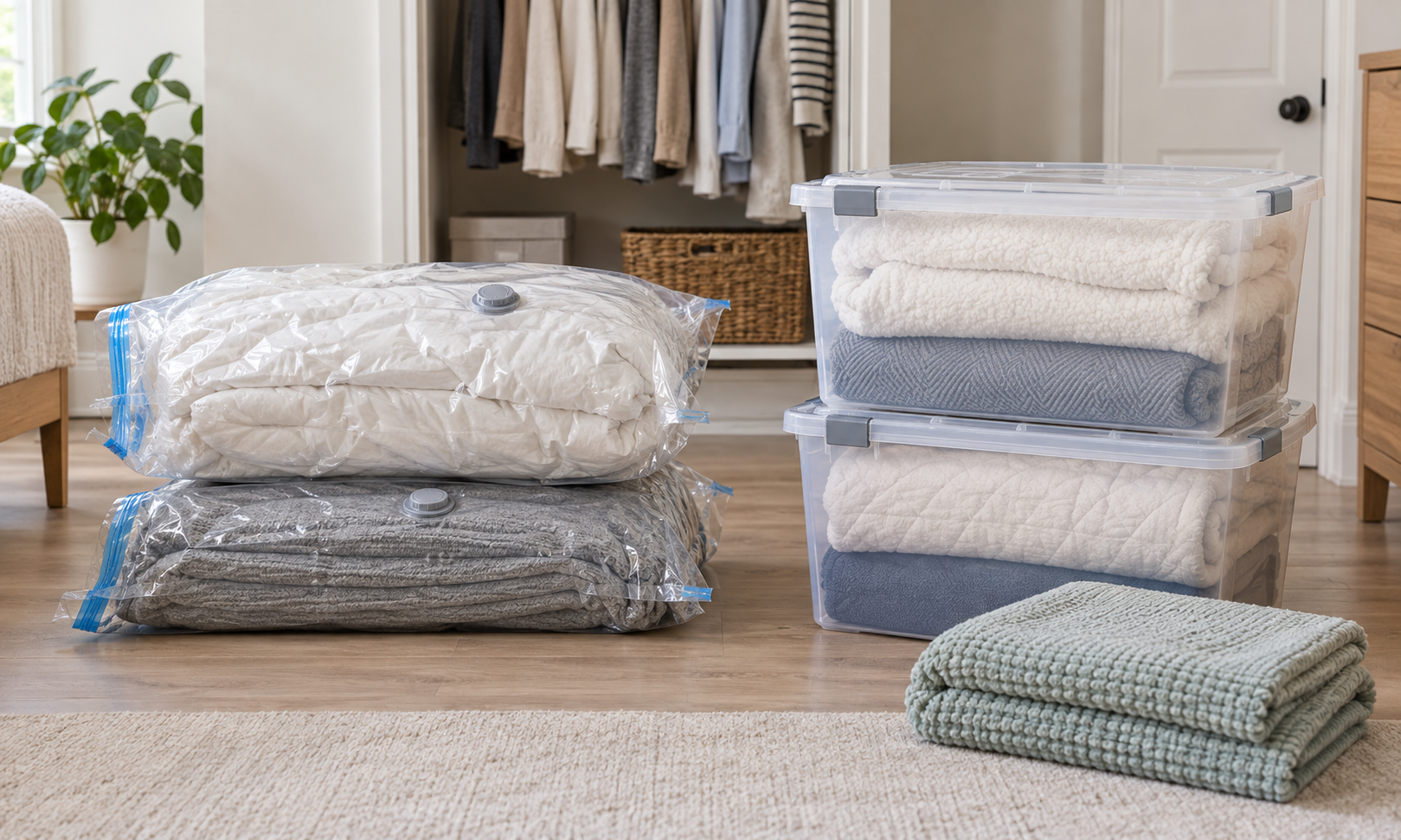
A vacuum bag reduces the volume of compatible bedding, while a lidded bin keeps a predictable shape and shields its contents from bumps and rough surfaces. The better choice depends on what the bedding maker allows, how often you need access, and whether the final storage space rewards compression or reliable stacking.
As an Amazon Associate, The Good Home Doc may earn from qualifying purchases.
Quick decision before shopping
First measure the available space, identify the setup or surface constraints, and decide who will maintain the item. Skip the category if it blocks access, conflicts with the manufacturer's instructions or lease, or adds more upkeep than the problem justifies.
Compare the format that fits the measured space:
- Browse category: Compare vacuum storage bags for comfortersStart here when compatible bedding must fit a shallow or narrow storage zone.
- Browse category: Compare large clear lidded storage binsStart here when protection, repeat access, and a stable footprint matter more than compression.
These are category shopping routes, not tested winners. Confirm exterior and usable dimensions, permitted contents, closure instructions, stated stacking or load guidance, materials, care directions, and manufacturer exclusions.
Quick Decision
Choose vacuum storage bags when reducing loft is permitted, the bedding will stay out of rotation for a while, and the compressed bundle can rest on a smooth protected surface.
Choose lidded bins when you need repeat access, want protection from snagging or crushing, or can use the bin's fixed shape in a stable shelf or floor layout.
Combine them cautiously when a correctly closed bag fits inside a smooth-sided bin without forcing the lid. The bag reduces volume; the bin protects it. Measure both products together because the outer bin still sets the final footprint.
Vacuum Bags vs Lidded Bins at a Glance
| Decision point | Vacuum storage bags | Lidded bins |
|---|---|---|
| Space use | Can reduce thickness of permitted compressible bedding | Keeps a fixed exterior footprint |
| Protection | Needs protection from punctures and sharp hardware | Rigid walls protect against ordinary contact and crushing |
| Access | Requires opening, restoring loft, and resealing | Lid can make repeat retrieval simpler |
| Stacking | Soft bundles may shift unless contained | Depends on the maker's design and stated guidance |
| Empty storage | Folds compactly after cleaning and drying | May nest, but lids and large shells still need space |
When Vacuum Storage Bags Fit Better
Compression is most useful when bedding loft, rather than the length and width of the bundle, blocks a closet shelf or under-bed opening. Measure the target space and the bag's flat dimensions; removing air may reduce thickness without making an overfilled bag shorter or narrower.
Vacuum bags also suit seasonal groups that can remain closed until the next rotation. Divide bedding into useful loads—such as one guest-bed set or two blankets—so one missing item does not require opening a giant mixed bag.
Skip vacuum bags when the textile maker advises against extended compression, when loft recovery matters, or when the storage area has sharp edges, recurring dampness, heat outside the product's instructions, or frequent access. Down, feather, wool, foam-filled, antique, and delicate pieces deserve particular attention to their own care guidance.
When Lidded Bins Fit Better
A rigid bin earns its larger volume when the shell makes handling and protection easier. It can keep bedding away from rough shelves and bed hardware, and a transparent wall or clear label can reduce rummaging. For repeat access, opening one lid is usually a simpler routine than extracting air again.
The cost is fixed geometry. A bin does not shrink around a partly filled load, and a tapered body may hold less than its exterior measurements imply. Measure the complete widest and tallest points, including handles, lid clips, wheels, and lid crown. Check the actual shelf depth and the route through doors or stairs before filling a very large container.
Skip lidded bins when their fixed dimensions waste the only viable storage gap, when a filled container would be difficult to lift safely, or when the bin would have to be stacked contrary to its current instructions.
Measure the Whole Storage System
- Inventory the load: Group only clean, completely dry bedding whose care guidance supports the planned storage method.
- Measure the destination: Record width, depth, and height around shelf supports, baseboards, door swing, bed framing, and walking clearance.
- Check access: Leave enough room to grip and remove the container without dragging a bag over rough hardware or tipping a bin from a high shelf.
- Include the closure: Account for valve and zipper clearance on a bag, or handles, clips, hinges, and lid lift on a bin.
- Test one format first: Avoid buying a large set until one filled unit fits the space and the household's rotation routine.
Must-Have Features
For a Vacuum Bag
- Flat dimensions that fit both the bedding and final storage zone.
- A closure sequence and valve design explained in current product instructions.
- A compatible vacuum hose or included pump.
- Enough clear border to keep fabric out of the zipper channel.
- A smooth, protected place to rest the filled bag.
For a Lidded Bin
- Complete exterior dimensions that fit the shelf, floor, or under-bed opening.
- A lid and handles intended for the planned load and carrying routine.
- Current stacking or load guidance that matches the layout.
- Smooth interior surfaces that will not catch delicate fabric.
- A cleaning and drying routine you can complete before loading bedding.
Nice-to-Have Features
A write-on area or removable label makes seasonal groups easier to identify. Clear walls reveal the load, though they do not replace a useful label when bins sit end-on. Smaller matched units can be easier to carry and rearrange than one oversized container. Wheels may help at floor level only when their added height fits and the surface supports controlled movement.
Moisture, Cleaning, and Inspection
Neither format fixes a damp storage area. Store only clean, completely dry textiles, and address leaks, condensation, or persistent dampness before putting bedding away. A closed bag or bin can make an existing moisture problem harder to notice.
Follow the storage-product and textile makers' cleaning and drying directions. Inspect bag zippers, valves, seams, and plastic before reuse. Inspect bins for cracks, distorted lids, damaged handles, and rough edges. Recheck a compressed bag after the initial storage period rather than assuming it will stay at its smallest size indefinitely.
Who Should Skip Both
Skip both products if the real problem is too much bedding for the home rather than an unsuitable container. Keep the pieces that match current beds, guest needs, and seasonal use before buying more storage. A breathable bedding bag may suit textiles whose care instructions discourage compression but that do not need a rigid shell.
Do not place an awkward heavy bin where retrieving it requires an unstable reach. If the only available location is difficult to access, reduce the load, use smaller containers, choose a lower zone, or get help moving it.
Bottom Line
Vacuum storage bags are the better fit when permitted compression turns unusable height into workable storage and access will be occasional. Lidded bins are the better fit when protection, predictable stacking, and repeat access justify a larger fixed footprint. Measure the full system, follow the current instructions for both the bedding and container, and solve any dampness before sealing textiles away.