Top-Down Bottom-Up Shades vs Standard Roller Shades for Renters
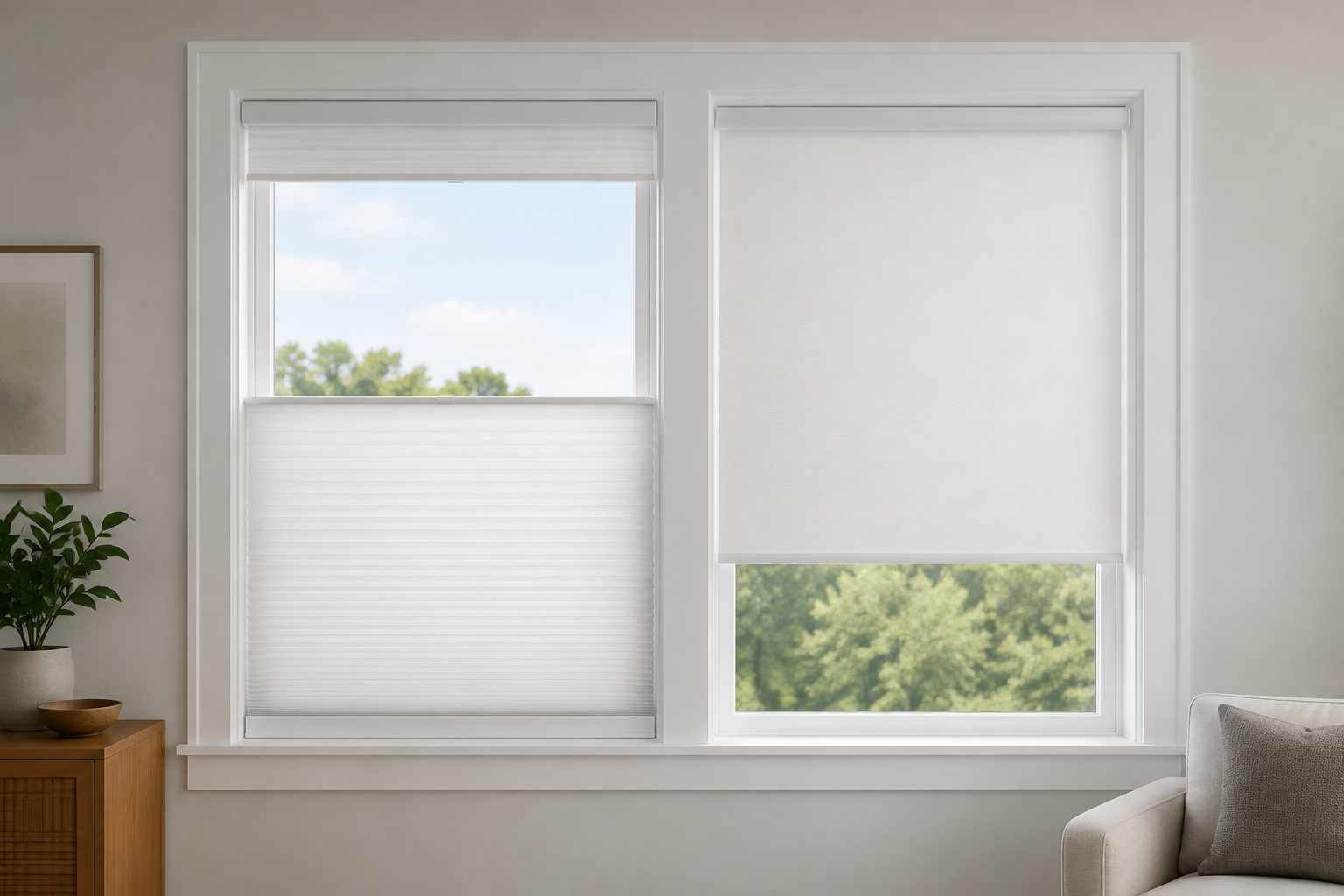
Top-down bottom-up shades are usually better when you want daylight above eye level while screening the lower part of a street-facing window. Standard roller shades are simpler when you mainly need an easy open-or-covered choice. For renters, the deciding factor is often whether either shade fits the existing window and can be mounted with written permission.
As an Amazon Associate, The Good Home Doc may earn from qualifying purchases.
Quick decision before shopping
First measure the available space, identify the setup or surface constraints, and decide who will maintain the item. Skip the category if it blocks access, conflicts with the manufacturer's instructions or lease, or adds more upkeep than the problem justifies.
Compare the two formats after measuring: These are category shopping routes, not tested winners. Confirm width, mount type, recess-depth requirement, controls, included hardware, return terms, and installation instructions.
- Browse category: Compare cordless top-down bottom-up cellular shades on AmazonStart here when adjustable lower-window privacy matters more than the simplest mechanism.
- Browse category: Compare cordless roller shades on AmazonStart here when simple full-window coverage and a compact roll are the priority.
Do not assume “renter-friendly” means no permission or no wall damage. Many installed shades use screws, and no-drill accessories still need explicit fit and load instructions.
This comparison is about operating format, not a promise that either shade can replace the landlord's blinds. For broader reversible options, use the renter-friendly upgrades hub. If you need nighttime darkness instead of flexible daytime privacy, start with the blackout curtain guide. For glass-applied screening, compare window privacy film for renters.
Quick comparison
| Decision | Top-down bottom-up shade | Standard roller shade |
|---|---|---|
| Best reason to choose it | Screen the lower sightline while keeping daylight above | Get a straightforward open, partial, or covered window |
| Operation | Two movable rails create more positions | One fabric panel raises into a compact roll |
| Privacy tradeoff | Flexible by height, but uncovered glass still needs a sightline check | Partial lowering leaves the lower window exposed |
| Light gaps | Side gaps plus possible gaps around movable rails | Side gaps depend on mount, roll direction, and bracket clearance |
| Upkeep | Pleats and multiple rails take more careful dusting | A flat sheet is generally simpler to clean as directed |
Choose top-down bottom-up shades for adjustable privacy
A top-down bottom-up shade can lower from the headrail and raise from the sill. That makes it useful in a ground-floor living room, a window facing a walkway, or a home office where the lower sightline is distracting but overhead daylight is welcome.
The useful feature is the ability to place the uncovered portion where nearby people are less likely to see through it. Privacy still depends on outside elevation, stairs, neighboring buildings, and indoor lighting. Check the real view from permitted public or shared areas in daylight and after dark; do not assume a high opening is private from every angle.
Choose this format if:
- You regularly want the lower window covered while the upper window admits light.
- The recess is deep, square, and clear enough for the specified headrail.
- You are willing to measure precisely and operate two moving rails evenly.
- The pleated material and rails fit your cleaning routine.
- The lease and property owner permit the specified installation.
Skip this format if:
- You only use shades fully raised or fully lowered.
- You need the easiest surface to clean in a dusty or greasy room.
- The window is shallow, out of square, or obstructed by hardware.
- The rails would interfere with locks, handles, an air conditioner, or required access.
- An existing blind already gives enough privacy and light control.
Choose a roller shade for simple coverage
A standard roller shade unrolls from the top. It is easy to understand, visually compact when raised, and available in materials ranging from light-filtering to room-darkening. Its weak point here is lower-window privacy: lowering it blocks upper daylight before it screens only the bottom sightline.
A roller shade can still be the better everyday choice if you close the whole window at night and open it during the day. Fewer moving sections simplify the routine, but they do not erase side gaps, bracket projections, roll-direction differences, or exact measurement needs.
Choose this format if:
- You want a clean open-or-covered routine rather than privacy zones.
- A compact roll matters near trim, furniture, or existing hardware.
- You prefer a flat material that is straightforward to maintain as directed.
- You can use a documented inside or outside mount that fits the window and lease.
- You can add another permitted covering if nighttime privacy requires it.
Skip this format if:
- You need lower-half privacy and upper daylight at the same time.
- Narrow side gaps would make the covering unsuitable for the room.
- The recess cannot accommodate the bracket and roll dimensions.
- You expect light-filtering fabric to provide undocumented blackout performance.
- The lease does not permit mounting and no approved hardware is available.
Measure the window before comparing fabric
First decide whether an inside mount or outside mount is allowed and practical. For an inside mount, measure width at the top, middle, and bottom; height at the left, center, and right; and usable recess depth. Record the narrowest width, but follow the selected maker's deduction and rounding rules rather than subtracting an improvised amount.
Record trim projection, handles, locks, screens, tilt controls, existing blind hardware, and how the window opens. An outside mount needs enough flat surface for the brackets and enough overlap to manage sightlines and side gaps. Do not remove landlord-owned blinds or drill into trim without permission.
Inside mount, outside mount, and light gaps
An inside mount looks contained in the recess, but hardware clearances naturally leave space beside the shade. An outside mount may overlap more, although it occupies wall or trim space and is more likely to require visible holes. Neither format is blackout solely because of its fabric; the installed perimeter matters.
On a roller shade, fabric width can differ from the bracket-to-bracket width, and roll direction changes its distance from the glass. On a top-down bottom-up shade, both moving rails need to remain aligned. Compare finished width, fabric width, bracket dimensions, and depth—not only nominal order width.
Controls, cleaning, and move-out planning
Prefer a cordless design when it fits the room and follow current product instructions. “Cordless” does not mean there are no operating or installation hazards, and this guide does not certify a product for a household. Arrange nearby furniture and operate the covering according to the maker's guidance.
Roller fabric presents one broad surface; pleated cellular material has folds that can hold dust and require gentler handling. Confirm whether the exact material may be vacuumed, spot-cleaned, or wiped. Do not soak, steam, or apply cleaner unless its instructions allow it.
Plan removal before installation. Keep instructions, spare parts, measurements, and landlord approval. Store landlord-owned hardware safely and label it. Move-out expectations vary, so agree on them rather than assuming a small hole or adhesive accessory will be ignored.
When neither shade is the right rental choice
Skip both if installation would violate the lease, damage an uncertain surface, interfere with window operation, or replace a covering that must remain. A portable shade may suit short stays; a permitted curtain can offer wider overlap; compatible static-cling film may handle a lower sightline on suitable glass. Each alternative has its own limits.
A shade is not a repair for cracked glass, failed seals, water intrusion, a broken lock, or a window that will not operate. Report those conditions through the property's maintenance process. Never cover a required exit, ventilation opening, safety device, or access point.
Bottom line
Choose a top-down bottom-up shade when lower-window privacy is the real problem and precise fit, extra moving parts, and careful cleaning are acceptable. Choose a standard roller shade when simple full-window coverage and a compact raised profile matter more. For renters, the winner is the format that fits the measured window, follows written installation instructions, and has an agreed removal plan.