Reusable Toilet Brush vs Disposable Toilet Wand
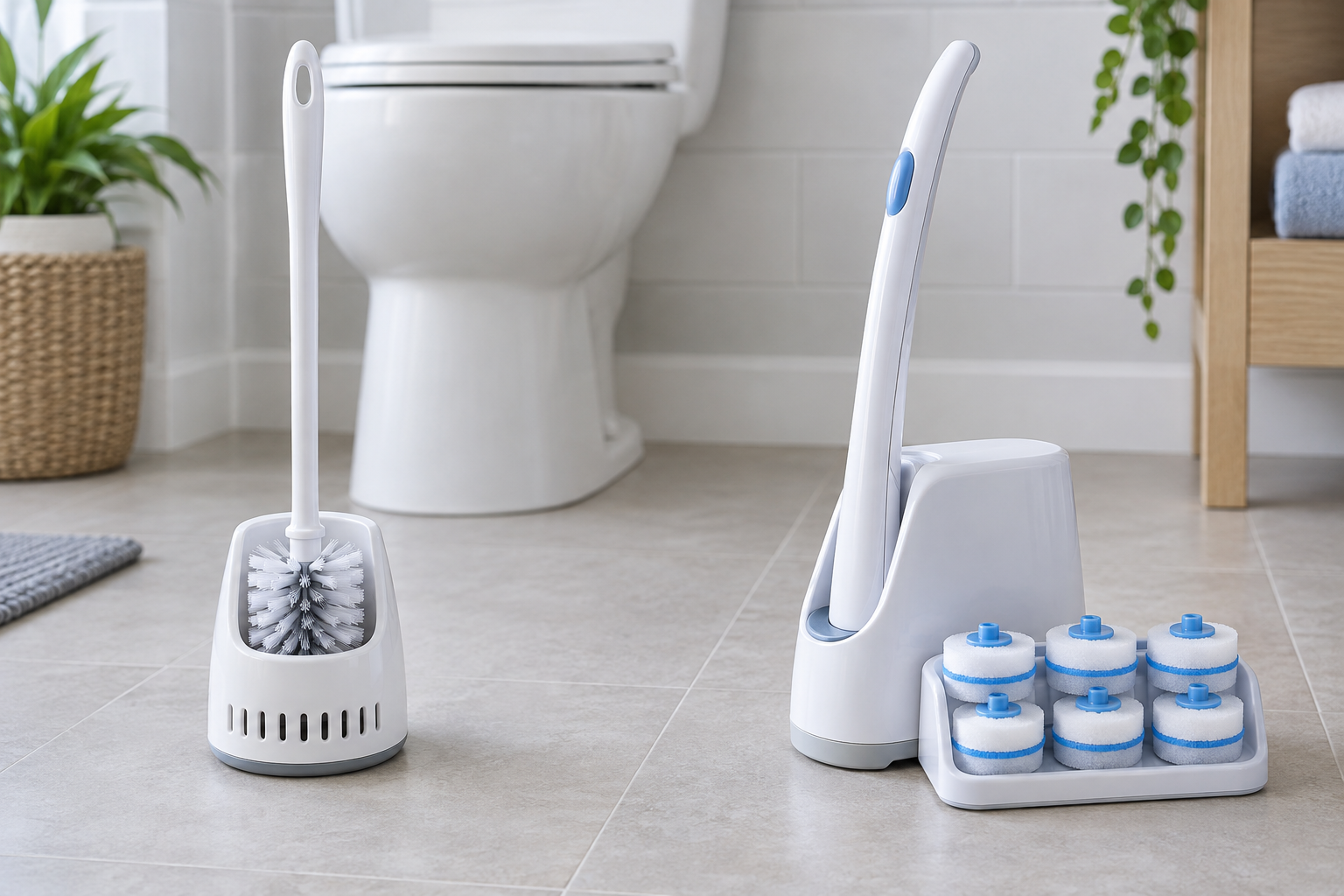
A reusable toilet brush keeps the working head attached and asks you to rinse, dry, and store it after every use. A disposable-head wand lets you release a used head and store only the handle, but it ties the routine to compatible refills and ongoing waste. Neither format cleans every bowl better by default; the useful choice is the system whose reach, handling, storage, and supply routine you will actually maintain.
As an Amazon Associate, The Good Home Doc may earn from qualifying purchases.
Quick decision before shopping
First measure the available space, identify the setup or surface constraints, and decide who will maintain the item. Skip the category if it blocks access, conflicts with the manufacturer's instructions or lease, or adds more upkeep than the problem justifies.
Compare the complete system, not just the handle:
- Browse category: Compare reusable toilet brushes and disposable toilet wandsCheck head shape, attachment or release method, handle length, holder ventilation, refill compatibility, product warnings, and the space the whole system occupies.
This is a category search, not a tested ranking. Confirm current dimensions, included parts, refill identity, tool and cleaner compatibility, care directions, disposal instructions, warnings, and return terms before buying.
Quick decision
| Choose | Best fit when | Main tradeoff |
|---|---|---|
| Reusable toilet brush | You want one durable tool, can rinse and fully dry it as directed, and have a ventilated storage spot | The used head remains part of the tool and needs regular care and inspection |
| Disposable-head toilet wand | You value releasing the used head and are willing to stock the exact compatible refills | Recurring supply cost, packaging, disposal, and refill availability become part of every use |
| Skip both for now | The bowl or seat is damaged, the cause of a stain is unclear, or the cleaner or tool instructions do not support the planned use | Identify the surface, problem, and manufacturer guidance before scrubbing |
Reusable brush: one tool, more after-use care
A reusable brush is the simpler supply system. Once the handle, head, and holder fit the bathroom, there is no proprietary refill to remember. Head geometry still matters: compare under-rim reach, contact around the bowl curve, splash control, and whether the brush can be moved without your hand approaching the waterline.
The ownership cost is maintenance. Follow the maker's instructions for rinsing and care, let the brush drain and dry, and clean the holder as directed. A closed cup with no practical drainage or airflow can turn storage into the weakest part of the system. Replace the tool when bristles deform, the head loosens, the handle cracks, or the maker's continued-use guidance says to do so.
Disposable wand: less used-head storage, more supply planning
A disposable-head wand separates the reusable handle from the working head. That can suit someone who strongly dislikes storing a used brush head, provided the release mechanism works without touching the used part and the approved disposal route is clear.
The tradeoff is dependence on refills. Confirm the exact head family, attachment method, cleaner ingredients or compatibility statements, quantity, storage requirements, and disposal instructions. Do not assume look-alike heads fit securely. Never flush a detached cleaning head unless the manufacturer and local wastewater authority explicitly permit it; placing it in household trash according to current instructions is the conservative default.
Compare reach and control inside your bowl
Handle length alone does not determine useful reach. The head must contact the bowl curve, reach beneath the rim where the toilet maker permits cleaning, and stay attached under normal pressure. A bulky pad may cover open surfaces quickly but miss narrow contours. A compact bristle head may follow curves but require more passes.
Look for a grip you can control with wet gloves, a connection that does not twist loose, and enough distance between the grip and working head. Heavy pressure is not a substitute for a compatible tool. If marks remain, check the toilet maker's surface-care guidance before using a stiffer head, abrasive pad, or different cleaner.
Storage changes the daily fit
Reusable brush storage
- The holder should stand steadily and contain drips without trapping the head in standing liquid.
- Its base and interior should be accessible for cleaning and drying.
- The complete footprint must stay clear of feet, bath mats, doors, and direct shower spray.
Disposable wand storage
- The handle needs a stable, dry caddy after the used head is released.
- Unused refills should remain in their specified dry storage, away from splashes and children or pets.
- Count the refill package and disposal route in the storage plan, not only the slim handle.
Cleaner compatibility comes before convenience
Read the toilet, tool, refill, and cleaner labels before combining anything. A preloaded disposable head may already contain a cleaning product. Adding another cleaner can create an unapproved combination. Never mix household cleaning products, and do not add bleach, acids, ammonia, drain products, or other chemicals to a tool or bowl unless every relevant label explicitly directs that exact use.
Use the ventilation, protective equipment, contact-time, rinsing, and storage directions on the current label. This comparison does not promise disinfection or germ reduction; those outcomes depend on the registered product, labeled surface, application method, and directions—not on whether the handle is reusable.
Recurring cost and waste
For a reusable brush, compare purchase price with realistic replacement of a worn head or complete tool, plus the time needed to maintain the holder. For a wand, estimate annual refill use from your real cleaning schedule, not the largest bulk pack. Include shipping or local availability and the chance that a proprietary refill changes or disappears.
Waste is also format-specific. A reusable brush uses fewer working heads but still needs eventual replacement. A disposable system uses a new head each session or as directed. Avoid broad environmental winner claims without product-specific material, manufacturing, transport, and disposal evidence.
Who should skip each option?
Skip a reusable brush if there is no stable, ventilated place to dry it, you will not clean the holder, the head cannot reach your bowl contours, or touching and maintaining the working end makes the routine unlikely to happen.
Skip a disposable wand if compatible refills are difficult to store or reliably obtain, ongoing supply cost is frustrating, the release mechanism requires awkward handling, or disposal instructions are unclear. It is also a poor fit if someone may mistake a used head for a flushable item.
Pause the cleaning task when the fixture is cracked, loose, leaking, or damaged; when staining may reflect a plumbing or water problem; or when product instructions conflict. Use appropriate qualified help for repair or persistent problems rather than applying more pressure or chemicals.
Bottom line
Choose a reusable toilet brush when a durable tool, compatible head shape, and ventilated holder fit your space and you accept the rinse-dry-maintain routine. Choose a disposable-head wand when hands-off head release matters enough to justify compatible refills, ongoing cost, storage, and disposal. The better system is the one you can use according to every label and maintain between cleanings—not the one with the strongest cleanliness promise.
Next step: Put this decision in context with the home-product buying framework guide.