Pin vs Pinless Moisture Meter for Home Checks
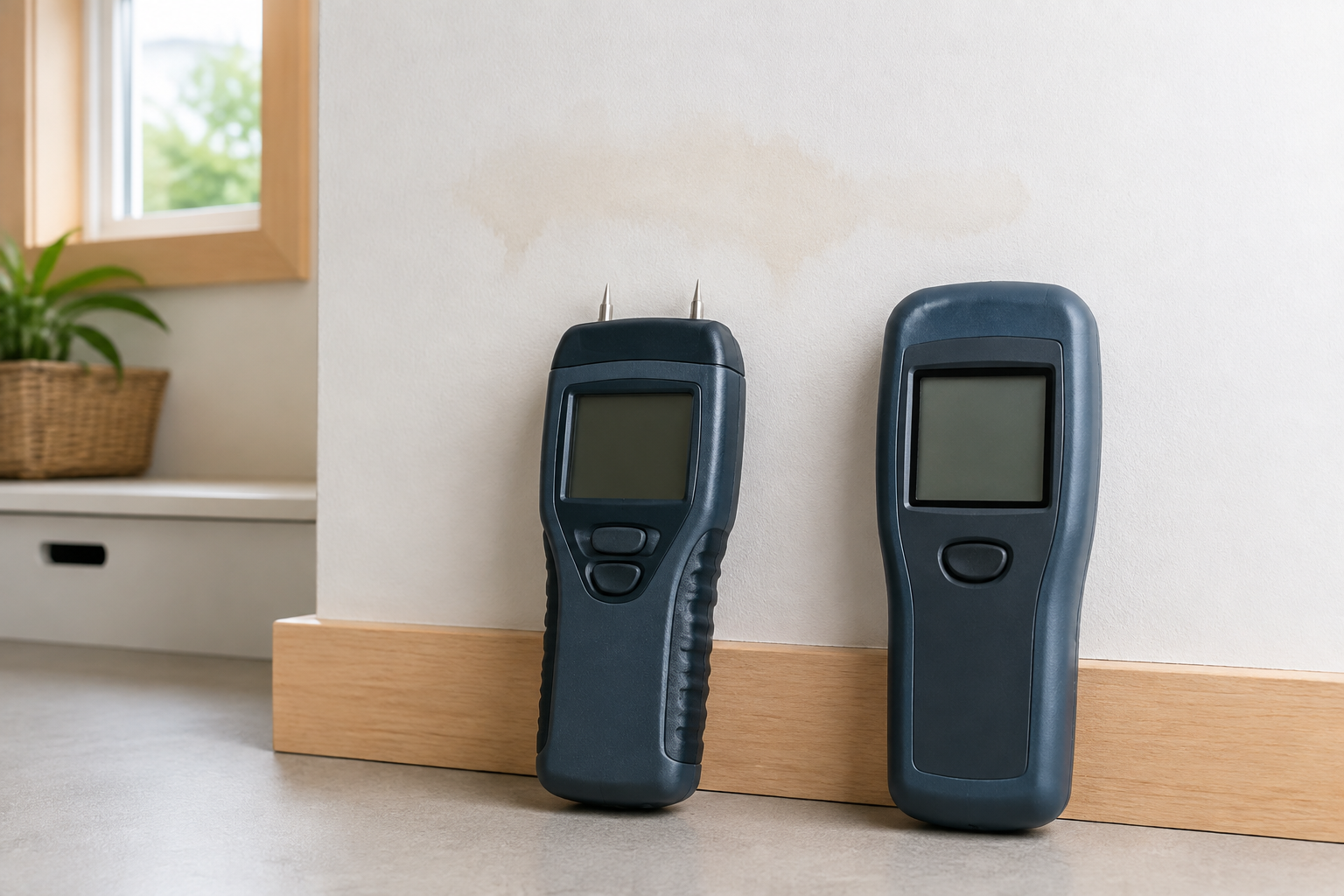
Choose a pin meter when you need a reading at one accessible point and tiny probe marks are acceptable. Choose a pinless meter when you want to scan a broader finished surface without puncturing it. Both are screening tools: neither identifies a leak source, confirms mold, proves a wall cavity is dry, or replaces qualified investigation.
As an Amazon Associate, The Good Home Doc may earn from qualifying purchases.
Quick decision before shopping
First measure the available space, identify the setup or surface constraints, and decide who will maintain the item. Skip the category if it blocks access, conflicts with the manufacturer's instructions or lease, or adds more upkeep than the problem justifies.
Compare the two formats: These category links are shopping starting points, not tested winners. Match the meter's documented modes and limits to the material you plan to check.
- Browse category: Shop pin moisture meters on AmazonCompare material modes, probe protection, replacement pins, display hold, and maker guidance.
- Browse category: Shop pinless moisture meters on AmazonCompare stated scan depth, sensor size, material settings, calibration steps, and surface limits.
This page owns the choice between sensing formats. If you still need to decide whether a meter belongs in your situation, start with whether you need a moisture meter at home. Once the format is clear, use the moisture-meter buying guide for broader feature criteria. The leaks and moisture prevention hub puts the tool in context.
The short answer
- Pick a pin meter for exposed wood, trim, subfloor edges, or another accessible material where a focused contact reading matters more than two small holes.
- Pick a pinless meter for mapping relative changes across a flat finished wall, floor, or ceiling when avoiding marks matters.
- Consider a combination meter when you genuinely expect to scan first and confirm an accessible point second.
- Skip both as a DIY verdict when water is active, damage is spreading, material is soft, odor persists, or moisture is near electrical equipment.
Side-by-side decision table
| Decision point | Pin meter | Pinless meter |
|---|---|---|
| Contact | Two probes enter or firmly contact the material. | A flat sensor face sits against the surface. |
| Best use | Focused comparisons at accessible points. | Broader relative scanning across flat areas. |
| Surface effect | Can leave small holes. | Does not puncture the finish. |
| Main interference | Material, probe contact, salts, finish, and temperature can matter. | Fasteners, pipes, wires, density changes, thickness, and uneven contact can matter. |
| Common mistake | Treating one number as universal across materials. | Treating a high scan area as proof of hidden water. |
Choose a pin meter for a specific accessible spot
A pin meter is the simpler fit when the material is exposed and cosmetic marks are acceptable. Trim in an inconspicuous area, unfinished lumber, or an accessible cabinet panel can allow steady probe contact. The small measurement area can help compare neighboring points, but it also makes placement important.
Check the manual for the exact material mode and insertion guidance. Do not push probes into a wall, floor, or ceiling where hidden wiring, plumbing, or another hazard may be present. Do not puncture a finish, rental surface, waterproof assembly, or material you cannot safely identify.
Choose pinless for a broader, non-marking scan
A pinless meter is useful when you want to move across a flat finished surface and look for a relative pattern. Keeping the sensor face flat and using the same mode and technique matters. Curves, texture, gaps, corners, changes in thickness, and objects behind the surface can distort the comparison.
Published scan depth is model-specific and should not be treated as a promise that the device sees every layer or separates one material from another. A meter may react to metal fasteners, pipes, wiring, adhesive, dense framing, or another feature. Use the pattern as a prompt for careful next steps, not a diagnosis.
Compare like with like
Start on a nearby area of the same material that appears unaffected. Use the same mode, orientation, pressure, and placement technique, then repeat readings. A baseline from painted drywall should not be compared casually with one from wood trim, tile, masonry, or flooring. Percentage displays may also represent different scales for different modes.
Write down the location, material, mode, and time. A repeatable difference can be more useful than chasing an absolute threshold copied from another device or material. Follow the meter maker's calibration or self-check instructions before relying on comparisons.
Must-have features
- Relevant material modes: the documentation should explicitly cover what you intend to screen.
- Clear operating guidance: look for baseline, placement, calibration, depth, and interference explanations.
- Readable hold function: useful when the display is hard to see against a wall or inside a cabinet.
- Protected sensing parts: a secure cap and replaceable pins for pin meters, or a clean, undamaged sensor face for pinless models.
- Simple controls: extra modes add little if you cannot tell which one applies.
What neither meter can tell you
Neither format identifies why a reading changed, measures every hidden layer, certifies that material is safe, confirms or rules out mold, or determines whether structural repair is needed. Paint, tile, wall assemblies, insulation, and mixed materials can complicate interpretation. Marketing language such as “detects leaks” should not replace the limitations in the manual.
Renters should document stains, dampness, swelling, or recurring odor and notify the landlord or property manager through the required process. Homeowners should contact the appropriate qualified professional when the source or extent is unclear.
Who should skip each option
Skip a pin meter when holes are unacceptable, the surface conceals unknown services, the assembly should not be punctured, or access would require unsafe reaching or removal.
Skip a pinless meter when the surface is too narrow, curved, textured, layered, or crowded with likely interference for stable contact and useful comparisons.
Stop screening and escalate for active water, growing stains, soft or swollen materials, recurring musty odor, sewage or contaminated water, visible growth, storm-related entry, or any moisture near outlets, wiring, appliances, or a service panel. Do not open walls or move electrical equipment to take a reading.
Bottom line
A pin meter favors a focused reading where small probe marks are acceptable. A pinless meter favors fast, non-marking comparison across a flat finished surface. Choose by the material and access—not by a promise of certainty—and use consistent baseline readings only to inform the next responsible step.