Is an Over-Sink Dish Rack Worth It for a Small Kitchen?
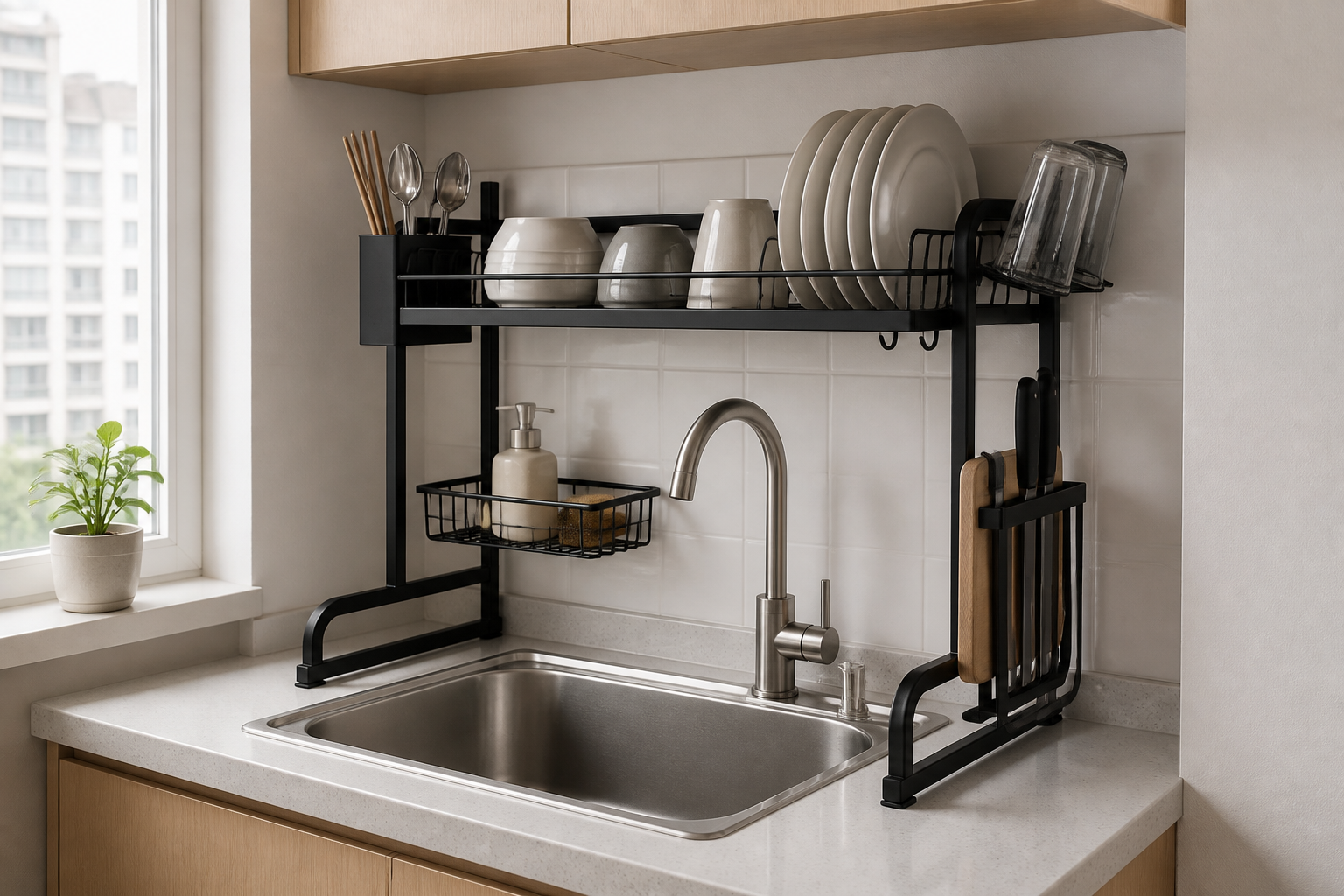
An over-sink dish rack can be worth it when counter space is scarce, the frame fits the complete sink area, and it keeps the faucet and basin usable. It is a poor fit when cabinets sit low, sink-edge supports are narrow or uneven, or the rack turns every rinse and large-pot wash into an obstacle course.
As an Amazon Associate, The Good Home Doc may earn from qualifying purchases.
Quick decision before shopping
First measure the available space, identify the setup or surface constraints, and decide who will maintain the item. Skip the category if it blocks access, conflicts with the manufacturer's instructions or lease, or adds more upkeep than the problem justifies.
Shop only after measuring the whole sink zone: Browse category: compare adjustable over-sink dish racks on Amazon.
This is a category shortcut, not a tested ranking. Confirm the exact product's outside dimensions, adjustment range, support requirements, faucet and cabinet clearance, stated use and load guidance, assembly, drainage, coating care, and return terms.
Quick Decision: Buy, Skip, or Choose a Smaller Alternative
- Buy: the measured rack stands securely on sound, level support areas, clears the faucet and cabinets, drains over the basin, and holds your normal washable load without blocking essential sink use.
- Skip: the sink rim or counter is too narrow, curved, uneven, fragile, or crowded; the rack would block a window, outlet, cabinet, sprayer, or the only comfortable washing position.
- Choose an alternative: use a roll-up rack, compact counter rack, in-sink basket, or drying mat when flexibility and open basin access matter more than upright capacity.
- Delay: if a listing does not show the exact adjustment range, assembled footprint, support width, or clearance diagram, get those dimensions before ordering.
When the Vertical Footprint Pays Off
The strongest case is a small kitchen where wet dishes routinely occupy the only useful prep area. A bridge-style rack can move plates, bowls, cups, and utensils above the basin so drips fall toward the sink. It may also keep the drying setup assembled instead of requiring a mat or folding rack to be deployed after every wash.
That advantage matters only when the rack matches the routine. A household with frequent small and medium dish loads may use the vertical space well. Someone who mostly washes a few cups—or regularly scrubs stockpots, sheet pans, and cutting boards—may find the frame more obstructive than helpful.
Measure Six Things Before You Decide
- Support-to-support span: measure where the feet will actually land, not just the basin opening. Include raised rims, backsplash lips, seams, and narrow counter strips.
- Faucet envelope: record faucet height, handle travel, pull-down hose movement, sprayer reach, and the space your hands need around them.
- Upper clearance: measure to cabinets, shelves, trim, lights, and windows. Add the height of your tallest ordinary plate while loading it.
- Front-to-back depth: confirm the feet fit fully on supported surfaces without hanging over the basin or counter edge.
- Basin access: picture washing a large pot, filling a kettle, cleaning the sink, and reaching the drain while the rack is loaded.
- Dish and accessory fit: compare plate diameter, bowl depth, cup width, utensil length, and cutting-board thickness with the documented slots and baskets.
Stability Matters More Than Accessory Count
Prioritize a frame that the manufacturer permits on your support surfaces, with feet that sit fully and adjustment points that lock as directed. Follow the stated assembly sequence and use every required fastener and brace. Recheck the frame after initial use, and keep heavy pieces low and close to the main supports rather than hanging them from an outer accessory.
Extra hooks, baskets, knife holders, and cutting-board slots are useful only when loaded items remain over the basin, do not unbalance the frame, and do not crowd the faucet. Treat the maker's load guidance as a limit, not a target. Stop using a rack that rocks, shifts, bends, develops loose joints, or no longer sits squarely.
Drainage and Cleaning Are Part of the Purchase
An over-sink position does not guarantee that every drip reaches the basin. Check where cups, utensil holders, side baskets, and boards drain. Keep water away from counter seams, wood trim, walls, outlets, and the floor. If an accessory hangs outside the sink footprint, decide whether its drip path creates more cleanup than the saved counter space is worth.
Open rails are easier to inspect than crowded joints, but every rack still collects soap film, minerals, grease, and food residue. Choose parts you can remove or reach, then follow the exact coating and cleaning directions. Let cups and trays dry between uses. Replace or stop using parts with peeling coating, persistent corrosion, split pads, bent wire, or edges that could damage dishes or hands.
Who Should Skip an Over-Sink Rack?
- People whose sink is also the main place for food preparation, large cookware, hand laundry, or frequent bucket filling.
- Anyone with low cabinets or a faucet that leaves too little loading and hand clearance.
- Households that cannot comfortably lift wet dishes to the upper tier.
- Renters who would need drilling, permanent attachment, or a lease-prohibited modification.
- People who want a drying surface that disappears completely between small loads.
Better Alternatives by Bottleneck
- You dry only a few items: a washable drying mat may be simpler to store.
- You need temporary prep space: a roll-up rack can bridge part of a compatible sink and then roll away, subject to its fit and use limits.
- You want upright support without the height: a compact counter rack with a directed drainboard may preserve faucet and cabinet clearance.
- You need the counter clear during cooking: a small in-sink basket can work for light loads if it does not interfere with washing or drainage.
The dish rack versus drying mat comparison helps separate upright capacity from fold-away simplicity. For the wider category, use the small-kitchen dish rack chooser.
Bottom Line
An over-sink dish rack is worth it when it converts otherwise unused vertical space into a stable drying zone without taking away the sink functions you rely on. The decision should come from exact support, faucet, cabinet, dish, and access measurements—not from the number of accessories in a listing photo.
Skip the category when the geometry is marginal or the frame would complicate every large washing job. If the fit is sound, continue to the over-sink dish rack guide to compare roll-up, expandable, and bridge-style formats.
Next step: Put this decision in context with the home-product buying framework guide.