Foot-Pedal Trash Can vs Swing-Top Trash Can for a Small Kitchen
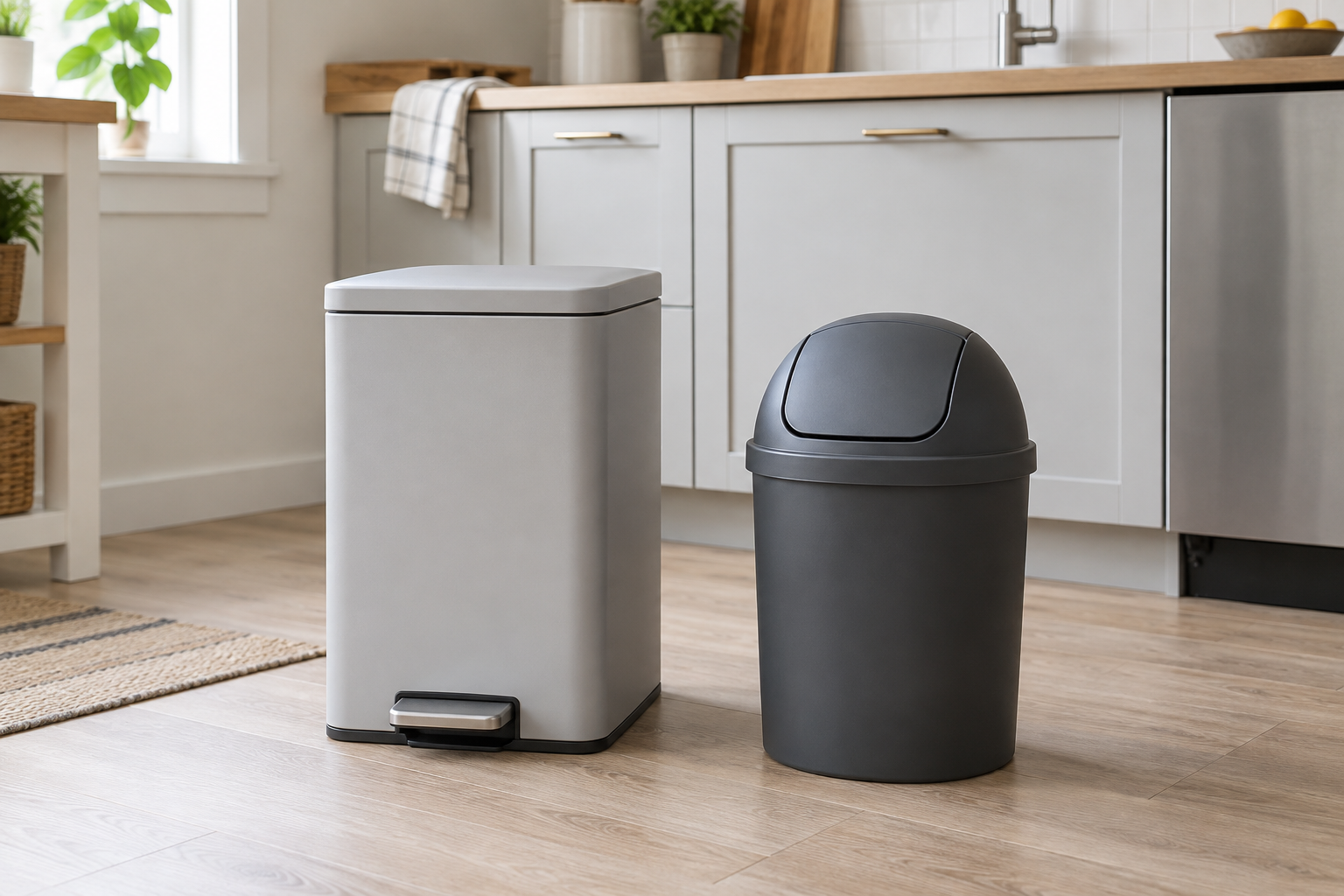
A foot-pedal can is usually the better fit when you want to open the lid without using a hand and have room for both the pedal and lid travel. A swing-top can favors a simpler, often more compact mechanism, but every deposit touches or pushes the flap and bulky waste can catch in the opening. In a small kitchen, the better choice is the one that works in its complete operating footprint—not merely the one with the narrowest listed width.
As an Amazon Associate, The Good Home Doc may earn from qualifying purchases.
Quick decision before shopping
First measure the available space, identify the setup or surface constraints, and decide who will maintain the item. Skip the category if it blocks access, conflicts with the manufacturer's instructions or lease, or adds more upkeep than the problem justifies.
Compare only after measuring: These affiliate category links are shopping starting points, not tested winners.
- Browse category: Compare small-kitchen foot-pedal trash cansCheck the full exterior size, pedal projection, open-lid height, inner bucket, liner fit, and cleaning instructions.
- Browse category: Compare small-kitchen swing-top trash cansCheck flap opening, usable opening width, wall clearance, removable lid parts, liner retention, and wash guidance.
Confirm current product dimensions and instructions before buying. A stated capacity does not tell you how much floor, lid, or bag-change clearance the can needs in your kitchen.
Quick decision
| If this matters most | Better starting point | Check before buying |
|---|---|---|
| Opening the lid while both hands are occupied | Foot-pedal can | Pedal reach, lid travel, and a stable position that will not slide |
| A simple lid with no pedal linkage | Swing-top can | Flap clearance, touch routine, and whether typical waste passes through easily |
| Placement under a counter overhang | Depends on the exact model | Full open height for a pedal lid; full swing path for the flap |
| A narrow aisle beside the can | Whichever has the smaller operating footprint | Pedal projection, body depth, lid movement, and standing space |
| Large or awkward pieces of waste | Often a foot-pedal can with a fully opening lid | Actual opening dimensions and the maker's intended use |
Measure the can in use, not just at rest
Mark the listed body width and depth on the floor with removable painter's tape. Then add the pedal projection or any base that extends beyond the body. Leave the walking route, cabinet doors, dishwasher door, refrigerator door, and nearby drawers fully usable. A can that technically fits a gap can still be frustrating if a person has to stand in the only aisle to operate it.
For a foot-pedal model, compare the listed open height with the underside of the counter and any wall shelf above. Check whether the lid swings backward, rises mostly upward, or needs the can pulled away from the wall. For a swing top, allow the flap to rotate in both directions without hitting the liner, wall, or contents. Product diagrams are more useful here than capacity alone.
Foot-pedal cans trade touch-free opening for more mechanism
A pedal lets you open the lid without putting a hand on it, which is convenient during food preparation or cleanup. That does not make the whole can touch-free: the rim, inner bucket, liner retainer, pedal, and surrounding floor still need routine cleaning. Look for a pedal you can reach from a natural stance without stretching across the aisle or pushing the can backward.
The pedal, linkage, hinge, and any soft-close parts add moving components. Compare the manufacturer's use and care instructions, and check whether replacement parts are offered if that matters to you. Do not hold the lid open against resistance, step on anything except the intended pedal, or assume a soft-close label establishes long-term durability.
Swing tops are simple, but the opening changes the routine
A swing-top lid can be easy to remove for a bag change and has no floor pedal to position. The tradeoff is that waste or a hand usually pushes the flap. A small opening may work for paper towels and ordinary food packaging but frustrate anyone regularly discarding wide trays, full dustpans, or awkward scraps. Compare the opening dimensions with the waste you actually generate.
The flap also needs space inside the lid as it rotates. An overfilled liner can stop it returning to its resting position, and a loose liner can catch in the flap. Look at how the bag is retained and whether the lid lifts off without scraping a wall or counter. If anyone in the household dislikes touching the flap, that daily objection outweighs the mechanism's simplicity.
Capacity and liner fit can change the result
Two cans with the same stated capacity can use space differently. An inner bucket, tapered walls, lid hardware, and liner-retaining ring can reduce usable room or change the bag shape. Compare the maker's recommended liner size, the dimensions of bags you already buy, and whether excess liner can be tucked away without blocking the lid.
Smaller households may prefer a compact can that is emptied often; larger households may find constant bag changes cancel out the saved floor space. Do not choose a larger bin only to postpone removal of wet food waste. Match capacity to the household's normal disposal schedule and local waste-sorting setup.
Cleaning access matters more than finish
Check whether the lid, inner bucket, and liner ring can be removed without special disassembly. Rounded interior corners and accessible hinges are generally easier to wipe than narrow seams, but follow the product's material-specific instructions. Metal exteriors and plastic bodies can both be damaged by unsuitable abrasives or cleaners.
A swing flap deserves attention on both faces because it moves through the opening. A pedal can needs cleaning around the pedal and base where crumbs collect. Whichever style you choose, place it where you can pull it out for floor cleaning without lifting it over an obstacle.
Consider children, pets, and the walking path
Neither lid type is automatically child-resistant or pet-resistant. A pedal may be activated accidentally; a swing flap may be pushed by a curious hand or animal. If access control matters, use only a product specifically designed and documented for that need, and follow its instructions. Avoid placing any can where its lid, pedal, or body creates a trip point or narrows an exit route.
Stability depends on the complete product, floor, and use. Check the base and floor-contact guidance, especially on smooth tile. Do not improvise restraints that interfere with operation or cleaning. A can that repeatedly walks backward when the pedal is pressed needs a different placement or model, not harder stomping.
Who should skip each format
Skip a foot-pedal can when
- The pedal would project into the walking path or cannot be reached from a balanced stance.
- The open lid would hit a counter, shelf, wall, or appliance.
- You want the fewest moving parts and do not mind touching a lid.
- The planned spot lets the can slide backward with no suitable clearance.
Skip a swing-top can when
- You do not want hands or waste to contact the flap during normal use.
- Your common waste is too wide or awkward for the measured opening.
- The liner or typical fill level would interfere with the flap's return path.
- A child or pet could readily push through the lid and product documentation offers no suitable control.
Bottom line
Choose a foot-pedal trash can when hands-free lid opening is worth the pedal space, open-lid clearance, and added mechanism. Choose a swing top when a simple removable lid and compact controls matter more than avoiding contact with the flap. Measure the full operating footprint, compare the real opening and liner system, and make sure the can can be cleaned and emptied in place. If neither mechanism fits the aisle, use the narrow-can guide to reconsider shape and placement before sacrificing kitchen access.