Expandable Drawer Organizer vs Modular Bins for a Small Kitchen
Choose an expandable organizer when one tray fits the drawer cleanly and most tools fall into a few predictable groups. Choose modular bins when the drawer is awkward, the utensil mix changes, or you need separate compartments for several shapes. Neither format fixes an overfilled drawer, so measure and edit the contents before shopping.
As an Amazon Associate, The Good Home Doc may earn from qualifying purchases.
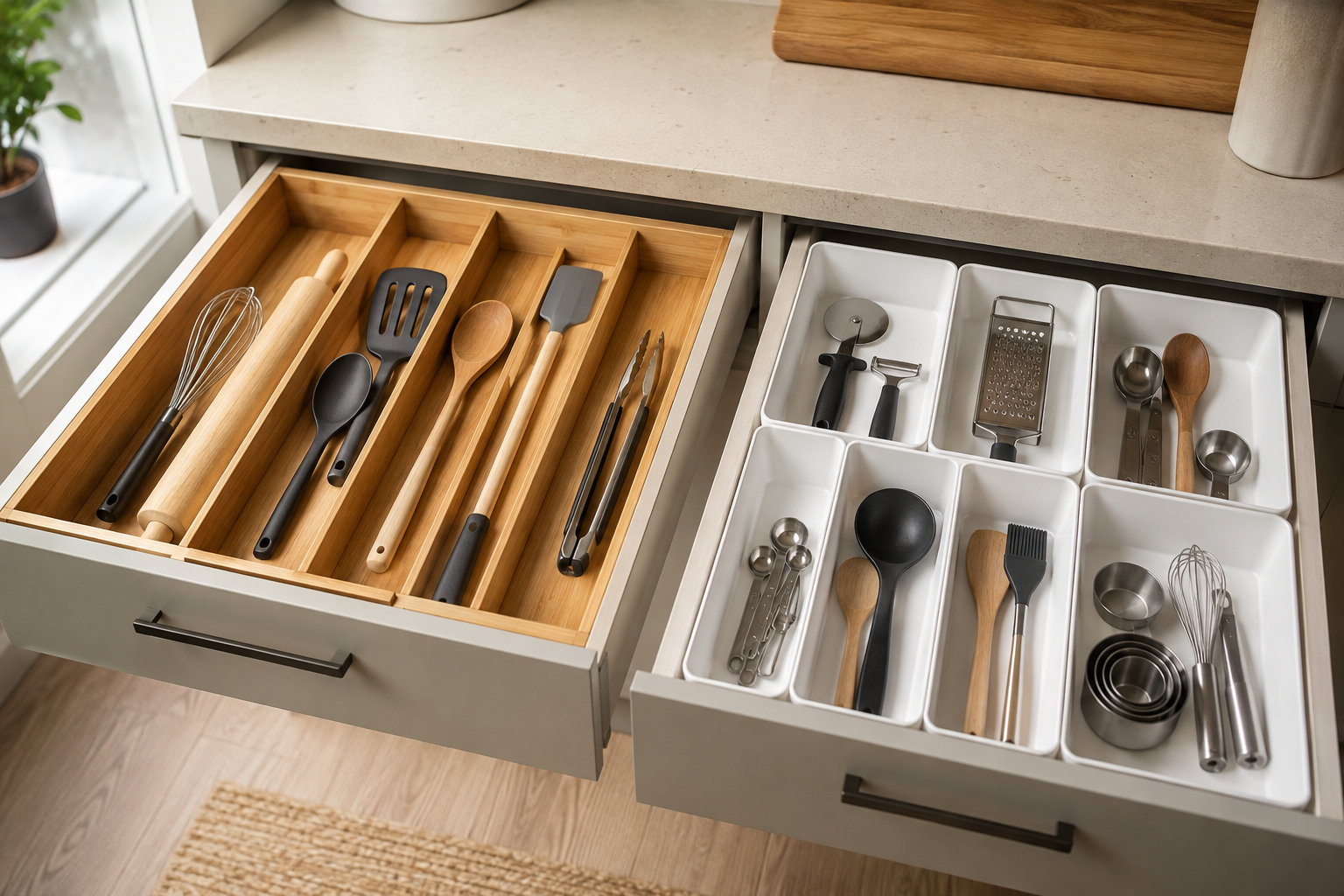
Quick decision before shopping
First measure the available space, identify the setup or surface constraints, and decide who will maintain the item. Skip the category if it blocks access, conflicts with the manufacturer's instructions or lease, or adds more upkeep than the problem justifies.
Measure the inside of the drawer first: These affiliate category links are comparison starting points, not tested rankings.
- Browse category: Compare expandable kitchen drawer organizersCheck closed and expanded width, full depth and height, compartment dimensions, base grip, material care, and side-panel clearance.
- Browse category: Compare modular kitchen drawer binsCheck each bin's outside dimensions, available sizes, non-slip features, usable interior space, cleaning instructions, and layout gaps.
This comparison covers formats, not specific products. Dimensions, materials, finishes, care instructions, and non-slip features vary. Confirm exact product measurements against the narrowest point inside the drawer, including screw heads, curved sides, and other obstructions.
Quick Decision
Expandable organizer: best when you want one stable insert, your drawer is reasonably rectangular, and long utensils fit the available channels. Expansion can reduce side gaps, but only within the product's stated range.
Modular bins: best when you want to build around unusual tools, leave an intentional open zone, or change the layout later. Flexibility comes with more seams, more pieces to lift, and potential gaps between bins.
Skip both for now: if the drawer will not close over the tallest tool, contains too many duplicates, or needs to hold utensils longer than either system's usable compartments.
Measure the Drawer, Not the Cabinet Front
- Empty the drawer and measure its usable inside width at the front, middle, and back.
- Measure usable depth with the drawer fully closed, noting curved backs or hardware.
- Measure vertical clearance from the drawer floor to the lowest obstruction above it.
- Measure the longest, widest, and tallest tools that must stay in the drawer.
- Lay out the proposed organizer footprint with paper or painter's tape and test where every daily-use group would go.
An expandable tray needs to fit at its closed width before its side sections add useful capacity. Modular bins need a combination whose outside dimensions fit together; adding advertised interior dimensions will undercount walls and gaps.
Where an Expandable Tray Wins
A single tray is easier to lift as one unit and can feel more settled when its footprint closely matches the drawer. Long continuous channels suit spatulas, serving spoons, and similar tools. Expansion panels can turn otherwise wasted side space into extra compartments.
The tradeoff is a mostly fixed internal plan. A wide gadget, bulky peeler, or very long utensil may not match the channels. Check whether expanding the tray exposes a useful supported compartment or merely creates a narrow strip that collects small items.
Where Modular Bins Win
Separate bins let you combine long, short, narrow, and square compartments around the contents you already own. You can remove one bin for cleaning or repurpose the layout after a utensil edit. They also work well when part of the drawer needs to stay open for an odd-shaped tool.
The tradeoff is movement and wasted seams. Product walls consume space, loose bins may shift when the drawer opens, and a nearly fitting grid can leave a narrow, hard-to-clean channel. Check documented grip features and do not assume every material is dishwasher-safe.
Cleaning and Material Tradeoffs
Look for care instructions that fit the mess the drawer actually gets. Smooth removable plastic bins may be easy to wash if the maker allows it. Wood or bamboo-style trays generally need the product's specified wipe-clean routine and should not be treated as waterproof unless the instructions say so. Seams, expansion rails, textured bases, and tight corners can trap crumbs.
Before buying, check whether the entire organizer can clear the drawer opening when lifted. An exact wall-to-wall fit can make removal harder, especially under an overhanging counter.
Must-Haves Versus Nice-to-Haves
Must-haves: verified outside dimensions, enough vertical clearance, compartments that fit the actual tools, a stable base, realistic cleaning access, and material care you will follow.
Nice-to-haves: several bin sizes in one system, rounded corners, removable dividers, expansion rails that stay aligned, and a little spare room for lifting the organizer out. A perfect visual grid matters less than easy access and a drawer that closes reliably.
Who Should Skip Each Format?
- Skip an expandable tray if the drawer is narrower than its closed width, the sides taper significantly, or most tools do not match its fixed channels.
- Skip modular bins if loose pieces and seams will make cleaning or resetting the drawer frustrating.
- Skip both if tall items catch, the contents are mostly duplicates, or the drawer needs repair rather than an insert.
- Use another location for sharp tools when the proposed layout does not keep edges protected and access controlled.
Bottom Line
An expandable organizer is the simpler choice for a regular drawer and a predictable set of utensils. Modular bins are better when the drawer or contents demand a custom layout. The best answer is the format that fits after accounting for every wall, seam, rail, obstruction, and actual tool—not the one that looks tidiest while empty.
For broader format and material criteria, continue to the small-kitchen drawer organizer guide.