Drawer Dividers vs Modular Bins for Home Office Supplies
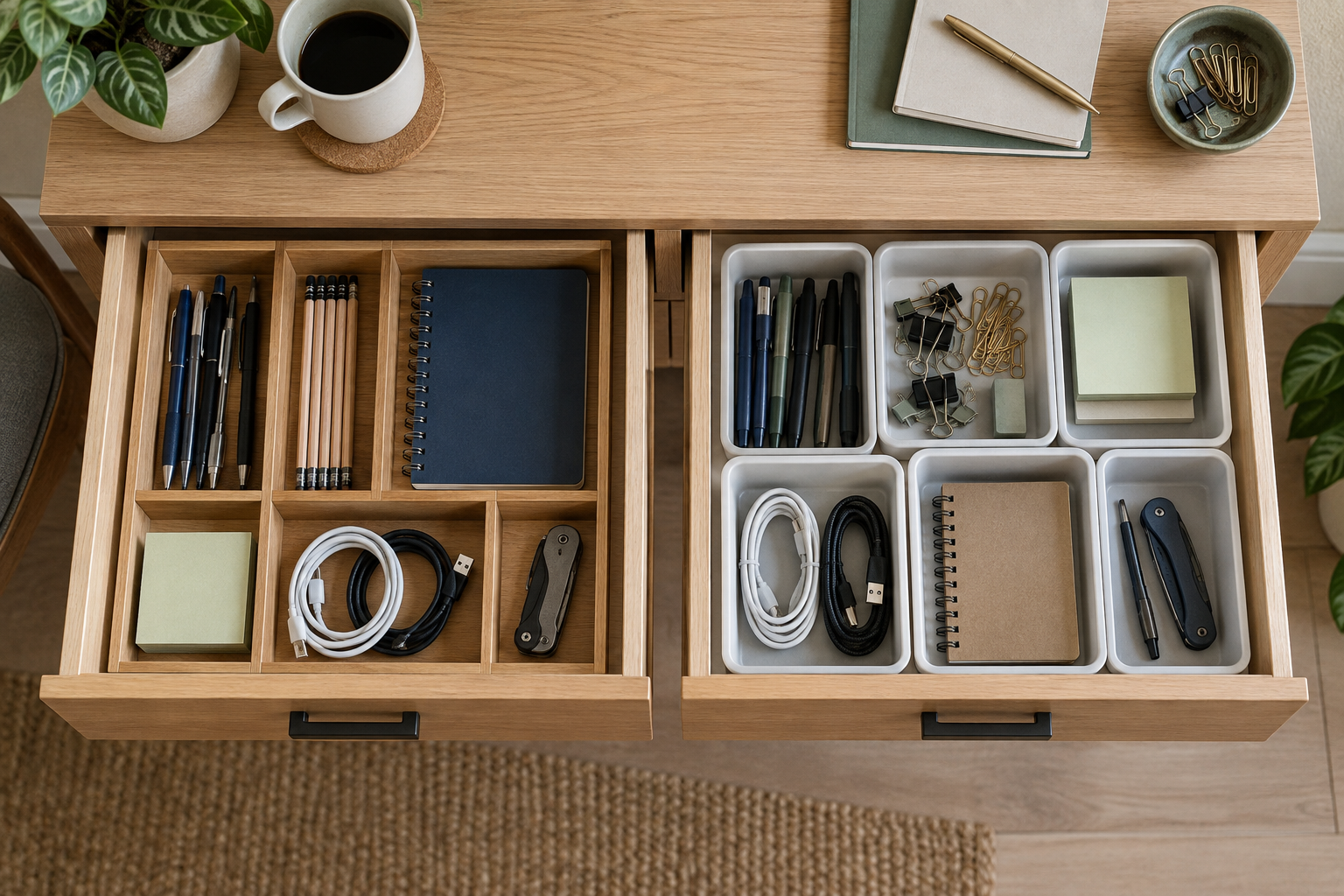
Choose adjustable dividers when you want long, continuous sections for pens, notebooks, cables, or a few larger tools. Choose modular bins when your supplies fall into several small groups or the layout changes often. In either case, measure the drawer and sort its contents before buying—the organizer cannot create space an overfilled drawer does not have.
As an Amazon Associate, The Good Home Doc may earn from qualifying purchases.
Quick decision before shopping
First measure the available space, identify the setup or surface constraints, and decide who will maintain the item. Skip the category if it blocks access, conflicts with the manufacturer's instructions or lease, or adds more upkeep than the problem justifies.
Start with inside dimensions and the supplies that must stay: These affiliate category links are shopping starting points, not tested winners.
- Browse category: Compare adjustable drawer dividersCheck adjustment range, height, tension or mounting method, end pads, material care, and clearance above the tallest item.
- Browse category: Compare modular office drawer binsCheck every bin's outside dimensions, usable interior, available sizes, grip features, cleaning instructions, and total seam space.
This is a format comparison, not a ranking of current products. Confirm the current listing and manufacturer documentation for dimensions, adjustment limits, materials, installation, cleaning, and any load guidance.
The Short Answer
- Pick dividers for a mostly rectangular drawer with long items, a few broad categories, and a layout that should use the full drawer depth.
- Pick modular bins for clips, adapters, erasers, sticky notes, batteries, and other small groups that benefit from removable containers.
- Mix the two only when measurements support it. One divider can reserve a notebook or cable zone while two or three bins contain tiny items, but every wall and gap consumes space.
- Skip both for now if the drawer sticks, the contents need to be edited, or the tallest supply already rubs the desk frame.
Side-by-Side Tradeoffs
| Decision point | Adjustable dividers | Modular bins |
|---|---|---|
| Best item mix | Long or mixed-size supplies in a few broad groups. | Many small supplies that need distinct categories. |
| Use of space | Fewer internal walls, but the layout usually runs in straight sections. | Flexible footprint, with more space lost to bin walls and gaps. |
| Reconfiguration | Move the dividers and regroup whole sections. | Swap, remove, or carry individual bins. |
| Movement risk | Depends on correct tension, end grip, and drawer surface. | Loose bins can slide unless the base or liner provides grip. |
| Cleaning | Fewer pieces, but installed edges can trap dust. | Each bin lifts out, though there are more seams beneath them. |
Measure the Usable Drawer
- Empty the drawer and measure inside width at the front, middle, and back; desk drawers can taper or contain hardware.
- Measure usable depth and note stops, screw heads, curved backs, cable openings, and lock mechanisms.
- Measure vertical clearance from the drawer floor to the lowest part of the desk above it.
- Measure representative supplies: the longest notebook, widest sticky-note pad, tallest tape dispenser, largest cable coil, and any small tool that must stay.
- Mock up the layout with folded paper or cardboard, including the thickness of each divider or bin wall.
For dividers, verify that the adjustment range matches the direction in which you plan to install them. For bins, add the outside dimensions—not the interior storage measurements—and leave enough room to lift each piece out.
When Dividers Fit Better
Dividers preserve continuous space. That helps when a shallow drawer holds a notebook beside pens, charging cables, a ruler, or a compact hand tool that would not fit a standard bin. A small number of long sections can also make quick daily resets easier because items need only return to the right zone.
The tradeoff is restraint. Straight partitions may not contain tiny clips well, and a tension divider can shift when its adjustment range, height, end pads, or drawer surface are a poor match. Do not force a spring-loaded divider against a delicate drawer wall or mechanism; follow its installation directions.
When Modular Bins Fit Better
Bins are useful when small supplies need individual homes. A bin of adapters can be lifted to the desk, a paper-clip bin can move beside a project, and a seldom-used category can leave the drawer entirely. Mixed sizes can work around a square note pad or an awkward tool better than evenly spaced partitions.
The tradeoff is the grid itself. Bin walls and narrow gaps reduce capacity, and a nearly complete layout can leave a useless strip along one edge. Loose pieces may slide or rattle. Check built-in grip features before adding a liner, because extra thickness can raise the bins enough to interfere with closing.
Setup: Sort by Workflow, Not Appearance
Keep everyday writing tools near the hand you use to open the drawer. Group cables by purpose and coil them loosely enough to avoid sharp bends. Reserve an easy-to-remove container for small items that scatter during cleaning. Put rarely used refills toward the back only if the drawer opens far enough to reach them.
Sharp blades, loose batteries, liquids, adhesives, and heat-producing devices may need storage outside a general supply drawer. Use protective cases and follow the product maker's storage guidance. A tidy-looking layout is not a substitute for safe, suitable storage.
Maintenance and Reconfiguration
Lift supplies out periodically and remove dust from the drawer using the care method appropriate for its finish. Clean organizer pieces according to their stated instructions; do not assume wood, coated board, felt, silicone, and plastic tolerate the same moisture or cleaners.
Revisit the layout when the drawer becomes difficult to reset. Dividers are usually quickest to re-space when entire categories grow or shrink. Bins are easier when one category should move to another drawer or come out for a particular task. In both systems, an empty compartment is permission to remove a piece—not a reason to buy more supplies.
Who Should Skip Each Option?
- Skip adjustable dividers if the drawer walls are weak or irregular, the required orientation falls outside the adjustment range, or tiny items will slip beneath or around the partitions.
- Skip modular bins if the drawer is extremely shallow, most supplies are long, or bin walls and gaps would consume too much of the footprint.
- Skip a full organizer grid if the drawer already works with one pencil pouch, cable case, or small tray.
- Fix or replace the drawer first if it binds, sags, has exposed fasteners, or cannot support ordinary use reliably.
Bottom Line
Adjustable dividers are better for long supplies and a few broad zones; modular bins are better for small categories and layouts that change. The best choice is the one that fits the measured drawer, leaves the contents easy to see and lift, and can be cleaned without turning organization into another chore.
For the next step, use the small-home organization systems guide to decide what belongs at the desk and what should move to files, shelves, or another room.