Cleaning Caddy vs Utility Bucket for Household Chores
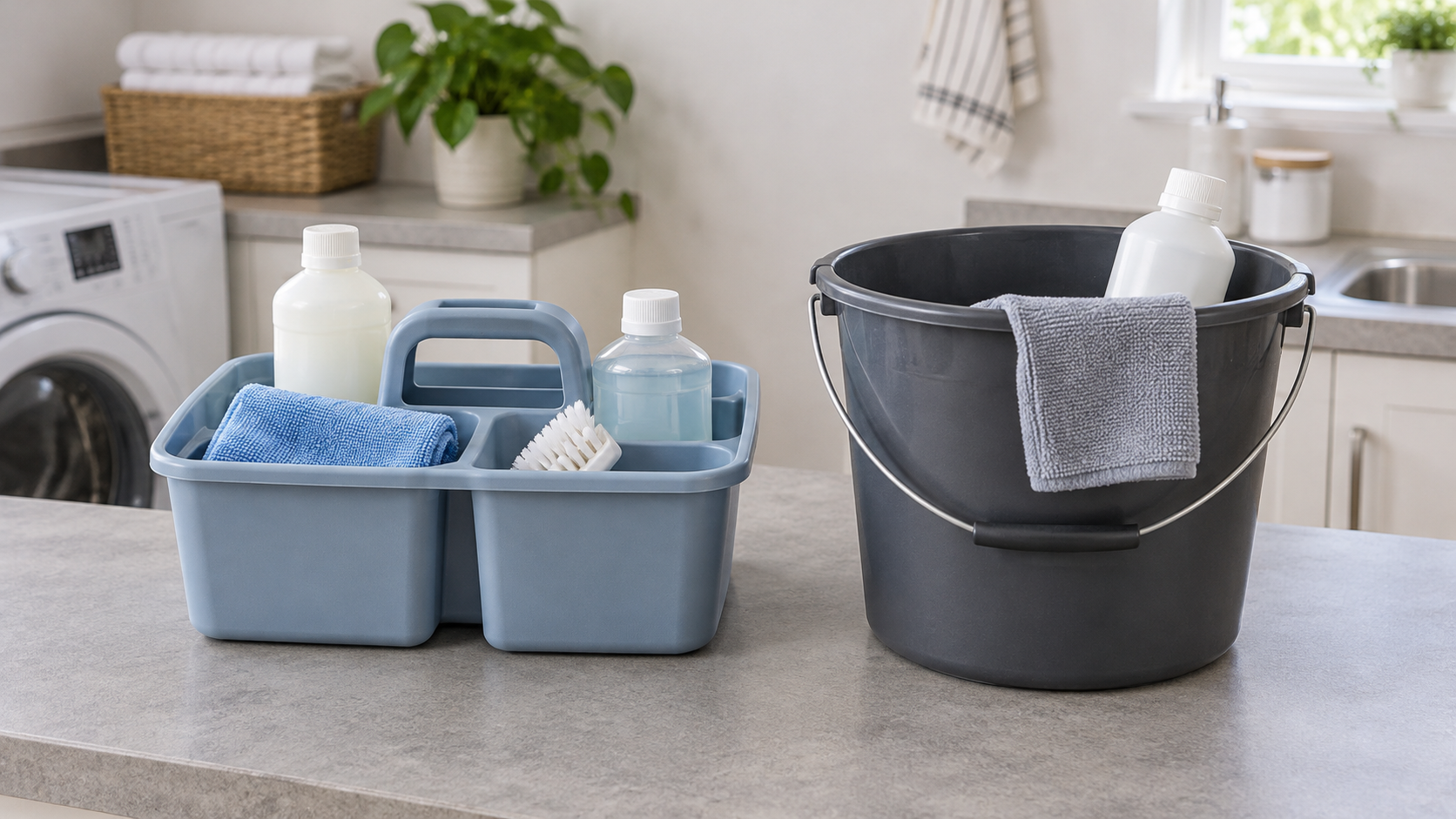
Choose a cleaning caddy when a small repeat kit needs divided, visible storage and quick access. Choose a utility bucket when you need a simpler open container, taller-item flexibility, or a separate vessel that its instructions permit for the chore. Neither is a safe place for loose, leaking, incompatible, or unlabeled products.
As an Amazon Associate, The Good Home Doc may earn from qualifying purchases.
Quick decision before shopping
First measure the available space, identify the setup or surface constraints, and decide who will maintain the item. Skip the category if it blocks access, conflicts with the manufacturer's instructions or lease, or adds more upkeep than the problem justifies.
Measure the supplies, route, and storage spot first:
- Browse category: Compare handled household cleaning caddiesCheck usable compartment dimensions, handle clearance, base shape, intended load, materials, and care instructions.
- Browse category: Compare handled utility bucketsCheck usable capacity, interior and exterior dimensions, handle attachment, pour shape, intended uses, and cleaning guidance.
These are category routes, not tested winners. Keep every product in its original closed, labeled container; follow each product label; and never mix cleaning products in either carrier.
Quick answer
- Choose a cleaning caddy for a compact group of frequently used supplies that fit its divided compartments and remain upright.
- Choose a utility bucket for an open, flexible load or when the bucket itself has a documented role in the cleaning method.
- Use separate carriers when products or tools belong to different zones and combining them would increase leaks, confusion, or cross-use.
- Skip both when the load is too heavy, containers cannot stay closed and upright, stairs make one-handed carrying unsafe, or product instructions require different storage or handling.
At-a-glance tradeoffs
| Decision point | Cleaning caddy | Utility bucket |
|---|---|---|
| Best fit | A small repeat kit with defined tools and bottles. | A flexible open load or a permitted water-container job. |
| Organization | Dividers keep small items visible but restrict bottle width and shape. | Open space accepts varied shapes but small items can settle underneath. |
| Access | Tools can have assigned positions around the handle. | The full opening is available, though a mixed load may need unloading. |
| Cleanup | Compartments and handle junctions add corners to wash and dry. | A plain interior is easier to inspect, but confirm any rim, spout, and handle care. |
| Storage | Fixed partitions prevent nesting and require overhead handle clearance. | May stack or nest only when the maker allows it and every item is removed. |
Who a cleaning caddy fits
A caddy fits a household that uses the same modest kit for routine, label-compatible chores. Measure each bottle at its widest point and include trigger sprayers, caps, brush heads, cloth bundles, and the space your fingers need under the handle. Tall bottles should not lean against the handle or protrude so far that they snag while moving through a doorway.
Dividers help when every compartment has a job: closed bottles on one side, dry cloths or gloves on another, and small tools in a shallow section. They become a drawback when the kit changes often or the partitions force containers to tilt. A caddy organizes supplies; it does not make incompatible products safe to store together.
Who a utility bucket fits
A utility bucket fits larger or less standardized tools because its interior is open. It can also suit a chore that calls for a bucket, but only when the exact product and surface instructions permit that method. Do not assume that a bucket used to carry closed supplies should later hold a cleaning solution without being emptied, cleaned, and used as directed.
The open shape needs its own organization plan. Keep caps and triggers closed, put stable containers at the base, and avoid a load that shifts above the rim. Small brushes and cloths may disappear beneath bottles, so a bucket is often better for a short task-specific load than permanent mixed-supply storage.
Carrying, setup, and room-to-room use
Map the complete route before buying: shelf to sink, through doors, around pets or children, and up or down any stairs. Compare the loaded carrier, not its empty weight. The handle should leave enough knuckle clearance, stay centered under a realistic load, and attach without sharp edges or visible damage.
Carry only a weight you can control without bracing the container against your body. On stairs, do not let a one-handed carrier prevent use of a handrail. Make smaller trips or stage supplies safely on each floor instead. Keep the carrier off counters used for food preparation unless the surface and carrier are cleaned as appropriate.
Maintenance and storage
Remove every item regularly and inspect the base, dividers, rim, and handle attachment for residue, cracks, rough edges, or trapped moisture. Clean and dry the carrier according to its material and maker instructions. A caddy's narrow cells may need a smaller cloth or brush; a bucket's handle pivots and rim can hide drips.
Store products according to their own labels, not merely wherever the carrier fits. Keep them in original labeled containers, closed, upright, and away from children, pets, food, heat, and any other restricted conditions. If a bottle leaks, isolate it and follow its label rather than placing a cloth underneath and returning it to the kit.
Who should skip each option?
Skip a cleaning caddy when the dividers do not match the actual bottles, the center handle blocks tall tools, or the household needs an open container for a documented cleaning step. Do not force a bottle into a cell or transfer a product into a smaller unlabeled container.
Skip a utility bucket when loose small tools will be buried, a mixed load will tip, or the open container encourages too many supplies to travel together. Skip a bucket without clear intended-use, handle, capacity, and care information.
Skip both when product labels require locked or separated storage, when a damaged or leaking container is present, or when the route and load cannot be handled safely. Strong fumes, unexplained reactions, large spills, or hazardous cleanup need label-specific directions and, when indicated, qualified help.
Bottom line
A cleaning caddy is the better organizer for a small, repeat kit whose containers fit the partitions. A utility bucket is the more flexible carrier for varied shapes or a documented bucket-based task. Measure the supplies and the route, keep products closed and labeled, plan the cleanup and storage, and choose the format whose complete routine is simplest to maintain.