How to Choose Window Fans for Apartments Without Central Air
The best window fan for an apartment is not simply the one with the most speeds. It is the format that fits the exact window, leaves a sensible cord route, supports the airflow direction you need, and can be removed when weather, outdoor air, security, or building rules make an open-window setup inappropriate.
As an Amazon Associate, The Good Home Doc may earn from qualifying purchases.
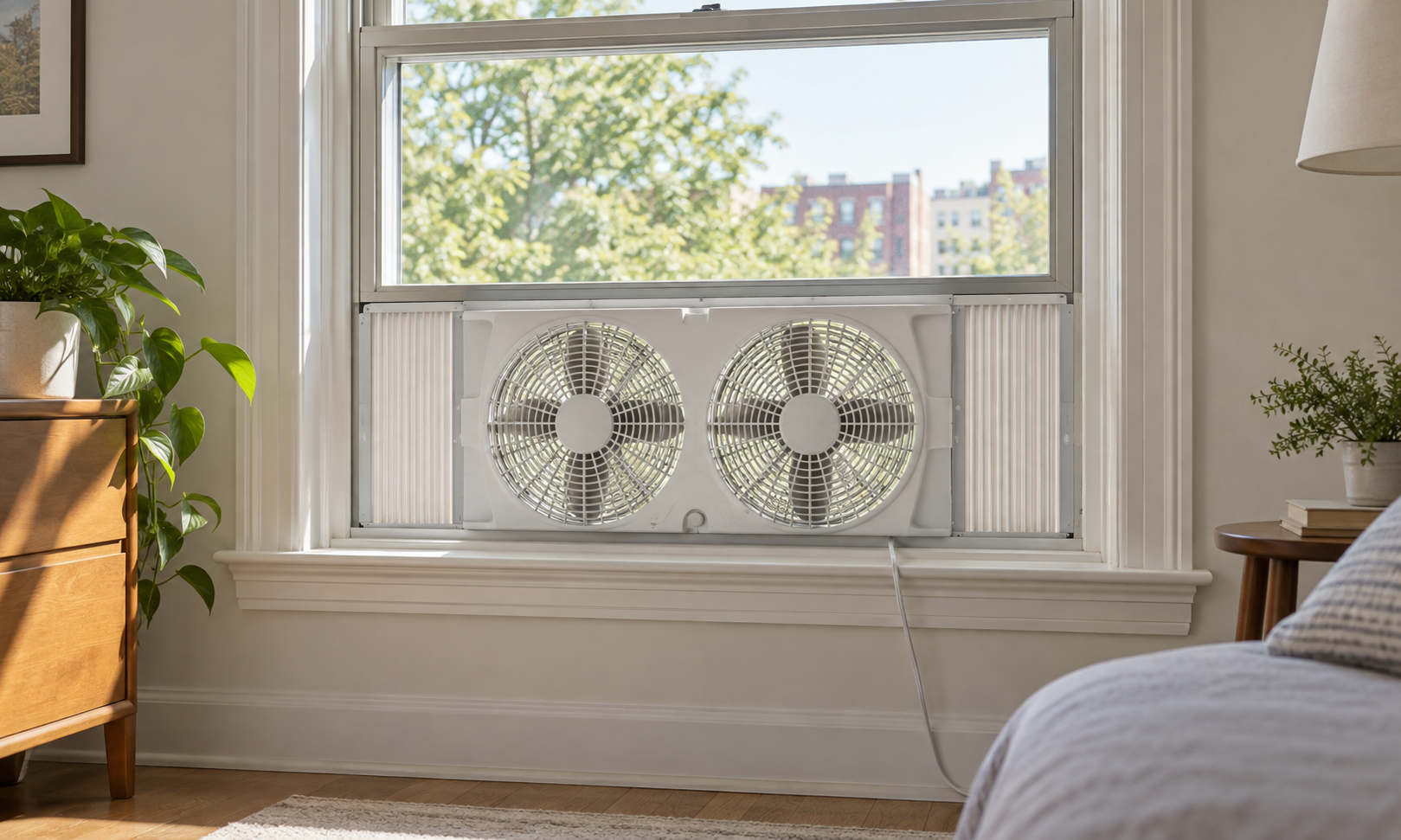
Quick decision before shopping
First measure the available space, identify the setup or surface constraints, and decide who will maintain the item. Skip the category if it blocks access, conflicts with the manufacturer's instructions or lease, or adds more upkeep than the problem justifies.
Compare the format only after measuring the window: These affiliate category links are shopping starting points, not tested winners.
- Browse category: Compare twin window fansLook for a documented panel range, intake and exhaust modes, independent controls if useful, and accessible grille cleaning.
- Browse category: Compare single window fansCheck the complete housing size, permitted window orientation, panel fit, controls, cord length, and storage dimensions.
Confirm current specifications, manufacturer instructions, return terms, and compatibility with your window before ordering. Category results can change and are not rankings.
A window fan moves air through an opening; it does not cool air like air conditioning. Its usefulness depends on the indoor-outdoor temperature difference, humidity, wind, outdoor air quality, apartment layout, and whether another opening provides a sensible air path. Do not use one to pull in smoke, combustion gases, strong chemical fumes, or visibly poor outdoor air. Follow official local health and weather guidance when conditions are extreme.
Best window-fan formats by apartment setup
| Format | Best fit | Main tradeoff |
|---|---|---|
| Twin fan with reversible airflow | Readers who want documented intake and exhaust choices in one measured opening | Wider housing and more controls can mean more fit and cleaning checks |
| Single large fan | A compatible opening where simple, broad airflow is the priority | May offer fewer independent airflow options and can be bulky to store |
| Compact twin fan | Narrower compatible windows or limited off-season storage | Smaller fan area may need a higher, more audible setting for the desired effect |
| Electronically controlled reversible fan | A reachable, secure window where direction changes are frequent | Displays, remotes, thermostatic modes, and beeps add complexity; behavior must be documented |
These are format categories, not universal performance tiers. A basic fan that seals a measured opening and is easy to remove may be a better apartment choice than a feature-heavy unit that does not fit the sash, screen, outlet, or storage spot.
Measure the complete window opening
Identify whether the window is double-hung, single-hung, sliding, or another type, then check which orientations the fan maker permits. Measure the clear opening width and height—not the trim-to-trim size—and note the sill depth, sash track, locks, handles, screen, curtain path, blinds, and any projecting hardware. Compare those measurements with both the fan housing and its stated extender-panel range.
Do not assume an accordion panel secures a fan or restores the window's normal lock. Check the installation instructions before buying. Ask the landlord or property manager before removing a screen, adding hardware, interfering with a required window function, or leaving an accessible opening less secure. A window that serves as a required emergency escape route needs special caution; do not obstruct it.
Choose airflow modes you will actually use
Intake can bring outdoor air into the apartment when that air is suitable. Exhaust can move indoor air toward the outdoors, but it is not a substitute for a required kitchen or bathroom exhaust system and should not be used around combustion hazards or unknown fumes. Reversible twin-fan modes may let the two fan heads run in different directions, but only count on that behavior when the current documentation clearly describes it.
Manual reversal can be workable if changes are rare and the instructions allow it. Electronic reversal is more convenient when conditions change through the day. Automatic temperature modes can switch or cycle a fan based on the sensor and controls, but they do not make the apartment safely cooled or suitable for unattended operation. Read the control logic and power-restoration behavior rather than guessing from the feature name.
Must-have apartment checks
- Documented fit: Housing and extender range suit the measured opening and allowed orientation.
- Stable installation: The sash and panels sit as instructed without improvised wedges, tape, or unsupported gaps.
- Safe cord route: The cord reaches an appropriate outlet without crossing a walkway, doorway, wet area, or pinch point.
- Weather routine: You know when the maker requires removal and can reach the fan quickly when rain or wind changes.
- Outdoor-air routine: Someone will check outdoor temperature, air quality, smoke, and local alerts before using intake mode.
- Cleaning access: Grilles and blades can be maintained according to the manual without turning a simple chore into a teardown.
- Normal window recovery: The fan can be removed and the window can close, lock, and operate normally when needed.
Nice-to-have features
Independent fan controls can support simultaneous intake and exhaust when the manufacturer documents that mode. A clearly labeled remote may help at a hard-to-reach window, provided it does not replace accessible physical controls. Multiple low settings, display dimming, a carry handle, washable or accessible grilles, and panels that stay attached during storage can all improve daily use.
Treat any published sound figure carefully. Compare only numbers with a stated speed, distance, and test basis. Panel vibration, the open window, street noise, curtains, and room surfaces all affect what you hear at home, so a practical return route matters when the fan will run near a bed or desk.
Placement, security, and weather limits
A window fan changes the normal window setup. Consider reach from outside, the floor level, child and pet access, the ability to lock the window, and whether the opening is exposed to driven rain. Do not treat extender panels as security devices, insect barriers, or weather seals unless the product documentation says exactly that. Remove the fan whenever the instructions or conditions call for it.
Keep curtains, blind cords, bedding, hair, fingers, toys, and loose objects away from the intake and outlet. Do not place a fan in a wet location or connect it through an unsuitable extension cord. Stop using any unit with a damaged plug, cord, grille, housing, control, or panel.
Cleaning and off-season storage
Window fans encounter indoor dust plus outdoor particles and insects. Check whether the grille is removable, what tools are needed, and which parts may be washed or only wiped. Unplug the unit and follow the maker's cleaning, drying, and reassembly directions. Never spray liquid into the motor or controls.
Measure the storage destination before buying. Keep track of extender panels, feet, fasteners, remote controls, and instructions. A unit that is easy to lift and store may be more useful in a rental than a larger fan that becomes a permanent obstacle when the window needs to close.
Who should skip a window fan?
Skip this category when the window type or opening falls outside documented fit, the setup prevents ordinary locking, the opening is security-sensitive, the lease prohibits it, or the fan would obstruct a required route. A pedestal or other room fan may be the simpler circulation tool when outdoor air is frequently smoky, humid, noisy, polluted, or hotter than indoors.
Neither window nor room fans are enough when indoor heat is dangerous, a vulnerable person needs reliable cooling, recurring dampness or odors point to a building problem, or ventilation equipment is malfunctioning. Contact the property manager or an appropriate qualified professional, and follow official cooling-center, emergency, health, and weather guidance where relevant.
Bottom line
For most compatible apartment windows, begin with a reversible twin fan only if its complete housing and extender range fit, the airflow modes are documented, and the window can be restored quickly when conditions change. Choose a simpler single or compact format when storage, controls, or opening width matter more than flexible airflow direction. Measure first, protect the window's normal function, plan the cord and removal routine, and treat outdoor conditions—not a long feature list—as the deciding constraint.