How to Choose Water Filter Pitchers for Narrow Refrigerator Shelves
A slim water filter pitcher is useful only if it fits the shelf, clears the refrigerator door, supports the specific reduction claims you need, and keeps up with the household without constant refilling. Measure the refrigerator first, identify the claims that matter second, and then compare pitcher formats—not marketing superlatives.
As an Amazon Associate, The Good Home Doc may earn from qualifying purchases.
Quick decision before shopping
First measure the available space, identify the setup or surface constraints, and decide who will maintain the item. Skip the category if it blocks access, conflicts with the manufacturer's instructions or lease, or adds more upkeep than the problem justifies.
Compare the format that fits your shelf and refill routine:
- Browse category: Compare slim refrigerator water filter pitchersVerify complete exterior dimensions, handle projection, usable capacity, filter model, and exact certified claim scope.
- Browse category: Compare narrow easy-fill pitcher formatsCheck whether the lid stays secure, the reservoir can refill beneath the faucet, and the full pitcher remains manageable.
- Browse category: Compare compact pitchers and replacement filtersConfirm the exact cartridge is readily available and its current replacement instructions fit your routine.
These are category searches, not tested rankings. Confirm current dimensions, capacity, NSF listing or other certification details, cartridge compatibility, replacement schedule, use instructions, and cleaning guidance before buying.
This is a category comparison, not a list of named winners. Filter capabilities vary by exact system and cartridge. A certification or test result applies only to the contaminants, conditions, and product configuration in its listing; it is not proof that a pitcher removes every possible substance from water.
Quick Best-Fit Guide
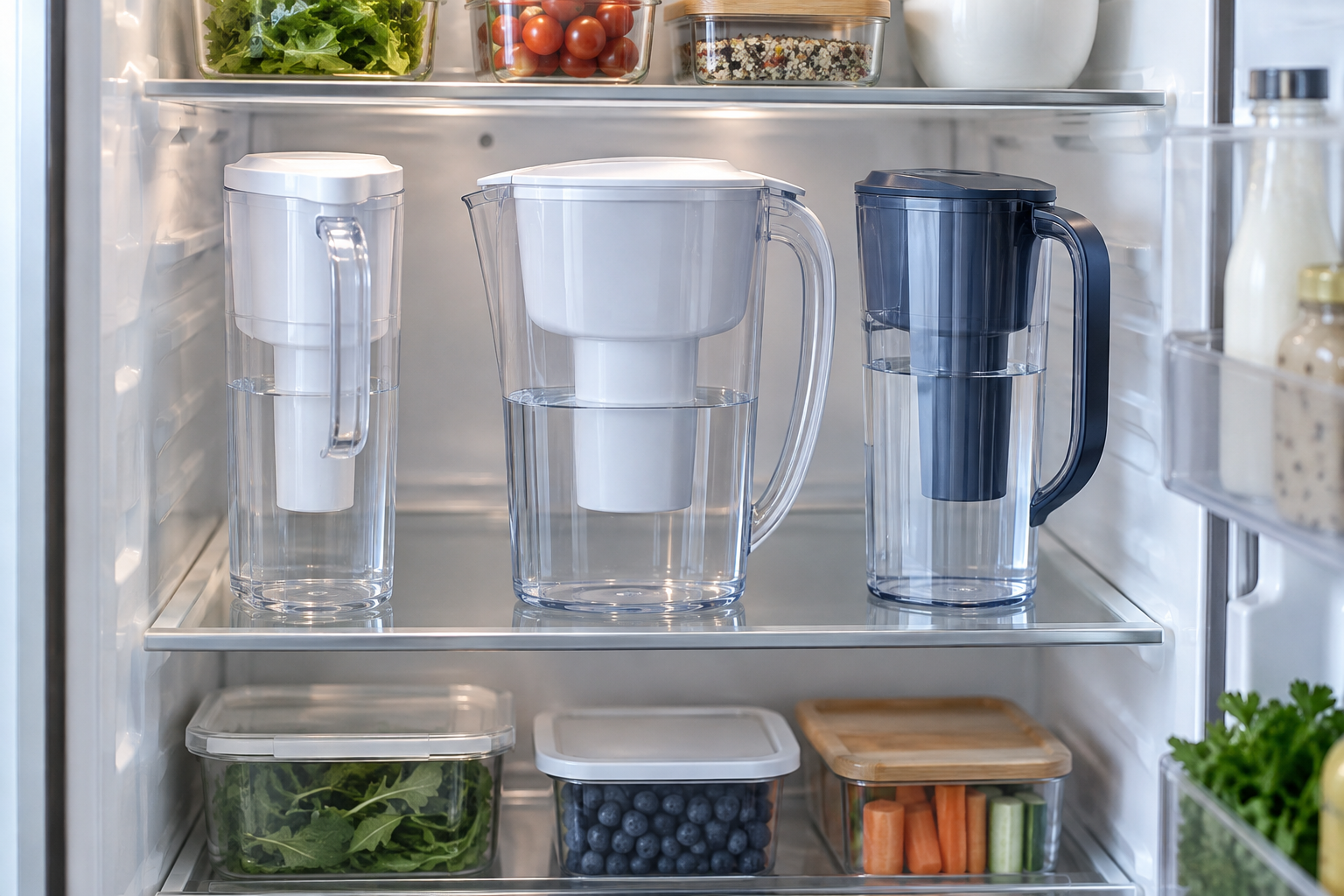
- Tall narrow pitcher: a good starting point when shelf width is scarce but vertical clearance and the pull-out path are generous.
- Short compact pitcher: easier to place under a low shelf and often easier to lift, but it may need more frequent refilling.
- Long slim pitcher: may use shelf depth efficiently, provided the handle, door bins, and normal door-opening angle allow a straight pull.
- Countertop dispenser instead: worth considering when several people need more capacity and the counter footprint is acceptable.
- Skip a filter pitcher: when your water concern requires professional testing, treatment beyond the pitcher’s documented scope, or faster daily output than batch filtering can provide.
Start With Four Refrigerator Measurements
Measure usable shelf width, depth, and height around every obstruction, including shelf lips, light housings, vents, controls, filter covers, and door bins. Then measure the exit path with the refrigerator door opened to the angle you normally use. A pitcher can fit on a shelf yet fail to clear a door bin or center hinge when pulled forward.
Use the product’s complete exterior dimensions, not its water capacity, to test fit. Include the handle, spout, lid, refill flap, and any part that projects beyond the body. Leave the appliance maker’s required clearance around vents and controls. A cardboard footprint and side profile can expose a bad fit before you order.
Decide What You Need the Filter to Address
Begin with a current water-quality report from the utility when one is available, or appropriate testing when the concern is specific. Then look for independent certification that names the exact system, cartridge, standard, and reduction claim relevant to that concern. NSF/ANSI standards cover different functions; a reference to one standard is not a blanket promise about every contaminant.
Verify a listing through the certifying organization’s current directory rather than relying only on packaging language or a marketplace title. Match the model number and cartridge combination exactly. If you use private well water, have an urgent contamination concern, notice a sudden change in water, or need treatment for a health-related reason, consult the relevant local authority or a qualified water professional instead of choosing by pitcher marketing.
Comparison Framework
Tall, Narrow Pitchers
This shape preserves shelf width and may slide beside milk or food containers. The tradeoff is height: the lid and refill opening need enough room, and the pitcher may become top-heavy or awkward for a shorter user when full.
Choose this format when: the shelf is narrow, the available height is verified, and the full pitcher can be lifted and poured comfortably. Skip it when: the top shelf blocks refilling or removal, or the handle forces the pitcher into a door bin.
Short, Compact Pitchers
A lower profile can fit beneath a closely spaced shelf and is usually easier to move between sink and refrigerator. The smaller usable capacity creates more refill cycles, which can become tedious in a multi-person household.
Choose this format when: one or two people use modest amounts and low vertical clearance is the main constraint. Skip it when: repeated filtering cannot keep pace with cooking, bottles, and daily drinking water.
Long, Depth-Using Pitchers
A long body can turn unused shelf depth into capacity without consuming much frontage. Look closely at balance, handle position, spout control, and the path past the refrigerator door. Deep designs can also hide behind food and make it harder to see the water level.
Choose this format when: the shelf is deep, the pitcher pulls straight out, and the household can lift it from its designed grip. Skip it when: the door cannot open far enough or nearby containers must be moved every time.
Usable Capacity Matters More Than the Headline Number
Compare the amount of filtered water ready to pour, the upper reservoir volume, and whether unfiltered water can mix with filtered water when the pitcher is tilted. A large total-volume number may include space that is temporarily occupied during filtering. Check the maker’s instructions for when it is safe to pour.
Estimate daily demand from drinking, bottles, coffee, and cooking, then compare it with the ready-water capacity and typical filtering workflow. Avoid assuming a published flow rate will match every home; water temperature, cartridge condition, setup, and product design can affect the experience. A smaller pitcher works best when someone is willing to refill it predictably.
Lid, Handle, and Refill Design
A secure lid matters because a loose lid can shift during pouring. Check whether it locks, rests in place, or uses a refill flap, and follow the maker’s pouring instructions. Make sure the pitcher fits under the faucet with enough room to open the fill area without removing shelves or bumping the sink.
Handle comfort depends on hand size and the full weight, not appearance. Look for a grip that allows controlled lifting without twisting the wrist. If several household members will use it, have the smallest regular user assess the filled weight. A convenient refill flap is a nice-to-have only after the pitcher fits, filters the relevant claims, and pours securely.
Cartridge Availability and Ongoing Cost
Record the exact replacement cartridge model before buying the pitcher. Check whether it is sold individually or in multipacks, whether the manufacturer still supports it, and whether genuine replacements are easy to identify. A low pitcher price is not useful if compatible cartridges are confusing, scarce, or more frequent than the household will maintain.
Follow the maker’s replacement schedule and any volume, time, or indicator guidance. Do not extend use because the water still looks clear or tastes normal. Conversely, do not assume an electronic or mechanical indicator directly measures every contaminant; confirm what the indicator actually tracks.
Cleaning and Daily Maintenance
Review disassembly and cleaning instructions for the lid, reservoir, body, spout, handle joints, and any indicator. “Dishwasher safe” may apply to only some components or a particular rack, so verify each part. A narrow pitcher with deep corners can be harder to hand-wash than its compact footprint suggests.
Follow instructions for preparing a new cartridge, storing the system, and handling periods of nonuse. Keep unfiltered water away from the clean-water chamber as directed, wash hands before handling filter components, and replace cracked or damaged parts. If the pitcher develops persistent odor, visible buildup, damage, or performance changes, stop and follow the maker’s troubleshooting guidance.
Must-Haves Before Nice-to-Haves
Must-Haves
- Complete dimensions that fit the shelf, door-opening path, faucet, and hand clearance.
- Current independent certification or documentation for the exact claims you need.
- A manageable filled weight, secure lid, controlled pour, and usable handle.
- A clearly identified replacement cartridge with realistic availability and maintenance instructions.
- Cleaning and storage directions the household will actually follow.
Nice-to-Haves
- A refill flap that works beneath the household faucet.
- A visible water level without pulling the pitcher fully out.
- A simple replacement reminder whose function is clearly explained.
- A shape that shares the shelf cleanly with recurring groceries.
Who Should Skip a Water Filter Pitcher
- Skip it when the exact system lacks documentation for the reduction claim you need.
- Skip it when lifting, gripping, or pouring the full pitcher would be difficult for a regular user.
- Skip it when household demand would require near-constant refilling; compare a larger documented system or another suitable format.
- Skip it when the refrigerator cannot maintain safe operation, has blocked vents, or lacks a clear pull-out path.
- Skip consumer pitcher shopping as the response to a boil-water notice, sudden contamination concern, private-well issue, or problem requiring professional water treatment guidance.
Buying Checklist
- Measure shelf width, depth, height, obstructions, door angle, exit path, and faucet clearance.
- Identify the specific water-quality concern using an appropriate current source.
- Verify the exact pitcher and cartridge in the certifier’s current directory for the relevant claim.
- Compare ready-water capacity and refill frequency with real daily demand.
- Check filled weight, handle fit, lid security, spout control, and pouring instructions.
- Confirm cartridge model, availability, replacement schedule, and indicator meaning.
- Read cleaning, cartridge preparation, storage, and nonuse instructions before buying.
Bottom Line
For a narrow refrigerator shelf, start with the smallest pitcher that supports the exact documented claims you need and still holds enough ready water for a practical refill routine. Tall slim formats conserve width, short formats solve low clearance, and long formats use depth—but none is a good choice until the complete dimensions, pull-out path, filled weight, cartridge supply, and cleaning routine all work in your kitchen.