How to Choose Under-Desk Footrests for Small Home Offices
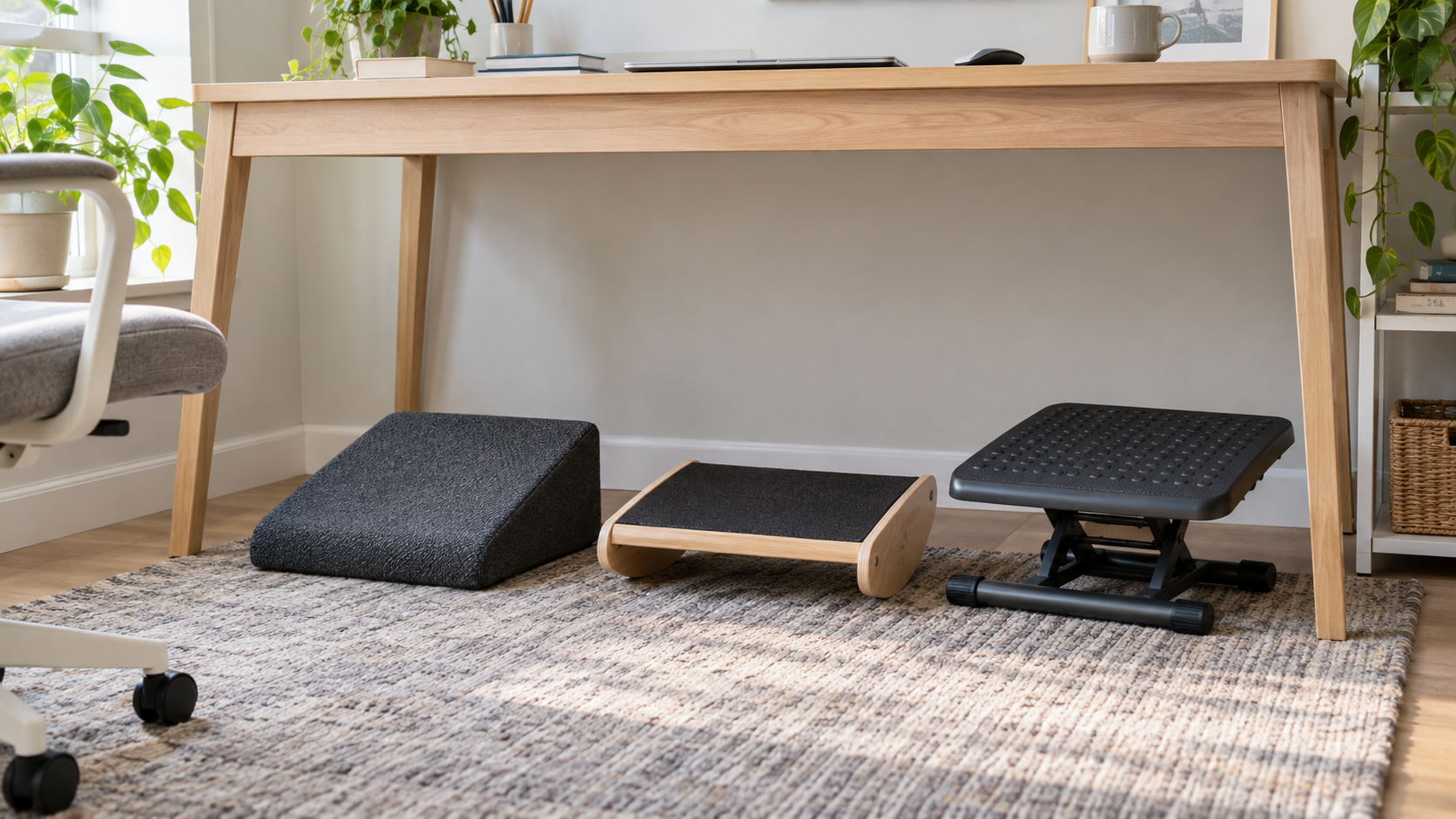
An under-desk footrest is useful only when it gives both feet a stable place without stealing knee room, blocking chair movement, or forcing one fixed posture. For a tight home office, start by measuring the occupied space beneath the desk, then choose between a simple foam support, a moving platform, or an adjustable frame.
As an Amazon Associate, The Good Home Doc may earn from qualifying purchases.
Quick decision before shopping
First measure the available space, identify the setup or surface constraints, and decide who will maintain the item. Skip the category if it blocks access, conflicts with the manufacturer's instructions or lease, or adds more upkeep than the problem justifies.
Compare the format that fits your desk and sitting habits:
- Browse category: Compare foam under-desk footrestsCheck finished height, firmness, cover care, base grip, and the space needed to reposition it.
- Browse category: Compare rocking footrestsCheck motion range, noise, floor contact, platform size, and clearance from desk supports.
- Browse category: Compare adjustable footrestsVerify each height and tilt position, lock behavior, platform texture, and overall footprint.
These are category searches, not tested rankings. Confirm current dimensions, adjustment method, materials, care instructions, intended use, floor compatibility, warranty terms, and return policy on the listing or maker documentation.
This guide compares product formats and fit. It does not claim hands-on testing, rank named products, or promise that a footrest will treat pain or correct a medical or ergonomic condition.
Quick Best-Fit Guide
- Simple, quiet support: a firm foam wedge with a removable washable cover and a base that stays put on your floor.
- Frequent position changes: a low rocking platform that moves smoothly without striking the desk frame.
- Shared desk or changing chair height: an adjustable platform with clearly defined settings and a mechanism you can operate safely.
- Very limited floor space: a compact fixed rest—or no footrest if it would crowd the chair, pedals, cables, or storage.
Measure the Whole Sitting Area
Sit in the chair at the desk setting you actually use. Measure from the floor to the underside of the desktop, apron, drawer, keyboard tray, cable basket, and any control box. Then measure the clear width between desk legs and the usable depth from your chair position to the back wall.
Mark the proposed footrest outline with removable tape. Leave room to place and remove both feet naturally, shift the rest, roll the chair away, and reach any nearby controls. An adjustable model can become taller or deeper when tilted, while a rocker needs space through its entire motion—not just at its resting point.
Compare the Main Footrest Formats
Firm Foam Wedges
Foam rests are quiet, light, and easy to move. Some can be flipped for gentle rocking, but shape and firmness vary. A very soft cushion may compress more than expected, and a deep wedge can push the chair farther from the desk.
Choose one if: you want a simple support, do not need exact height settings, and can clean or replace the cover.
Watch for: unclear finished dimensions, a slippery base, covers that are hard to remove, exposed foam, and marketing that substitutes vague comfort claims for fit details.
Rocking Platforms
A curved wood or molded platform lets the ankle angle change as you sit. Movement can be pleasant for some users but distracting for others, and the platform may travel or tap nearby furniture.
Choose one if: you deliberately want movement and the complete rocking envelope fits beneath the desk.
Watch for: pinch points, hard edges, floor scratching, noise, uncontrolled sliding, and a curve that raises the toes or heels too far for your preferred position.
Adjustable Framed Footrests
These use a platform on a plastic or metal support with height, tilt, or both. Adjustability can help a shared setup, but the mechanism adds bulk and may not lock at every angle.
Choose one if: multiple people use the desk or you need a height that a fixed wedge cannot provide.
Watch for: settings that require lifting or turning the unit, loose pivots, narrow platforms, exposed mechanisms, and maximum positions that collide with the desk.
Must-Haves Before Nice-to-Haves
Must-Haves
- A platform wide enough for both feet in the positions you normally use.
- A height and tilt range that fits the chair and desk without crowding knees.
- Stable contact on the actual floor or rug.
- Clear adjustment and intended-use instructions.
- Surfaces that can be cleaned on a realistic schedule.
- Enough room for chair movement, cables, vents, and under-desk storage.
Nice-to-Haves
- A removable, washable textile cover.
- Tool-free settings for a genuinely shared workstation.
- A carry handle if the office is packed away after work.
- A mild surface texture that is comfortable with the footwear you use.
Floor Grip, Movement, and Noise
A base designed for hard flooring may behave differently on a thick rug, and aggressive grippers can mark some surfaces. Follow the maker's floor guidance and inspect the contact area periodically. Do not improvise an unstable stack of books, boxes, or loose cushions to gain height.
If you choose a rocker, test whether its normal movement reaches chair casters, desk feet, power strips, or loose cables. Cord organization can reduce clutter, but never trap heat-producing equipment or hide damaged wiring; the desk cord-organizer guide explains the basic tradeoffs.
Cleaning and Storage
For foam models, check whether the cover is removable, how it should be washed, and whether the inner foam can be spot-cleaned. For hard platforms, look for accessible hinges and textured areas that do not trap debris. Follow the manufacturer's instructions rather than soaking foam, lubricating an unspecified mechanism, or using a cleaner that could damage grips.
If the room changes function after work, measure the footrest's storage location too. A rigid adjustable frame may not fit on a shallow shelf, while a foam rest can collect dust or deform if compressed under heavier items.
Who Should Skip a Footrest
- Anyone whose feet already rest comfortably and stably with the current chair and desk arrangement.
- People who would lose necessary knee, wheelchair, mobility-device, pedal, or chair clearance.
- Users who need an individualized accommodation or help with ongoing discomfort; a qualified ergonomics or healthcare professional is a better source for that decision.
- Households where the product would become a trip obstacle when the chair is pulled away.
- Anyone relying on the footrest to compensate for an unstable chair, damaged desk, unsafe wiring, or a workspace that cannot be adjusted to fit.
Buying Checklist
- Set the chair and desk to their normal working positions.
- Measure width, depth, maximum usable height, and all under-desk obstructions.
- Trace the fixed, tilted, or rocking footprint on the floor.
- Compare platform dimensions, settings, stability, floor guidance, and care.
- Confirm the footrest will not conflict with chair movement, cables, vents, pedals, or storage.
- Choose a seller with clear specifications and a workable return policy because seated fit is personal.
Bottom Line
For most small home offices, a firm foam wedge is the simplest low-noise starting point when its height and footprint fit. A rocker suits people who intentionally want movement, while an adjustable frame earns its extra bulk in a shared setup or where a fixed height does not work. Measure the complete sitting area first, and skip the category if it creates a new clearance problem or is being asked to solve persistent discomfort.