How to Choose Light-Blocking Curtain Liners for Existing Curtains
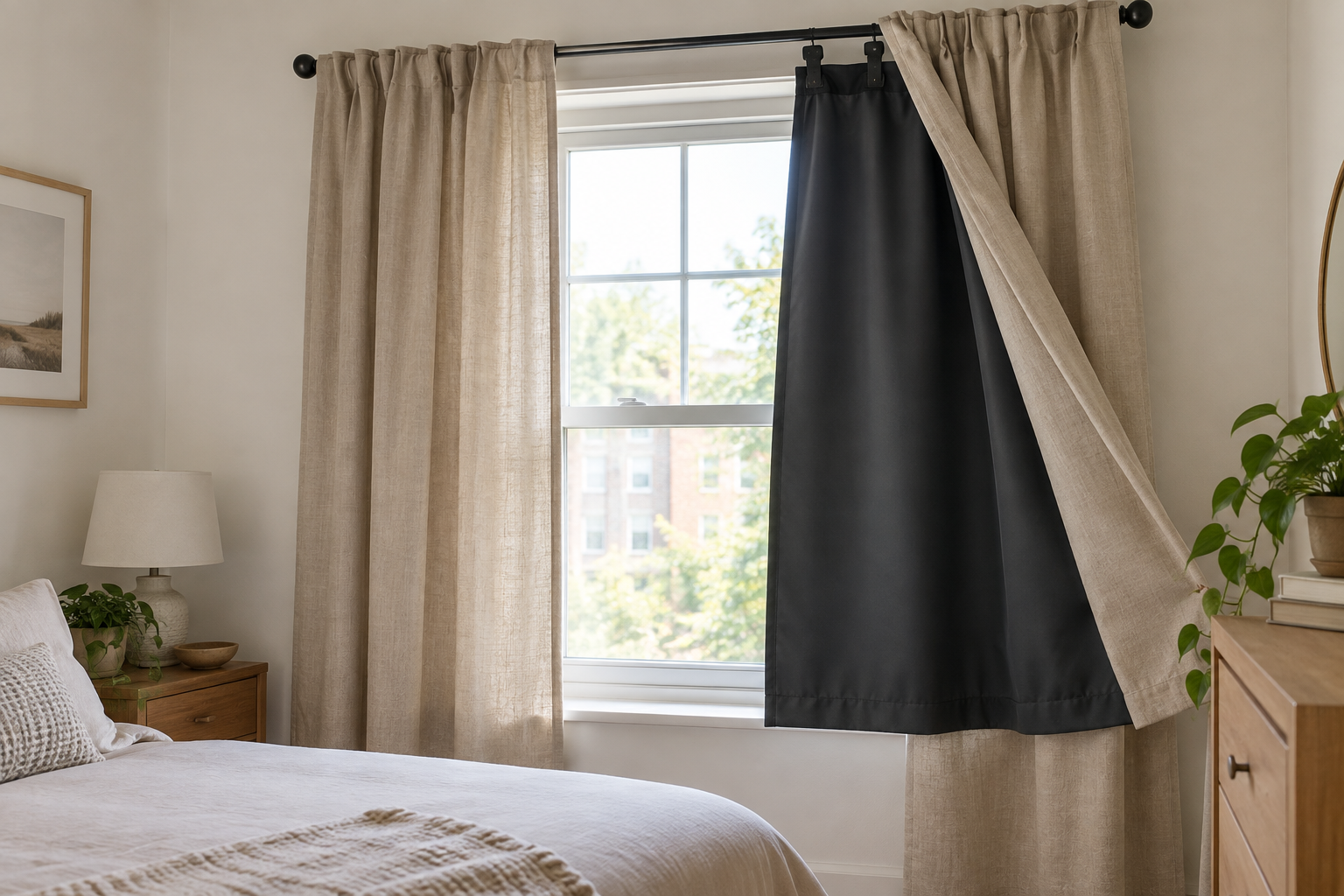
A detachable liner can make existing decorative curtains more useful without replacing the whole window treatment. The best fit is a liner whose attachment matches the curtain heading, whose width covers the glass with useful overlap, and whose added weight stays within the rod and hardware instructions.
As an Amazon Associate, The Good Home Doc may earn from qualifying purchases.
Quick decision before shopping
First measure the available space, identify the setup or surface constraints, and decide who will maintain the item. Skip the category if it blocks access, conflicts with the manufacturer's instructions or lease, or adds more upkeep than the problem justifies.
Compare liner formats after measuring the curtain and checking the rod:
- Browse category: Compare clip-on light-blocking linersCheck clip spacing, finished width, drop, fabric care, and the added load on the existing hardware.
- Browse category: Compare hook-on curtain linersConfirm that the hooks and heading work with the current curtain, rings, and rod arrangement.
- Browse category: Compare detachable liner panelsVerify panel count, actual coverage, joining method, removal, and laundering instructions.
These are category searches, not tested rankings. “Blackout” and light-blocking descriptions use different test methods, so verify the maker's current measurements, attachment, care, material, and performance basis before buying.
This guide compares liner formats rather than naming a universal winner. A liner is an add-on for otherwise usable curtains; it cannot compensate for a rod that is loose, undersized, damaged, or not approved for the combined setup.
Quick Best-Fit Guide
- Clip-on liner: best when the existing curtain has a simple top edge and removable clips can be spaced evenly without distorting the fabric.
- Hook-on liner: best when the heading, rings, or pleats already provide compatible attachment points.
- Separate liner panel: best when the current rod arrangement can carry a second layer and both layers still open normally.
- Replacement curtains or a shade: better when the existing panels are too narrow, the rod is already near its stated limit, or daily operation becomes awkward.
Measure the Existing Setup, Not Just the Window
Record the rod width, curtain-panel width and length, distance from the attachment point to the desired bottom edge, and how far the curtains extend past each side of the glass. Then measure the closed center overlap and any top or side gaps. A liner as wide as the glass can still leave bright edges if the entire curtain assembly barely covers the opening.
Check the liner's finished dimensions rather than assuming its listed size matches the usable hanging area. Attachment tabs, pleats, hems, or gathered fabric can change the coverage. Keep the liner clear of heaters, vents, radiators, candles, and any clearance area specified for nearby equipment.
Attachment Types and Their Tradeoffs
Clip-On Liners
Clips make a liner easy to add and remove, and they can work with many plain curtain headings. The tradeoff is concentrated pull at each clip. Check the clip opening, grip surfaces, spacing, and whether the curtain maker permits clips. Too few clips can create sagging gaps; aggressive clips can mark delicate fabric.
Hook-On Liners
Hooks can keep the layers aligned when the curtain has compatible tape, rings, or pleat hardware. Compatibility is specific: confirm the hook shape, attachment spacing, and whether the points are enclosed once installed. Do not improvise sharp hooks through fabric that was not designed for them.
Separate Panels on Rings or a Double Rod
A separately supported liner can move independently, which is useful when you want the decorative curtains open while the liner stays closed. It also requires compatible rings or a rod arrangement approved for two layers. For renters, do not add drilled hardware without permission, and do not assume a tension rod can carry heavy layered fabric.
Combined Weight Is a Must-Check
Add the documented weights of the existing panels, liner, rings, clips, and any other hanging parts when that information is available. Compare the total with the instructions for the rod, brackets, fasteners, and mounting surface. The weakest component sets the practical limit.
If weight information is missing, do not treat a marketing phrase such as “lightweight” as a capacity calculation. Choose a lighter solution, contact the maker, or replace the support system through a permitted installation. Stop using a setup that shifts, bows, slips, pulls away from the wall, or repeatedly falls.
Light Control Depends on Gaps
Fabric matters, but much of the unwanted light often enters above the rod, around the sides, or between panels. Prioritize enough total width, a useful center overlap, and a liner that hangs close to the outer curtain without bunching. A dark liner may reduce visible light through the fabric, but color alone is not a verified performance rating.
Do not expect a liner to guarantee complete darkness. Window shape, mounting position, heading style, and daylight angle all affect the result. If light enters around the frame rather than through the curtains, wider coverage or a compatible shade may solve the actual problem more directly.
Care, Daily Use, and Window Access
Check whether the liner can be machine washed, hand washed, or only spot cleaned, and whether hooks or clips must be removed first. Confirm drying and ironing restrictions. Some coated or layered fabrics need different care from the decorative curtain, so treating both as one washable bundle can damage one of them.
Open and close the complete setup several times before deciding it works. Make sure layers do not catch, pull apart, block locks, interfere with screens, or make a required window difficult to operate. Keep any cords and loops managed according to current product instructions, especially around children.
Must-Haves Before Nice-to-Haves
Must-Haves
- Finished width and drop that cover the intended area with practical overlap.
- An attachment method explicitly compatible with the current curtain or hardware.
- A combined load within the rod and mounting system's documented limits.
- Care instructions that fit the outer curtain and household routine.
- Normal access to window locks, ventilation, and any required opening.
Nice-to-Haves
- Removable attachments that make separate laundering easier.
- Multiple attachment rows or adjustable drop.
- Panels that can be separated for partial coverage.
- A color that stays visually unobtrusive behind the outer curtain.
Who Should Skip a Curtain Liner
- Anyone whose rod, brackets, or no-drill hardware cannot document enough capacity for another layer.
- Renters whose proposed attachment or hardware change is not permitted.
- Windows where layered fabric would obstruct a lock, vent, heater clearance, or required opening.
- Households whose existing curtains are already too narrow to control side and center gaps.
- Anyone who needs a verified performance level that the liner maker does not document.
- People who would get a simpler, lighter setup by replacing the panels or adding a compatible shade.
Buying Checklist
- Measure the rod, current panels, attachment-to-hem drop, and all visible light gaps.
- Identify the existing heading, rings, hooks, and rod arrangement.
- Choose clip-on, hook-on, or separately supported panels only after confirming compatibility.
- Check the combined weight against every part of the support system.
- Verify finished dimensions, panel count, fabric, attachment parts, and performance basis.
- Review washing, drying, ironing, and hardware-removal instructions.
- Confirm the complete setup opens normally and preserves window access.
Bottom Line
A clip-on liner is the simplest retrofit for many plain curtain panels, while a hook-on liner fits headings designed for compatible hardware. A separately supported layer offers more independent control but asks more of the rod setup. Measure coverage and attachments first, treat combined weight as a hard constraint, and choose replacement curtains or a shade when another layer would make the window harder to use.