Temporary laundry work surfaces
How to Choose Folding Laundry Tables for Small Laundry Rooms
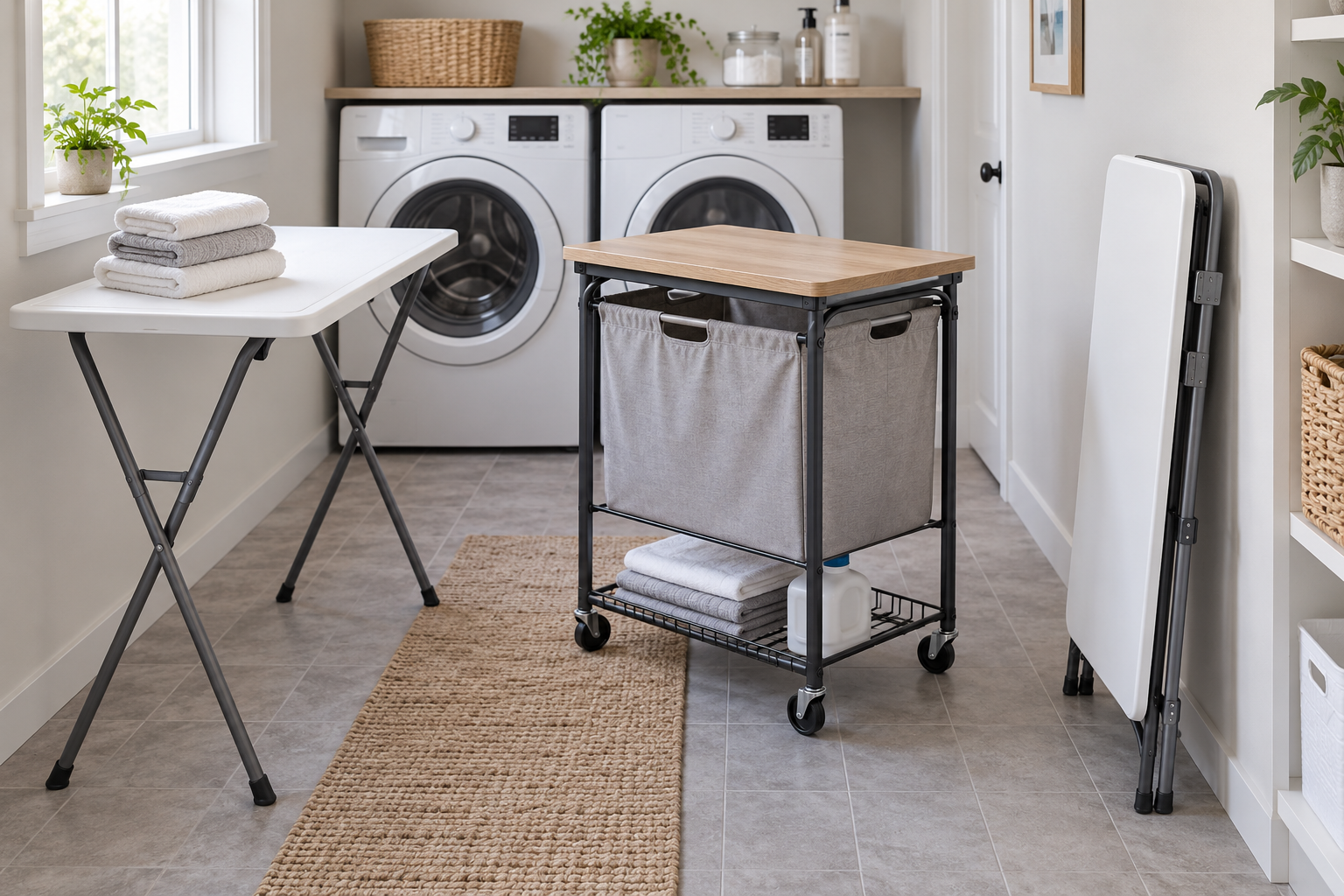
A folding laundry table is useful only if it gives you a comfortable sorting surface without trapping you between an open table, appliance doors, and the room exit. For most tight rooms, start with a plain freestanding fold-flat table sized to one realistic batch. Choose a rolling station only when its permanent stored footprint also earns its place.

As an Amazon Associate, The Good Home Doc may earn from qualifying purchases.
Compare work-surface formats
- Browse category: Compact freestanding folding tablesStart here when the table will be opened for a batch and stored elsewhere afterward.
- Browse category: Rolling laundry carts with worktopsCompare when sorting storage and a work surface need to share one permanent footprint.
- Browse category: Slim fold-flat utility tablesUseful when stored depth is the binding constraint and the open dimensions still fit the room.
These category searches are shopping starting points, not tested rankings. Confirm current open and folded dimensions, work height, stated load, leg and caster locks, assembly, floor-contact material, care instructions, storage guidance, and return terms for the exact product.
Quick Answer: Buy for the Open Room, Not the Folded Product
A table that stores in a narrow gap can still be unusable when open. Mark the full top and leg footprint on the floor, open every appliance and room door, and walk the normal route with a basket in both hands. If the table requires moving a washer, climbing over a basket, or blocking the only exit, it does not fit.
A compact folding-leg table is the simplest choice when you can unfold it on a clear, level floor and put it away after each load. A rolling station makes more sense when it can remain parked without blocking appliances or service access. Skip both if an existing manufacturer-permitted surface already supports the routine and adding furniture only creates another obstacle.
Measure Four Different Footprints
- Open footprint: include the tabletop, splayed legs, braces, casters, handles, and anything that projects beyond the top.
- Working envelope: add the space your body and basket occupy while placing, folding, and lifting laundry.
- Appliance envelope: fully open front-loader doors, top-loader lids, detergent drawers, lint-filter access, and nearby cabinet doors.
- Stored footprint: record folded thickness, total height and width, feet or hooks, and the clear route to the storage location.
Measure the narrowest doorway and every turn between storage and the laundry room. A lightweight table that fits the destination can still be awkward to carry through a hall. For a rolling station, measure thresholds and floor transitions, and confirm the casters are intended for the actual flooring.
Choose the Right Format
Freestanding Folding-Leg Tables
These provide the largest temporary surface for their stored volume. Useful models have complete open and folded dimensions, a work height that suits the user, a leg-lock method you can see and operate, and feet appropriate for the floor. A center-folding top may store shorter but adds a hinge and often a thicker folded package.
Best fit: rooms or adjacent spaces with a predictable setup zone and separate storage slot. Watch for: legs in the walking path, pinch points, a bowed or textured top, and a table too bulky to move calmly.
Rolling Laundry Stations with Worktops
A rolling cart can combine hampers, supplies, and a folding surface. It is not truly temporary: the cart keeps its footprint all week. Compare the top size, handle projection, basket access, caster locks, frame dimensions, and whether lower storage remains usable while you work.
Best fit: a measured parking bay clear of doors, vents, hookups, shutoffs, and appliance service space. Watch for: an undersized top, overloaded baskets, hard-to-clean shelves, and casters that roll or mark the floor.
Slim Fold-Flat Utility Tables
A narrow table can fit a shallow wall gap or closet, but stored thickness is only one part of the decision. Some have a smaller surface; others use wide splayed legs or braces that consume more floor than the top suggests.
Best fit: small batches and a narrow, reachable storage location. Watch for: low work height, incomplete diagrams, unstable proportions, and a setup sequence that is hard to control in a tight room.
Must-Have Features
- Complete dimension drawings: open width, depth, and height plus folded width, depth, and height.
- Documented locks: folding legs, braces, top hinges, and casters should have clear operating instructions and inspection points.
- A usable work height: compare it with a counter or table you already use comfortably.
- A cleanable top: choose care instructions suited to detergent drips, damp textiles, lint, and ordinary cleanup.
- Predictable floor contact: feet or casters must suit the floor and remain free of grit.
- Honest load guidance: verify the maker's stated load and conditions. Never use the table as a seat, step, appliance stand, or climbing aid.
Nice-to-Have Features
- A carry handle: helpful when accessible after folding and not awkwardly one-sided.
- Adjustable feet: useful within the instructions on a sound floor, not as a fix for severe unevenness.
- Rounded top edges: more comfortable in a narrow passing space, though adequate clearance matters more.
- Removable sorter bags: valuable when their dimensions, care directions, and full-bag removal path work.
Set Up a Repeatable Routine
- Clear the setup area and route. Remove baskets, cords, rugs, and loose objects that interfere with legs or casters.
- Move the folded table with the maker's carry points and enough help for its size and weight.
- Open it by the instructions, keeping fingers away from hinges and braces. Confirm every required lock is engaged.
- Set it on a clean, level surface and check for rocking before adding laundry.
- Keep the stated load centered and distributed. Do not lean, sit, stand, or place a child, pet, appliance, or heavy liquid container on it.
- Empty and clean the top before folding. Release locks in the documented order and store the table so it cannot tip into a walkway.
Do not block appliance ventilation, electrical connections, water connections, drains, shutoffs, labels, or maintenance access. If the room has an active leak, damaged outlet, unstable appliance, burning smell, or other fault, stop using the area and contact the property owner or an appropriately qualified professional.
Maintenance and Long-Term Fit
Wipe the top by its care instructions and dry it before folding. Lint and spilled products collect around hinges, feet, caster forks, and basket rails, so include those areas in routine cleaning without disassembling parts the maker does not identify as user-serviceable.
Before each setup, check fasteners, braces, locks, hinges, feet, casters, and the top. Stop using the table if it rocks, folds unexpectedly, has a cracked top, bent frame, loose hardware, damaged lock, or rough edge. Use only specified replacement parts and repair methods.
Who Should Skip a Folding Laundry Table
- Skip it when the open table blocks an exit, appliance, cabinet, vent, hookup, shutoff, or service space.
- Skip a portable table if carrying and controlling it through the storage route is unrealistic.
- Skip a rolling station when there is no permanent parking spot clear of the working aisle.
- Skip any model without usable dimensions, lock instructions, load guidance, or care directions.
- Skip the category if a basket on a bed or existing table already supports the routine without adding furniture.
- Skip DIY wall-mounted surfaces unless the lease permits them and the wall, utilities, mounting, and installation are appropriately assessed.
Bottom Line
The best folding laundry table for a small room is the smallest stable surface that holds one real batch, stands at a workable height, leaves the appliance and walking envelope clear, and stores without a difficult carry. Start with a plain fold-flat table for occasional setup. Choose a rolling laundry station only when its full-time footprint replaces other storage rather than adding to it.