How to Choose Faucet Water Filters for Rental Kitchens
A faucet filter can be a compact, removable option when a pitcher crowds the refrigerator, but it is not a universal fit or a universal water-safety fix. Start with the faucet, the water-quality question, and an exact third-party-certified reduction claim—then compare housing direction, switching control, flow, cartridges, and cleaning.
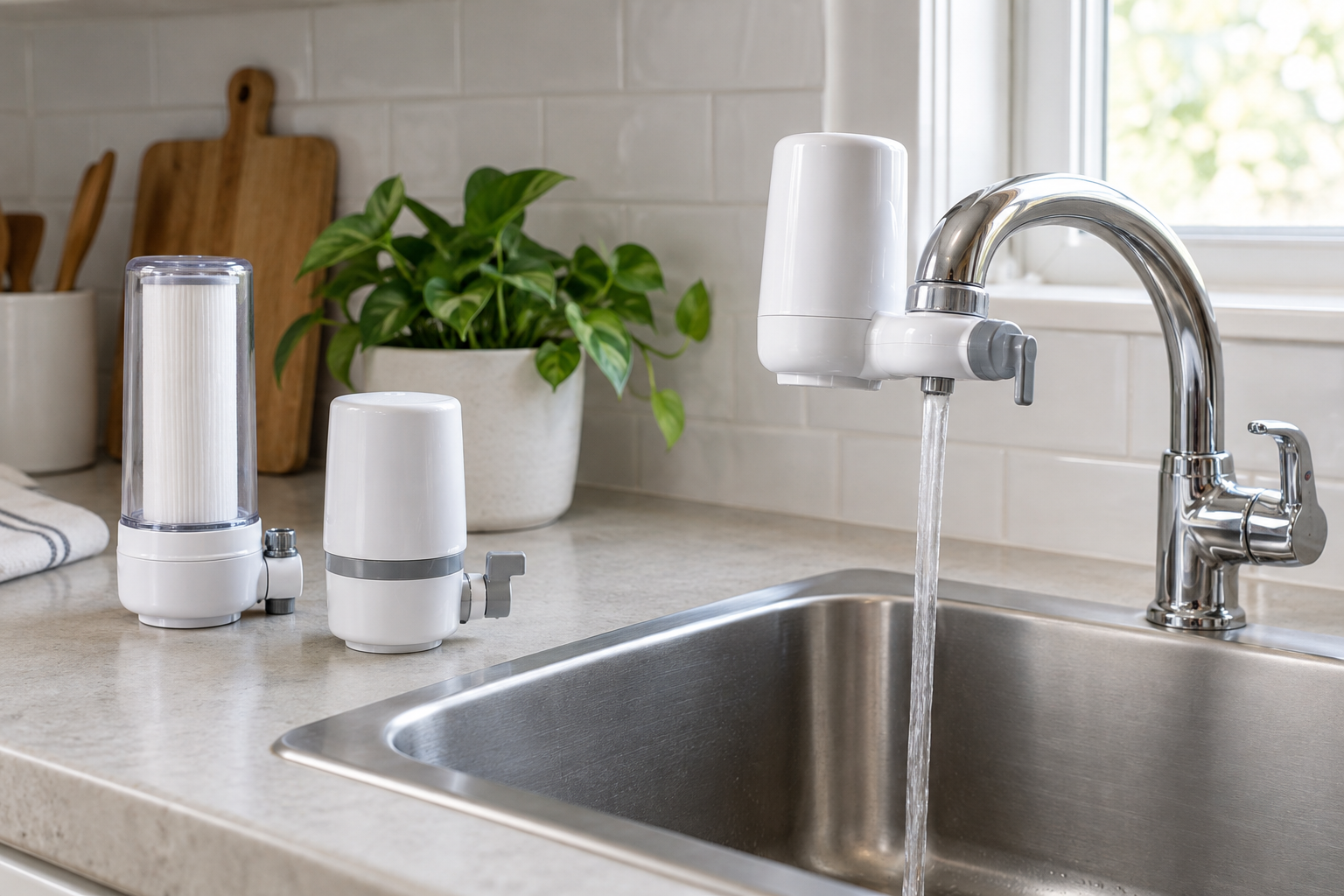
As an Amazon Associate, The Good Home Doc may earn from qualifying purchases.
Quick decision before shopping
First measure the available space, identify the setup or surface constraints, and decide who will maintain the item. Skip the category if it blocks access, conflicts with the manufacturer's instructions or lease, or adds more upkeep than the problem justifies.
Compare only filters that fit the faucet and document the reduction you need:
- Browse category: Compare certified faucet-mount water filtersUse the maker's model number to verify the exact certification listing and faucet exclusions before buying.
- Browse category: Compare horizontal faucet-filter formatsConsider when vertical sink clearance is limited, provided the housing clears the handles and backsplash.
- Browse category: Compare vertical faucet-filter formatsUseful when side clearance is tight and the mounted height still leaves room for pots and routine sink work.
These are category searches, not tested rankings. Confirm the exact faucet types, adapters, certified reduction claims, cartridge model and replacement interval, flow basis, water-temperature limits, installation instructions, and return terms for the current model.
This guide compares faucet-filter formats rather than naming winners. Certification, compatibility, cartridges, and instructions can differ between models that look alike. A filter reduces only the substances included in its current certified claims under the stated test conditions; it does not make every water source safe.
Quick Best-Fit Guide
- Best first choice for most compatible standard faucets: a compact unit with a clearly documented faucet list, a simple filtered/unfiltered selector, and replacement cartridges you can reliably obtain.
- Best where side clearance is tight: a vertical housing that clears the sink basin, faucet controls, backsplash, and any window ledge.
- Best where height over the basin is limited: a horizontal housing that does not interfere with handles or extend into a busy prep path.
- Best for uncertain water concerns: no purchase yet—check the current local water-quality report and identify the substance of concern before matching a certified claim.
- Best for pull-down, pull-out, sensor, or specialty faucets: usually skip a faucet-mount unit unless the filter maker explicitly lists the exact faucet as compatible.
Start With the Water Question, Not the Filter Shape
Read the current consumer confidence report from the local water supplier where available. If the concern comes from a private well, a building-specific issue, a health advisory, unusual color or odor, or a suspected plumbing problem, use guidance from the relevant local authority or a qualified water professional. Do not choose a cartridge from a broad phrase such as “cleaner water.”
For a specific reduction claim, verify the exact system and replacement cartridge in an independent certification directory, such as NSF or the Water Quality Association. Note the standard, the named substance, and any conditions or rated capacity in the listing. Certification to one standard or claim does not imply certification for unrelated substances.
Compatibility Preflight
Identify whether the faucet has a removable aerator and whether its threads are inside or outside. Record the aerator or adapter dimensions using the filter maker's instructions rather than guessing from appearance. Many faucet-mount units exclude pull-down and pull-out sprayers, handheld heads, faucets without a removable aerator, and some sensor or specialty designs.
Measure the complete mounted envelope. Check the distance to the backsplash, handles, window ledge, basin bottom, dish rack, and the largest pot normally filled in the sink. Confirm that the unit can switch modes, open for cartridge changes, and rotate only where the instructions permit. Ask the landlord before changing a fixture when the lease or building rules require it, and keep the original aerator and parts for move-out.
Comparison Framework
Compact Horizontal Housings
A horizontal body can preserve vertical clearance over a shallow sink. Its tradeoff is side projection: the housing may crowd a nearby handle, backsplash, window trim, divided basin, or countertop work zone.
Choose this format when: measured side clearance is generous and the lower profile helps with pots. Skip it when: the unit blocks a control, collides with the backsplash, or would be bumped during normal washing.
Vertical Housings
A vertical cartridge body keeps more of the assembly close to the faucet's centerline. It may fit narrow sinks better, but the added height or lower drop can reduce clearance for tall cookware and may look bulky on a short faucet.
Choose this format when: it clears the faucet arc, basin, and cartridge-change path. Skip it when: it makes routine pot filling awkward or sits where dishes will strike it.
Units With a Filtered/Unfiltered Selector
A selector lets the household reserve cartridge use for drinking and cooking while using ordinary tap flow for dishwashing. Compare the control's visibility and handling, and follow instructions about switching modes and permitted water temperature.
Choose this format when: everyone can operate it consistently and the indicator is easy to understand. Skip it when: the control is hard to reach or the household is unlikely to follow the cartridge and flushing routine.
Must-Have Buying Checks
- Exact certification: Verify the system and cartridge model, standard, named reduction claim, and current listing in the certifier's directory.
- Explicit faucet fit: Match thread type, adapter, and exclusions; visual similarity is not enough.
- Complete installed dimensions: Include adapters, selector, cartridge body, removal path, and the sink work zone.
- Available replacement cartridges: Check the precise part number, typical supply route, storage needs, and replacement instructions before buying the starter unit.
- Useful flow: Compare manufacturer-stated flow under its stated conditions, while expecting household pressure and cartridge condition to affect the experience.
- Clear maintenance instructions: Look for flushing, cleaning, temperature, stagnation, and cartridge-change guidance that the household can follow.
- Reversible rental setup: Keep original parts and avoid a unit that requires an unapproved permanent change.
Cartridge Cost and Maintenance Matter More Than the Starter Price
The housing is only the first purchase. Before choosing it, confirm the cartridge identifier, replacement trigger or interval, flushing instructions, and whether the cartridge remains available from a dependable source. Do not extend use beyond the maker's instructions because water still appears clear or the flow seems acceptable.
Use only permitted water temperatures and cleaning methods. Wipe the exterior and outlet as instructed, and inspect adapters and seals for leaks after installation and cartridge changes. If a connection leaks, stop using the unit and reinstall it according to the instructions; persistent leakage belongs with the manufacturer, landlord, or a qualified professional rather than improvised plumbing changes.
Who Should Skip a Faucet Water Filter
- Skip this category when the faucet is excluded, lacks a compatible removable aerator, or cannot support the unit without an improvised adapter.
- Skip it when the needed substance is not included in the exact system's current certified reduction claims.
- Skip it when a drinking-water advisory calls for a different response; follow the issuing authority's instructions.
- Skip it if the sink layout makes the unit easy to strike, blocks controls, or leaves too little room for routine washing.
- Skip it if replacement cartridges are difficult to identify or obtain, or if the household will not follow the flushing and change schedule.
- Skip it when a pitcher, dispenser, under-sink system installed with permission, or another verified format better fits the volume and routine.
Bottom Line
The best faucet water filter for a rental kitchen is the removable unit that explicitly fits the faucet, clears the real sink workspace, carries a current third-party-certified claim for the specific reduction needed, and uses cartridges the household can replace and maintain correctly. If any one of those conditions is missing, pause the purchase and choose a better-matched format.